
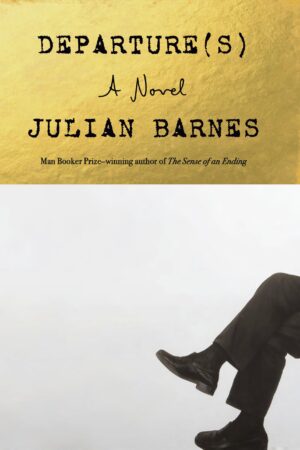
Departure(s)
by Julian Barnes
reviewed by Sarah Moorhouse
How should a writer say goodbye? It’s rare that they get a chance to: the annals of literature are full of books left incomplete at the time of their author’s death. Sometimes, though, a writer chooses to conclude their career with a planned farewell. Take the epilogue to Shakespeare’s The Tempest, in which the sorcerer Prospero, whose magic mirrors the dramatist’s own art, announces that “Now my charms are all o’erthrown.” The game is up, Shakespeare is saying: a story can’t continue forever.
In Departure(s), British author Julian Barnes has chosen to make his own literary adieu. “I am now seventy-eight, and this will definitely be my last book–my official departure, my final conversation with you,” he tells us. The result is a novel, but also an intimate, autobiographical book dedicated to taking stock of the author’s life in writing. Barnes is convinced that by designating the end of his writing career in this way, he is “denying agency to death.”
And yet, Barnes—who is the author of a whole host of beloved novels, from Metroland to The Sense of An Ending to Elizabeth Finch—is preoccupied by the awareness that life itself isn’t a narrative with a neat ending. His wife, the literary agent Pat Kavanagh, died suddenly of a brain tumor in 2008; in his subsequent grief, the author consoled himself by reminding himself that it was “just the universe doing its stuff.” Barnes argues that “most of our lives don’t have” a “punchline,” let alone the coherence of a narrative arc. But even if our lives don’t fit neatly into a narrative, we still like to tell stories about ourselves and to view our memories as a continuous, logical course of events. Barnes takes the opportunity to challenge this narrativizing impulse, while considering other ways in which we might take stock of who we are.
Rather than a seamless narrative, then, Departure(s) unfolds as a series of episodes which, as Barnes reveals, are fictional only insofar as memory is itself an act of fictionalizing. When the author was a student at the University of Oxford, he introduced two of his friends, Stephen and Jean, to one another, and they began a romantic relationship that lasted the duration of their time at university. That’s episode one. Episode two takes place forty years later, when, after going their separate ways post-graduation, the narrator facilitates a reunion for the couple and they resume their relationship. Barnes points out that this is a “story with a missing middle.” He doesn’t know much about Stephen and Jean’s lives in the intervening years, nor could they reconcile the two phases of their relationship with the decades in between.
Barnes punctuates these episodes with reflections on his own life: he discusses his diagnosis with incurable but treatable blood cancer, his opinions (largely cynical) about Proust, and his take on aging. The book isn’t just a novel—it’s a meandering series of reflections that, if they are at times a little indulgent (Barnes allows himself a reminder to the reader that he has been overlooked for the Nobel Prize), are on the whole permissible as the wise meditations of a writer who has had a well-lived, full life. His comments on the nature of storytelling, for instance, are illuminating: he muses that the two episodes about Stephen and Jean have “two different textures” because the earlier part, having taken place longer ago, is less reliable. (On the subject of memory, quoting T. S. Eliot, he declares that “the moths will get in.”)
Meanwhile, the characters of Stephen and Jean allow Barnes to weigh up differing approaches to memory and identity. The couple are at odds with one another about the significance of their reunion: “What Stephen viewed as a rounded, dramatic, necessary conclusion to their two lives Jean saw as–what?–no more than a somewhat intriguing possibility.” The problem here is one of narrative: Stephen sees their reunion as fated and inevitable, a joyous continuation of the bond he and Jean had forged forty years earlier. But Jean feels disconnected from her earlier self and their former relationship. While Stephen thinks he’s won back the university student he fell for at twenty, Jean laments that “it seems that I am the answer to a question I was never asked, and haven’t asked myself.” The stories these characters tell themselves about their own lives just don’t match up.
Underpinning the drama of Stephen and Jean (whose names Barnes has fictionalized in a rather weak nod to a promise he made to the couple never to write about them) is the philosophy of G. Strawson, laid out in a 2004 paper called “Against Narrativity” from which Barnes quotes. According to Strawson, some people do see their lives as a continuous narrative: these people readily identify with their selves at previous stages of their lives, from childhood to early adulthood. Others, Strawson says, have a different perspective: this second type, who conform to what he terms “episodic self-experience,” do not perceive narrative continuity. The episodic person doesn’t feel a strong link with their earlier self.
Strawson warns in “Against Narrativity” that these two types are “likely to misunderstand one another badly.” So it proves with Stephen and Jean, who, unable to resolve their differences, go their separate ways once again. Meanwhile Barnes is left grappling with the dilemma posed by the couple’s failed relationship. Is there value in composing narratives about ourselves, even if they make our memories more unreliable and doom us to clash with others? Ultimately, and perhaps inevitably, he settles on a positive angle. He leaves us with a scene in which author and reader observe passers-by from a café pavement in “some unidentified country,” watching and musing as people walk past, providing little glimpses of episodes in their lives. Barnes asks us to remember him as an observer of these “many and varied expressions of life that pass in front of us,” ever attuned to how a tiny episode “might possibly metastasise into a story.” The storytelling impulse makes us human. Barnes’ books are a celebration of this: long may they continue to be read.
Published on February 10, 2026