
Françoise Sagan Isn’t Home
by Paul Mandelbaum
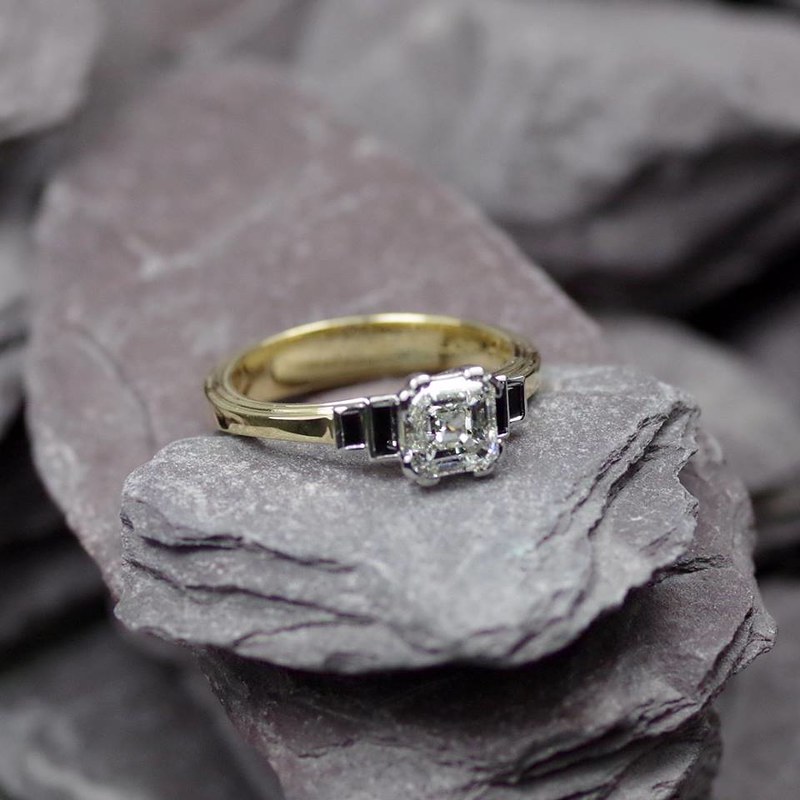
My mother wants to give me a pair of diamonds even though, she admits, they’re cursed. It’s the early 1990s, and these gems, the size of baby teeth, have already been in our family half a century. They’re cursed because her father’s refusal to part with them was the thing that likely got him denounced for being a Jew in Nazi-occupied France. Nonetheless, she went on to have one diamond mounted for her wedding ring, but divorce only confirmed that the curse had followed her to America. Handing them over, she suggests I choose the second, less-unlucky stone for my own impending marriage. Good idea, I say, with a slight edge that Mom lets slide, because the two of us are close. Pressing the point, I say, It’s nice having a spare.
Behind that tasteless joke lie my lingering doubts about fidelity, along with a dig about hers. I’m still holding a grudge, though one that remains mostly hidden from my thirtyish self. Nor have I given much thought to the lines connecting my love life to hers, much as hers leads back to her father. This family tree of affections will come to seem obvious but, as for most people, only in hindsight. Maybe it’s the way of love—unhappy love, at least—to resist understanding as a way to keep itself alive.
*
For some weeks before my grandfather’s arrest, in the summer of 1942, he’d been angry at my future mom about something—wearing lipstick, or flirting with her tutor—and punished her with his infamous silent treatment. She’d placed imploring notes on his pillow, but still he refused to talk. Years later, she’ll confesses to her journal: I absolutely must immunize myself against “the treatment.” It is an unfair, inhuman weapon. There is no “misdeed” serious enough to warrant that kind of reproach. Shit, a thousand times shit! However much that insight feels directed at her father, it will be her husband who triggers it with his own moody silences. Her husband is my father. Not long after writing this entry, Mom will decide she’s had enough.
*
I’m fifteen when they break the news. Mom perches on our Danish modern couch, very popular in 1970s suburban Maryland. Dad’s posture conveys the degree to which this idea is not his; next to the fireplace lies our beagle, Shari. Other than Pookie the cat, who has better things to do, everyone’s here. After a long pause, Dad asks, Do you understand what we’re trying to say?
Sure, you’re getting divorced. Long time coming, I maybe add. Between themselves it’s been decided: Dad and I will stay in the house; Mom will move out, which comes as the harsher blow by far. As mentioned already, my mother and I are close. So much so, our closeness has often felt like an irritant in their marriage, hence perhaps the fourth-grade play I titled Is She His or Not?
From the dining room window, I watch her beige sedan disappear behind the blossoms of a dogwood tree. But it must feel even stranger, months later, to see her return. There’s been some hiccup with her job or lodging, I’m told, and she’s encamped, temporarily, in the furnished attic above my father and me.
Your mother’s a whore, explains my best friend, and your father is her pimp. That’s not his own personal judgment, my friend insists, just the musings of his Polish-born grandfather, though why my parents’ situation should make anyone a whore confuses and upsets me. As for being a pimp, isn’t my dad just offering compassion? In a handwritten note from the time, he tries to explain his choice, incomprehensible to the other men in his Separation and Divorce Workshop, not to simply hate her. About her recent setback, he writes: Anyone who did the kind of things you did during the Second World War has the internal guts it takes to survive.
Maybe they’ll even get back together, I hope, unaware of my mother’s newly awakened desire for women, or that the real timing of her return may be linked to her breakup with someone named Maryanne.
*
Later, Mom and I will start confiding about such things, but she never does mention this early transitional love. Instead, I’ll be surprised to discover it in the journals I eventually inherit. They present Maryanne as a wounded soul: an orphan raised by devout Catholics, who’d hoped she would join a convent instead of becoming a government clerk, a divorcée, and a drunk. And yet, so persistent are the feelings harbored by my mother, Rachelle, that months after the breakup she’ll keep picking at them through pages of invented conversation:
R: I love you for the pain you suffered as a child. I wanted to conquer that fear, erase it.
M: Even when I drank, you continued to love me. Even after my accident, when you soaked the blood out of my carpet. I knew then I had to leave or make you go . . .
R: I feel unfinished. You are the one I fantasize about.
M: I wish you would stop.
Other journal-keepers might have omitted that last line, but my mother is training to become a psychotherapist, and even her fantasies aspire to self-awareness. Would she mind my sharing such a personal document? She was that rare person, unafraid to be known, so maybe it’s OK.
*
About that whore business from before, if it applies to anyone in the family, it’s me. Starting with my virginity, which at sixteen I give to D for no better reason than her boyfriend can’t get it up. N’s unhappy with her boyfriend, too, and starts seeing me on the side. So will C, a sweet girl from a strict Catholic family. In the late 1970s, America may be interrogating its presumptions about monogamy, but my own fixation with unavailable women points to a solid Oedipal template. Rather than whore, a more accurate label for me might be home wrecker. Anyway, Mom has moved out again, this time for good.
*
While still pining for Maryanne, Mom has met someone new. I admired your stride coming toward me at the clinic, she recounts in her journal. A red flag should have gone off—arrest for drunk driving—but I dismissed the warnings.
Another red flag: “J” is her patient, court-ordered to attend group therapy. But the spark between them is undeniable, so Mom refers the case to a colleague. This frees J to become Jean, whose name, along with others, I’ve changed because, even beyond the grave, some prefer their privacy. In life, Jean is warm and generous, sly and witty, creative with food, flowers, and thrift-store clothes. But by far, her most impressive efforts are on canvas: abstract collages of watercolor, lacquered newspaper clippings, bits of cut-out text in the self-effacing style of a kidnapper.
Granted, like Maryanne before her, there’s that drinking problem and its underlying pain. In Jean’s case, her mother claimed to hate her back when she’d been in the womb. Forty years later, on Jean’s birthday, her husband left. And yet, the fractures left by such trauma have created a personality that shimmers like, to use my mother’s word, a kaleidoscope.
For Jean’s part, she initially describes Mom as the warden of my wayward past. Little did I know that you would hand me the key to free the prisoner locked inside. These lines are part of a hundred-stanza love poem, written to my mother, by the person whom, over the next fifteen years, she will try her utmost to fathom.
Do I feel strange poring over the artifacts of my mother’s love life? Not really, which may be strange in itself.
*
While still in high school, I barely intuit this love life, consumed as I am by my own intrigues. I break up with C, the Catholic girl with a boyfriend, but receive her blessing to date her sister M, so long as I keep our past a secret. As M and I grow close, however, I’m compelled to confess, though not until we’ve already slept together. She’s upset, even more than I feared, but over something that feels like a technicality. That’s incest, she says, amazed how blind I am to this point.
*
My love for you is brimming over tonight, writes Jean to Mom. I was reciting the Yeats poem about the Pilgrim Soul, and want you to know I would never change or restrain that part of you. My only regret is that it took me so long to know what I was denying myself. I can feel every nuance of your body through my fingers . . .
Maybe Mom’s return letters express similar poetry and passion, but her journals hew to the basics: Warm loved and loving feelings. Strengthening of relationship. Relief she started therapy.
*
Midway through my freshman year of college, I’ll jump at any chance to quit the lovelorn house of my childhood, and so I sublet an older friend’s half of an apartment. The family animals, Shari and Pookie, have fewer options, and, left alone all day, the beagle gets loose and is hit by a car. Luckily, she seems okay, but Dad no longer feels able to care for her alone. When he asks Mom what she wants to do, she arranges to board the dog with Jean. From my mother’s journal, it’s unclear what Dad knows about Jean. Unclear, too, why Mom’s own living space is not an option. What’s clear is her guilt over not taking Shari herself. Felt I did not want to be obligated, she writes, before demanding of her conscience: How can I leave her? Dump her? Did it anyway. Whatever else my mother may be willing to leave, she’s not one to turn her back on the truth—at least not on purpose.
*
The dog is not OK. Shortly after moving to her new home, she has a seizure and bites Jean, who phones Mom in a panic about having to endure that awful rabies shot! They agree to meet at the local vet, to see if Shari can be tested instead, but when Jean fails to show, Mom finds her at home, drunk.
This is the darker side of Jean, the turbulent artist who stays up all night, choking the air with cigarette smoke and draining a bottomless glass of scotch, while on the stereo Neil Diamond sings: I am, I said, over and over, like an anthem. At this point, Mom may still hope to conquer a lover’s fears. But the song lyrics—I am lost, and I can’t even say why—suggest it won’t be easy.
*
Shari needs to be put down, and Pookie the cat won’t last much longer. He, too, has found himself boarding at Jean’s, where he stops eating. A hunger strike, writes Mom, acting exactly like a human in a deep depression. She tries to coax his appetite, dabbing bits of salmon mousse on his nose, which he licks clear with annoyance rather than pleasure. A week later, curled on Mom’s lap as she drives in tears, he’ll be taken to the vet for the last time.
What obligation have I shown this cat, or to Shari, dear creatures of my childhood? Since fleeing our sad house—following in my mother’s footsteps, so it seems to me now—I’ve hardly looked back.
These horrible losses, these final goodbyes, she writes. First Shari, then Pooks, and yesterday the marriage. It’s 1978, the summer before my sophomore year, and my parents are at the courthouse finalizing their divorce. Mom feels an uncharacteristic pang of regret, even a fleeting fantasy of starting afresh with Dad. After the court official leaves, my parents loiter and talk, exiting the building with their arms around each other. He said he still loved me, and I almost felt love for him.
Almost; the difference of a single word.
*
My roommate Dave expresses surprise to have fallen for a man, a middle-aged spiritualist, and plans to move in with him. When I mention this to Mom, she takes the opportunity to come out herself. Hearing her confirm my intuition restores some of our closeness. Maybe she feels freer to tell me now because she and Jean, who’s still closeted, have just broken up. There was too much chaos, says Mom who wants the stability of someone she can grow old with.
I’m sorry things didn’t work out, I tell her sincerely. If her preference for women implies any rejection of men—my moody father and her punitive own—I don’t seem to take it personally. What I do want to hash out that morning is her decision to leave me behind in the divorce. She does her best to explain how it was meant to help Dad and me learn to get along. They’d both agreed this was important, and I can see the point, how it even succeeded. But also, I tell her, it really stung.
Since becoming a therapist, Mom has zealously urged her clients, indeed everyone she knows, to clear the air with parents before it’s too late, so that those of us who are left behind won’t have to spend the rest of our lives grappling with phantoms, as she puts it. By confessing that her abandonment stung, I’m heeding her own professional advice. This puts a lump in her throat, locus of whatever survivor’s guilt she carries over the divorce. Still, she’s glad I’ve told her. Hurting me, she says, was the last thing she wanted. I believe her. And yet, of course, she did it anyway.
*
While still in college, I develop a literary crush on the French novelist Françoise Sagan, beguiled by her work’s melancholic charm. Her precocious debut, Bonjour Tristesse, speaks to my own guilt over my parents’ breakup. Herself twice divorced, Sagan also has a son my age, and has since, like Mom, embraced the romantic company of women, so, clearly, the two of us would have much to talk about. Even though she doesn’t respond to my fan letter, I decide the next time I’m in Paris—the city I’ve adopted, much as my mother had, as an emotional homeland—to show up unannounced at the author’s apartment. So untethered to reality is this idée fixe, I have no plan beyond hoping to declare my admiration and a desire to learn at the author’s feet, possibly in exchange for becoming her houseboy.
To the concierge, I invoke my credential as a fledgling journalist and my wish to interview Mademoiselle Sagan. I keep hidden any fantasies for a literary mentor and surrogate French mother, clearing the air with my own having taken me only so far. In any case, Mademoiselle, alors, is not at home, having gone perhaps to her estate in the Norman countryside near Honfleur, to which—remarkably—I somehow find my way, only to be told by the woodcutter guarding Sagan’s estate with a chainsaw and a pair of German shepherds that the owner is abroad.
Beaten down by my mission’s failure, I am staring out the window on a sunset bus ride along the coast when I remember having seen this famous stretch of water before, with Mom, on a trip when I’d been ten. We’d returned to the France of her youth several times over the years, though never to the apartment where her family had lived during the war, and where her father had been arrested. Gazing out the window at low tide, I am struck by the ocean’s withdrawal, so drastic one requires a leap of faith to imagine it will ever return, though, of course, it will, as the tide always does.
*
Mom is back with Jean, who claims to have given up drinking. With you by my side, she writes, I’ve rediscovered the natural high. She produces a new set of collages but, lacking confidence to market herself, lets Mom create a portfolio for galleries. Nowhere, however, is Jean’s work more exhibited than in my mother’s new condo. A garden apartment in the pleasant suburb of Bethesda, Mom finally has a permanent place to call her own and quickly turns it into a museum of her love.
*
Soon after graduating, I invite the two of them for dinner at my own new apartment in Baltimore. Though I’ve met Jean, this will be our first social engagement, and I want it to go well. The three of us huddle around the cloth-covered plywood that forms my dining table, as I serve a first course—celery root remoulade, like Mom used to make—and the evening feels very adult. Jean is quietly charming, tall with short blond hair, blue eyes, and slender fingers, whose beauty is lovingly described in Mom’s journals. Even the lines of her smoker’s face are compelling. Between her and Mom there’s a chemistry I feel lucky to witness.
The dinner goes well, my bond with Mom now deeper. After they leave, I’m ready to remember the occasion as a pleasant milestone, when around midnight the phone rings. It’s Jean, calling to thank me again, but really, it seems, to commiserate about my mother’s controlling nature. As her son, she says—her voice slurred from too many nightcaps—I’m sure you know, must know what I’m talking about.
Whatever else our deal includes, feeling controlled by my mother has never been part of it, I say. With a sigh, Jean expresses her disappointment. She’d hoped for more than some show of filial loyalty. By then, I’m anxious to get off the phone, and the next day call Mom to ask, What the hell was that?
Unfazed, Mom explains: she was hoping to validate her grievances.
Only years later will I consider how my mother’s wartime upheaval could have shaped the controlling nature Jean observed but I had failed to appreciate.
*
Come summer, the two of them go to Maine, a lovely idyll judging by the snapshots: Jean fishing in the lake, Jean roasting marshmallows, Mom lounging by the fire. And yet, these pictures fail to convey Jean’s increasing withdrawal and my mother’s anxiety about it. By the time next summer approaches, Mom starts to dread their planned return trip. I would almost prefer going by myself, or maybe Paul could go, she writes to Jean, in an unsent letter I’ll come to own one day, startled to see my name listed as an understudy. Their relationship feels doomed, she writes, adding, I only get what I deserve. We have needs and indulge them—and then comes time to pay. The indulgence meant here is my mother’s habit of casting herself as the savior to a certain type of heartsick partner. They have been hurt to the point of making the decision not to ever let anyone close. That is my challenge. The “romance,” or should I say the “Family Romance,” begins and the testing begins. I am tested and tested and pushed to the wall until I give up. They were “right” in the end, and everybody loses.
It’s an idea of Freud’s, this family romance, in which children, disillusioned with their own parents, fantasize that their real, superior parents exist somewhere in the world, waiting to be reunited with them. Most children discard this notion soon enough, except for certain neurotics who impose their outsized expectations onto future relationships. By marrying my father, who could be sullen like her own, I suspect Mom may have created a similar test. But in diagnosing her current dilemma, it’s the Maryannes and Jeans of the world she sees as longing for a parent-substitute to make everything all right. Does she realize, so am I?
*
V has tragic eyes and a rebellious soul and once gave serious thought to smuggling heroin into the hospital where her mother lay dying, an idea so touching-yet-bad-ass I fall in love upon hearing the story. Being thirty, she has five years on me, which only adds to her mystique. During our meetups over lunch, she confides about her distressed marriage and how nasty its arguments have become, and soon the two of us are hurtling headlong toward one another.
Everything about the affair excites, including its need for secrecy. I long to tell my friends about her arty style, her iconoclastic mind, her favorite word, which is minutia. She wants to divorce him, a decision I urge her not to make for my sake. And yet a barely concealed part of me can’t help being thrilled by the idea.
*
In Maine that summer, Jean proposes friendship, a demotion Mom finds intolerable. Better to cut off contact altogether, she tells her journal. But how to say goodbye without tearing myself apart?
She’s the only person I’ve told about V, whose impending divorce weighs on me. Says Mom in her professional opinion: spouses don’t divorce for other people, they become involved with other people as an excuse to get divorced.
Her observation would seem to let me off the hook, but I don’t feel that way.
*
V, I’m compelled to admit here, has a one-and-half-year-old son.
Waking in a sweat, after a nightmare about diapers, I attempt to break things off. I’m in over my head, I tell her, have no business pretending to be a family man. V doesn’t argue and sends me on my way. Back in my apartment, weeping at the plywood table and listening to sad French music, I wonder if I’ve made a terrible mistake. Many times I consider calling, but decide it’s kinder to leave her in peace. When the phone rings that evening, however, it’s V. She claims to have spent the day without a second thought to whatever I’d blathered that morning, and did I want to come have a sleepover? So great is my relief—as though our breakup was the real nightmare, from which I am only now waking—that I rush right over.
Much like my mother’s relationship with Jean, the status of mine with V will waver, each of us breaking up with the other, then changing our minds. Unable to put an end to this whiplash, I do the cowardly thing and apply to out-of-state graduate programs. But isn’t that one way people learn what they want: by constructing a crossroads? If couples cheat as an excuse to part, then graduate school will be my mistress.
*
The application process takes so long, however, that by the time I’m accepted, my romance with V has become a polyamorous mush, both of us sleeping around. The broad anxiety I’ve experienced in the weeks before leaving town has combined with my newfound awareness of the AIDS crisis to form a narrative in which years of whorish home-wrecking has left me culpable down to the cellular level. But any relief my negative AIDS test should have offered is eclipsed by my actual illness, a late-onset case of Obsessive Compulsive Disorder. The French call it folie du doute, which sounds more charming, but the brutal reality is I’ve become alienated from my own blood—anyone’s blood, but especially mine—as well as my spit and cum and even my sweat. I’m incapable, for example, of going to a grocery store without worrying any item I touch will infect the next shopper with this disease I don’t really have. It’s like I’ve adopted a religion focused solely on damnation, as poetic justice for having toyed with V’s marriage.
*
To the degree I’ve hinted at this condition, my parents sympathize, of course, but are powerless to help. Dad jokes it must come from Mom’s side of the family, though I’d have bet otherwise. So, it will startle me, years later, to hear a famous neuroscientist claim Holocaust trauma can leave genetic markers passed on to one’s offspring. In light of that research, I’ll reconsider some of the stories I’d heard growing up: the time Mom sat trembling, soaked with sweat, in a Paris café as police barred the door and began randomly checking papers. Or the time she dodged fate again when detectives, arresting her neighbor, chose to look the other way and wished my mother good luck. Or, most gravely, the time she risked her own life for her father’s. After his arrest by the French, she visited him at police headquarters, where he finally dropped his silent treatment and begged her to solicit a reprieve from the German command. Save my life, he sobbed.
In her retelling of these events, she never emphasized her own damage. And yet, in the light of epigenetics, I can’t help but wonder what dread might have hatched within her as she quaked before the Nazis only to bequeath itself to me.
*
Shortly after my move to small-town Iowa, I meet the Scholar. If my path to grad school has been winding, hers is byzantine: a first marriage at seventeen, motherhood at twenty, then a second marriage and divorce. She’s writing her dissertation on the subject of childbirth in literature (she has a daughter who’s ten), and though the Scholar is only two years older than me, her potential as a parent-substitute must seem glaringly obvious, if only to my subconscious.
As graduate teaching assistants, we share an office—along with a third TA, Mike, who has the avuncular air of a high-school gym teacher—and I’m charmed by the graceful curve of the Scholar’s foot slipping in and out of her loafer, as she sits grading the mangled syntax of freshman compositions.
Of course she has a boyfriend, Richard, but over winter break she drops him, and soon I ask her out. In the dark movie theater, each stroke of my thumb across her palm elicits a sigh of pleasure, astounding in its openness. For the first time in a year, and despite the backdrop of my ongoing phobia, I feel moved to have sex with someone. What a relief to leave my mind and experience passion. The Scholar herself is quite passionate and suggests a romantic getaway to the Ozarks. While she makes arrangements, I fly home, just long enough to attend a friend’s wedding.
*
They’ll throw it in your face during the first big fight, says Mom. We’re in her art-filled condo, where she spells out the risks of marrying a non-Jew, though who knows what brought this up. Yes, the Scholar’s gentile, but my mother has never before cared about that. Perhaps there’s been a fight with Jean, or maybe we’re talking about my friend, who’s marrying a Christian. At their wedding, I imagine my own someday to the Scholar and our vows, tearful with joy.
*
When she picks me up at the airport, immediately I see bad news written across her pale face. Excuse me, she says, after the briefest kiss, then races to the bathroom. Positive HIV test? I wonder, insanely. But no, it’s Richard, who claims she’d shortchanged their relationship. Ashamed he’s identified some moral failing, she feels obliged to give him another chance. And yet, there persists some ambiguity about our own planned getaway to the Ozarks.
Is She His or Not? If it wasn’t already clear, the title of my fourth-grade play has emerged as the theme of my love life. But any patience I once had for being a supporting player disappears when, in a state of high drama, I insist she go on the trip with Richard. To my horror, she’ll take this suggestion at face value. According to my journal’s feverish scrawl, this amounts to the worst betrayal since Mom left home. In the reenactment fated to unfold, the Scholar has officially been cast.
*
Of course, it’s Mom I call, distraught my Ozarks decree might have sabotaged any chances with the Scholar. That’s irrelevant, Mom insists, she was simply involved with someone else.
But as long as we’re analyzing this thing, my in-family therapist mentions other red flags: the two ex-husbands, the Scholar’s rough relationship with her own father, the low point of which came one night, sometime after she’d moved back home with her infant daughter, when he’d drunkenly brandished a shotgun.
Could it be the Scholar and I are better off apart?
*
Meanwhile, Jean becomes increasingly dark. Nothing makes her laugh, scribbles my mother, and the drinking, worse than ever, has come to seem like a horrible death wish. In an attempt to exorcise her own anxiety, Mom writes Jean a long letter. I’m holding onto fog, ghosts. To call it love is a travesty at this point. But no sooner is it sealed than the phone rings—Jean reaching out—and Mom feels momentarily better, like a magic hand has been applied.
*
The Scholar and I still have lunch together, still hold hands, even though she’s supposedly working things out with Richard, an absurd contradiction that probably feels normal to me. I call to wish her a happy birthday and, before hanging up, say, I love you. It comes out naturally, because I’m not expecting her to say it back, so I’m doubly warmed when she does, though who knows what either of us means by it?
With buoyed spirits, I return to my homework, a novel by Alasdair Gray about the chaos and power plays of love affairs. It’s a warm day, so I’ve set up a chair in the backyard and drift within the book’s fugue state when, through the porch’s glass door, a mirage of the Scholar appears. Soon, the glass slides open, and there she stands, trembling before me.
Richard, she moans, just dumped her, and on her birthday no less. (What is it about birthdays?) Even though she’d conceded to his many, many demands, he still felt he’d given up too much control and she’d been waffling far too long. As it happens, he was at her apartment when I’d called and she’d committed the final waffle of saying I love you. In my backyard, she tearfully asks what is wrong with her. Nothing, I insist. In that moment I’m unable to imagine a single thing.
*
In her journal, Mom notes: Romance is on again, this time referring to mine. He’s embarrassed. I reassure him: I know whereof he speaks!
*
The Scholar is plenty embarrassed herself. When she confides in Mike, our officemate is shocked she could even ask my forgiveness. Mike would never be able to forgive her. But I do, or at least intend to, I write Mom. Regarding her own troubles with Jean, I hope there are still some good times between them.
*
In a quest for community, my mother drives to Lancaster, Pennsylvania, to attend a Holocaust survivors’ conference. Although she’s touched by the stories, she is appalled when speakers grab the microphone from one another. Over and over, she writes. Very tiresome. Conclusion: suffering does not ennoble. Instead, she’ll reach out to a local Jewish group to be interviewed for their archives. You’ve already told that story, says Jean, in one of her fouler moods. Who needs to hear it again?
I try to imagine Mom’s stung reaction: they’ll throw it in your face!
*
Things with the Scholar look promising. Our painful episode seems to fade whenever she lies in my arms. Also, her daughter and I get along—the idea of step-parenting less fraught than when I was with V—maybe because my role in the girl’s life seems like that of an older brother. One day, when the two of us go canoeing on the Iowa River, I notice she asks lots of questions about capsizing, which leads me to consider the fact that she’s already been through twice as many divorces as I have.
*
One night Mom dreams of her lover dying in her arms as Jean’s children look on in shock. Their mom has never come out to them, and so mine tries to explain, in terms they might accept: Jean needs mothering.
Waking life is less poetic. Haggard when she arrives for brunch, Jean asks for a Bloody Mary. Since they’re past pretending, Mom lets her pour her own vodka, like water. Mercifully, moments of tenderness still unfold between them. A simple July 4th, she records, a picnic on Beach Drive—loving hands leading me into sleep.
*
It must be painful to watch her illness progress, the Scholar writes, in her own correspondence with my mom—letters that will one day circle back into my hands and disorient me to read. I’ve spent time with an alcoholic, and there is nothing in my experience to equal the helplessness I felt. Her father’s shotgun, she’s likely picturing. It’s very hard to feel close to people who distance themselves as my parents have, she adds. No doubt, Mom has been urging her to clear the air, but her family has never privileged that kind of honesty. The Scholar envies the “happiness” Mom and I share. But is happiness the word? Our bond seems more tangled, though one I wouldn’t trade. Those people whose mothers feel like strangers to them, how do they bear it?
*
Election Day, four days into my 65th year. J’s health is downhill. She covers up valiantly, but it is written all over her. A year. I am thinking I have her one more year.
*
For no better reason than a journalist friend asks me to participate, People magazine includes me in an article about children of divorce. Mine is their “success story,” in which they also excerpt a scene—my parents’ separation announcement—from my amateurish student fiction. When my professor mentions that she read the article, while waiting in line at the Hy-Vee, I’m duly mortified. On the plus side, millions of People readers are now rooting for the Scholar and me to live happily ever after.
*
Eerily accurate are Mom’s predictions for her beloved. In March of 1990, Jean’s failing liver puts her in the hospital. I’m going crazy, she says, I’m scared, take me home. But the medical establishment is rigid, and Mom can only watch as Jean suffers for fifty-one days before dying. Toward the end, in an approximation of Mom’s dream, Jean cries out for her own mother. In the dream version, Jean’s children were meant to sense, through the tenderness of Mom’s care, the intimacy before them. But, in reality, they remain blind to the depths of this love and its loss. They think Mom’s just a loyal friend.
Grieving, she’ll soon wander her apartment, touching a few inherited items of Jean’s—a coffee machine, a blue pot—talking to each of them. Are you hearing me? she asks, wishing she could believe in an afterlife. She phones Jean’s old number, just to hear her voice on the answering machine, but the line’s been disconnected.
In July, I travel east to visit, and to pursue a magazine assignment. According to Mom’s journal, my partial presence feels like more of a hindrance than a help. Does she wish I hadn’t come? My most urgent need is to be heard, I will read, years too late.
*
I feel lonely for you this evening, the Scholar writes during my absence. I want to share that with you now, even though you won’t get this until next week. It’s been a long, busy day. But I think if you were here, my body and mind would come alive again. Enough to even try something naughty (dare I put it in writing?) After painting a brief word-picture, she writes, Burn this! If it fell into the wrong hands, what would I do?
As if I’d ever burn such proof of love. We’re engaged, she and I, to be married.
*
We buried you, my love, my wounded bird, my precious, my hurtful one, my Jean. There we were at Blowing Rock, freezing to death with your ashes in a box wrapped in my old bedspread on which we’d lain on the beach. When her own end comes, Mom wonders, will she want her ashes joined with Jean’s ? Or should she try to preserve, for the Scholar and me, the beauty of a Maine unspoiled by loss?
*
The wedding will take place near Mom’s condo in Bethesda, at a hall she’s rented. Creative thrift being one of her great pleasures, she’ll do all the cooking: chicken Rockefeller and poached salmon, taramasalata and chicken pâté for the forty guests—virtually all of them from my side, since most of the Scholar’s friends attended one previous wedding or the other—dishes which can be made in advance and served cold, freeing Mom to enjoy herself on the big day. Several of her friends have volunteered to help serve. She has embraced these preparations as a welcome distraction from her recent sorrows, and confesses, in a letter to my fiancée, having wedding on the brain. She also has thoughts about the honeymoon: Maine is lovely this time of year, she writes, recommending several inns.
For her part, the Scholar pauses her dissertation research in order to sew her own wedding dress. Mom asks for a fabric sample, so the décor will match, then responds in a swoon, I’ve been fingering the sensuous silk like rosary beads! She buys her own silk dress for the occasion, a bold print in the style of Jean’s art.
*
It’s around this time that Mom gives me those diamonds. They’d been collateral in one of her father’s black-market schemes, his last, because someone—his accomplices maybe—denounced him to the police. The French were only too happy to arrest a Jew from Romania, whom they intended to deport. And though my mother tried to save him—how could she refuse his plea?—by appealing to the Nazis in charge of France, the officer she spoke to cut her off in mid-sentence. If you know what’s good for you, he said, you will leave this building at once. (How rare to know, as clearly as my mother grasped in that moment, what is good for us.) Racing down the stairs and out to the Place de la Concorde, she felt the relief of having discharged a perilous, if futile, mission. As she once described it to me: I had done my duty, my crazy duty. I had cleansed myself of a potential guilt that would have haunted me the rest of my life.
That moment of relief, she insisted, was the greatest feeling in the world. And I had no reason to doubt her.
*
My folie du doute continues to distract from the blessings of life, especially my fiancée. There is also a part of me that hasn’t gotten over her trip with Richard to the Ozarks. And we both seem to be wrestling with our own versions of Freud’s Family Romance. Several months before our wedding, she writes me a letter hoping to set things right. It’s written with love, though the bottom line is this: We both long for some parent that disappeared or never was, and we both take it out on each other. And it’s got to stop. The words it’s got to stop pierce me with their ultimatum. Of course she’s right, but do either of us know how?
*
The wedding day is lovely, after which we honeymoon, not in Maine, but Nags Head, North Carolina, where I’ve been assigned a travel piece. Am I concerned that dividing my attention this way is not so romantic? Does my wife—the article uses the word three times, as though I can’t quite fathom having one—object? I remember her being a good sport about it, but still.
*
Since Jean’s death, Mom has become obsessed with end-of-life planning. Lingering beyond hope is what concerns her most. In the event of a dire prognosis, she’s even gone so far as to save a recipe of pills from the Hemlock Society.
During a visit to Iowa, she takes me aside to discuss living wills and powers of attorney. She needs us to be on the same page. And I want that as well, to be a help and comfort, though it occurs to me how useful a partner would be in this situation—a fair enough thought, but why share it out loud? Yes, a partner would be nice, says Mom, used to my lack of filter. She may even laugh. Still, I regret the remark, even if it’s innocent and harbors no hostility for her having left my father, which can’t be known for sure.
*
I wanted to thank you for the shampoo, she writes the Scholar. I can use some pampering these days since I can’t seem to drag myself out of a nasty depression. The death of my neighbor has not helped my mood, nor does my dwindling caseload, or the fact that I find most people in my circle as unconnected as can be! I was impressed with a copy of the Journal of Couples Therapy well enough to copy it for you two.
*
A year after our wedding, the Scholar earns a prestigious post doc, so we move to Minneapolis. When she’s at the university and her daughter’s at school, I spend my time editing an anthology, for which I’ve been corresponding with dozens of authors about their childhood writings. The publisher wants to trace their lifelong obsessions to specific moments in their juvenilia. This is time consuming but not hard. Everybody has a primal story they keep returning to, again and again.
*
Ever the practical traveler, Mom will wait until spring before visiting the newlyweds in Minnesota. Meanwhile, she accepts her new in-laws’ invitation to Santa Cruz. People shouldn’t ask unless they mean it! she writes to me. But they seem genuinely happy to host her. Mom is amazed by the beautiful home they’ve built with their own hands—an undertaking the Scholar had experienced as a childhood torment—and is warmed by their company. My new father-in-law, I should make clear, has been sober for years by this point. Mom seems eager to expand her sense of family connection, and I’m glad to have helped bring it about.
*
Of the Scholar’s new peers, she spends most of her free time with Celia, an outdoorswoman at work on a hunting memoir. Celia’s husband works at the Minneapolis Star-Tribune, where I wouldn’t mind freelancing. He graciously agrees to give me a tour and introduces me around. Thanking him, I suggest getting a beer sometime. Yeah, he says, that’s not going to happen.
A puzzling response.
*
That winter, the Scholar accompanies me on a visit East, during which Mom overhears a phone call to Celia back in Minnesota, alarming in its intimacy. Be careful, Mom warns her in private, you’re playing with fire.
There survives a photo from that visit of the three of us standing arm in arm. It’s impossible to tell from everyone’s smile that one of us is playing with fire, another has found the spent match, and the third remains unaware his house is about to burn down.
*
One rainy night in Minneapolis, I kill some time around the pool table in the apartment complex rec room, waiting for Celia to drop off my wife. When the car pulls up, I stop playing, but the Scholar doesn’t get out, so I re-rack the balls for something to do. I can see them talking with intensity, and the longer they go on, the more I worry for my marriage. Her husband’s refusal to get a beer has been making a strange kind of sense. And though I’ve been unsure how to discuss it, tonight is shaping up to be the moment of truth. Finally, the passenger door opens, and the Scholar rushes inside.
I continue holding my pool cue; I might even take a last shot, feigning nonchalance, like when I was fifteen: Sure, sure, it means you guys are getting divorced. Because that’s what she’s about to say, right? But no, she has other news, that Celia just dumped her. This past half-hour, the two of them were not scheming how to spend the rest of their lives together. Instead, I’d been witnessing the breaking of my wife’s heart.
Dear Paul,
May 6 TWA flight 507V—Arr. 1:53 pm.
So much for business.
Now; I am deeply affected by your news and I feel terrible for you both. Why don’t people pay attention and catch trouble before it is too late instead of careening down the chute out of control? Rhetorical question, of course.
This is going to be quite a different visit from what I anticipated. I’m not one to pretend and play social games. Let us hope you will both do the same with me.
I love you very much and feel for you. I also have come to love and feel for her too. Everybody carries their pain—it’s time to understand what we do to ourselves in the name of love.
See you soon, Mom.
p.s. Next time you come to Washington, we will go to the Holocaust Museum together.
Can this marriage be saved? Does my mother imagine she’ll serve as our couples’ therapist? In the lead-up to this visit, my wife and I debate our plight with varying degrees of angst, sorrow, and rage. The stress of all this has not helped my folie du doute. But more from wounded pride than any phobia, I demand, during one of our more heated negotiations, that she get an AIDS test. The Scholar stiffens, alert to the possibility that I am hiding behind my disorder, my folly, as a way to punish her. Our love life, she informs me, is over.
In this way, I’ve pushed her to the point of giving up, which is how Mom once described the upshot of Freud’s Family Romance: in the end, the damaged partner is proven right not to trust, and everybody loses.
*
At the newly opened Holocaust Museum, Mom and I each receive the one-page dossier of someone who perished during the Shoah as a way to personalize our visitor experience, though of course it’s already personal. As she’s gotten older, my mother has been sending letters to the Red Cross and others, searching for any last details about her father, though he was almost certainly exterminated shortly after his arrival at Auschwitz. The murder itself isn’t documented in the Museum’s ever-growing archives. But the interview she gave, detailing his arrest—the same testimony Jean once scorned—soon finds a permanent home here, near the testimony of another woman who, as a child, hid out the war in Holland and who would go on to have a daughter who will eventually become my second wife.
That day at the museum, I have no way of anticipating this union. Nor that it will last upwards of twenty-five years (so far). Instead of marrying my mother again, I will marry her story, just as my wife will recognize her own mother’s story in me. These familiar contours will seem meaningful and ripe with destiny, which may be the appeal of patterns in general—even harsh ones, even curses—except this time neither of us will feel any need to change the outcome.
*
The next time Mom and I see each other, she visits me in Cincinnati, where the Scholar and I had planned to move, and still do, just separately. I’ve rented the top floor of a Victorian house—my turn to live in an attic. Mom poses for a picture in the cupola’s funky space, flashing a peace sign. Though she has something serious on her mind to discuss, she hams it up for the camera, poking her face through an aperture in the wall, or pretending to stir an empty wok, the wok being one of the wedding presents I got to keep. My impending divorce is something Mom has been dragged through as well, and I wonder if this finally makes us even.
Sometime during a stroll through the city’s Gaslight District, she mentions her serious topic: she thinks the Scholar should return that diamond.
Her engagement ring? I object. But that was a gift!
It’s a family heirloom, Mom reminds me. An heirloom for which— this hovers unspoken—her father died. If I have to, she says, I’ll ask for it myself.
Ah, please don’t, I implore her as we pause at a red light.
Despite our trip to the Holocaust Museum, I’ve yet to consider how much heavier lies the burden—heavier than she’s let on all these years, heavier even than she’s confided to her journal—of having failed to rescue her father. Save my life, he’d begged. His first words spoken to her in weeks, his last to her as well.
Unsuccessful in her attempt, she later hoped to save her loves— Maryanne then Jean—who, like him, were also unsavable. She may or may not have seen this connection herself, though I wonder if it would have made a difference, or would she still have felt compelled to try?
At some point, she will indeed ask for that diamond back, and my ex, from some mix of guilt and grace, will restore our family’s dubious legacy. But in the moment, arguing at that red light, I beg my mother one last time: Please can we just drop the whole thing?
Don’t be ridiculous, she snaps.
There’s a twinge in her voice, as though it were she in the throes of a separation, its wounds still fresh and timeless, and this pains me to hear. But as for being called ridiculous, I don’t mind. That’s just another sign of our closeness.
Published on April 7, 2026
First published in Harvard Review 62.