
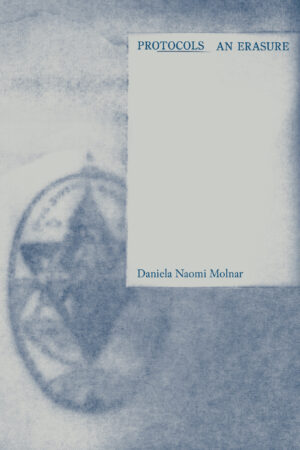
PROTOCOLS: An Erasure
by Daniela Naomi Molnar
reviewed by Rachel Kaufman
We begin in the darkness of a public library receipt—who has checked out The Protocols of the Elders of Zion, the antisemitic conspiracy document published in 1903 Russia and reprinted too many times despite early confirmation of its falsity, and why? The reader is quickly suspended in the space of the archive: a text careening through time, fingernail marks on its spine and microfilm shadows looming in the background. What are we meant to remember, and how are we meant to forget? “[T]o return to the / center,” what historical truths must we bear, what ordinary violences must we enter, and what powers can we embroider until they are undone?
Molnar’s pages are archival—sparse and brimming—as she erases and (mis-)aligns The Protocols of the Elders of Zion to create a text laced with the temptations and catastrophes of belonging. “[Y]ou will be free to / be / an / us,” the poet writes, and the reader hears every comfort and danger offered by this freedom: “quiet / ( the mass ) / hands of / ( the masses ) / ( the crowd ) / (the mob ) / animals / and / ( the people ) / women — their / sheer force / indispensable / ( power ) / ( power ) / ( power ) … ” The erasure poem abstracts “power,” “masses,” and “crowds” to leave them unfamiliar, hanging at the page’s edge like (and sometimes as) lost letters. When a historical document crafted to encourage violence is abstracted, what of our alphabet survives? The Chicana poets of the late twentieth century asked a similar question of language; scholar and writer Emma Pérez declared the solution was to craft a new “sitio y lengua,” a “space and language” that deconstructed as it built. Molnar walks to the edge of this aspiration, peers over the echoing hollow, and attempts to reach something new.
This new imagining can only come after we have reckoned with violence, and after the reader and poet have entered a language bent close to dissolution. “[L]et us / free / the background / of blood,” the poet writes, and this freedom does not arrive without stain: “absolute want / is a / yoke / perpetual want / finds / hunger / ( power ) / and feelings of / need.” The desire for new language does not exist unaccompanied; the alphabet retains its bloody traces, and the words fall slanted. Molnar’s white pages do not shy away from the haunted history and legacy of the Protocols, or from a broader admittance to the terrifying tendencies of the human spirit: “[w]e animals fall asleep / satiated with our blood / enchanted by our blood.” The eye must tire as it travels from word to word across broad empty spaces; the mouth must wrap around thick words which hold the residue of a conspiratorial court room (“the / loquacious / labyrinth”—any delight in alliteration disrupted by the dizzying white page). The reader is thrust into language at its most bodily and its most dismembered, and as she reads the text, it is difficult to not swallow this dismemberment.
What does it mean to make your reader feel the violence of language? Molnar has not made the Protocols more digestible; rather, she has bared its inedible outlines and her own difficulties in processing the text into something new. As she writes in a note: “[Although every word in the poem is drawn directly from the source text,] I made myself an offer: I was allowed to alter the poem’s form, to not exactly replicate the placement of the words as they appear in the source text. The poem’s form became an expressive reprieve from the unrelenting abhorrence of the source text, allowing new formal meanings to be made.” Throughout the book, the reader can hear the words (and the poet) struggling to find a new voice as consonants collide, can see their straining for new space across a page willing and unwilling to hold this archival language in new form. Body parts coat the page: “throats / and / hands / and / hopeless / despair // by freedom / freedom / ( power ) / ( power ) // the whole world forms.” It is every letter, structure, and feeling at once that form Molnar’s linguistic world, and our continual reckoning with despair, freedom, and power is unavoidable and essential. The poem helps reveal what some of this reckoning may look like, and it purposefully does not resolve it. “Protocol 12” goes: “[t]he word / can be / useful to us / it will // permit // empty /// reins … ”
We arrive at the end of the sequence of erasure poems exhausted by the “( power )” refrain. The spaces on either side of the word seem to hold the impossibility of bringing the past productively (i.e., not cyclically) into the present. And yet these spaces, contained by parentheses, can also be filled with new possibilities: “dissolve / circumvent / propose / conceal // spite // ( power )” and, later: “hope, a broken horse / let it ride … ” These glimmers of arrival are startled by a return to the text’s language, by some insistence on the part of the original text that its traces will not be re-shaped entirely. “We are repeat children,” and we are stuck inside recurring ideas, recurring losses. Still, the poet persists in her task: “this world is / sacred / is not secret / is common policy / is more powerful than / people … ”
A poet once asked me how a poem can translate horrific violence without turning it into beauty. Molnar’s erasure perhaps yields some answer: the poem cannot entirely evade the beautiful. Even in poems that preserve the yoke of the text from which they come—the poems feel literally heavy as they demand of the eye, tongue, and mind a laborious act—a new imagining peeks through. “[T]he question ends in hands” and those hands are sewing and stitching, even with the most dire of threads. The poet ends with “love // unshakeable / direction, dangerous, pure.” “Purity” hangs genocidally in the air; love is a few steps behind.
How much faith does the poet have in the poem? The poet grew up in a household where Jewishness was “indistinguishable from historical pain and its echoes,” where hauntings justified the oppression of another people, and where eating the chicken soup and honey cake might “offer spiritual protection against the starving that would inevitably return.” Haunted by her grandmother Rosalie, a haunting which Molnar describes as “seeing light without light actually entering the eye,” the poet’s world thickened, and the new arrangement provided relief. Rosalie wrote poems in Auschwitz, memorized them, and wrote them down in the hospital later—“what was exceptional about her was her capacity to feel,” Molnar writes of her grandmother, “her need to feel everything life can hold.” As it turns out, the poet has the utmost faith in the poem; it is her inheritance, it is what survives of her grandmother, it is what allowed her grandmother to survive, in and for the next generation. “But the dead don’t have hands,” Molnar writes of her book. “Who will I hand this to?” The question ends in hands; the poet reaches out her fingers, her letters, her song—“nothing is forgotten, only subsumed.”
Published on April 6, 2026