
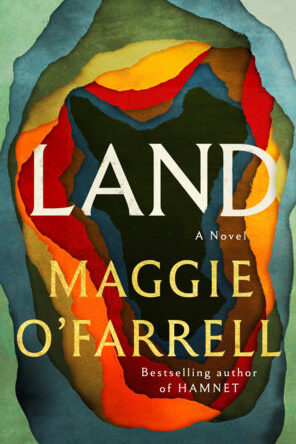
Land
by Maggie O’Farrell
reviewed by Kazuo Robinson
Hilary Mantel sold an awful lot of books, but what is her literary legacy? Since her Wolf Hall trilogy, historical fiction has earned itself more space on the “New Fiction” table, surely in part by learning some lessons from her example. Some novels showing her influence would include Clare Pollard’s The Modern Fairies and Lauren Groff’s Matrix. The selling style involves one or more of the following: the use of the present tense, an abundance of physical, sometimes lurid, detail, and, if length permits, an overdetermined, overexplained sort of character psychology.
Irish-British novelist Maggie O’Farrell, who served as a judge for the inaugural Hilary Mantel prize for fiction in 2022, has assumed the first and second of these techniques. Now, in the wake of Hamnet, she presents a novel about an Irish family in the nineteenth century which, with bold and bald directness, she has titled Land. The novel plays insistently on themes of faith, destiny, and restlessness over more than four hundred pages, cutting forward and backward in time and across land and sea, to the New World and back.
After an ominous opening paragraph in which one of our main players, Liam, is shown to be in some kind of trouble, Land begins with Liam and his father Tomás as they survey an Irish peninsula, “the westernmost scrap of Europe.” Tomás is a master mapmaker with a passion and a steady hand, and Liam, though talented in the field, is shivering out here by the sea and starting to be resentful of his stern daddy. It is 1865, and Tomás only just survived the Great Hunger. He and his son are working for the perfidious Sassenachs (the British)—that is to say, they are selling out—which makes Tomás, at least, feel a little guilty. Soon, quite by accident, they discover on this wild peninsula a mysterious copse with a special, possibly magical spring. The discovery frightens Liam but changes Tomás more profoundly, making him temporarily mad and inspiring in him a new scheme: to make a map “of how this land really is, of how it has always been.”
The idea racing around in Tomás’s feverish mind is for some new kind of anti-colonial cartography. In case there was any danger that a reader might miss this, O’Farrell has him say that this document will be an act of “honour and resistance.” Indeed, as Tomás explains patiently to both Liam and us, “to map is to assume power.” Readers of Land may have one of two reactions at this early point in the novel: either accepting and even relishing Tomás’s brave words, or bristling at the anachronistic language and foreseeing trouble ahead. As it turns out, compromises are made, a family life is to be lived, and the map is not the book’s primary concern. But the notion Tomás has of showing “how this land really is,” matched with O’Farrell’s apparent confidence in depicting how things really were, not just in the nineteenth century but in flashbacks to millennia before, forms the novel’s sentimental basis. Having discovered the spring, whose supernatural element she seems unsure what to do with, O’Farrell will first hint at and eventually depict an earlier, happier way of living in Ireland before the arrival of the pesky priests and the redcoats. It is because she feels she must give us more than just an appealing picture of the past that Tomás, as if a recent graduate of an Anglophone university, talks about the “intersection” of Ireland’s geography and its history, and that she also takes up the gender issue and does it nearly to death. Land is really rather mawkish, but the note is somewhat muffled by the academic language and the other social themes for the benefit of those who like to think the book they are reading is more than just a paean to a dubious imagined past.
But the writing is not good enough even to satisfy our ears. Descriptions are allowed to go long in the hope that they will be made more vivid, but they are often generic. The hold of a passenger ship is “filled with jostling bodies and people calling to each other, pushing this way and that.” We will be disappointed if we hope for more specific detail: “There were packages and luggage stacked in passageways, bottles lashed together, doors opening and closing, sailors rushing, passengers arguing and shoving.” O’Farrell has not quite been able to picture the scene and needed to return to the pushing or shoving. As in much historical fiction, language is a general issue because full historical immersion is unachievable or undesirable, and the compromise involves archaic and slightly formal, stiff vocabulary and phraseology. Things don’t happen to people in Land, they “befall” them, and when someone has learned something, we are told that they “attained the awareness.” Rather than say yes, a character might prefer “exactly so” to keep up old-timey appearances. Regular Irish characters use words like “Da” and “feckers” (in reference to the British) and contract “they had” to “they’d,” while the talented family of Tomás, Liam, the mother (named Seraphina!), and the other children, Rose and Enda, distinguish their heritage with both folksy wisdom and, in the case of Tomás, Liam, and Enda, exceptional autodidacticism.
Another son, Eugene, who “is not as other children,” does not speak at all, but he watches and listens carefully. In O’Farrell’s world, people who are different, much like dogs, are to be credited with special powers of insight. Late in the story, she describes how Eugene lives a pure, hermetic life on the land, “much as his ancient forebears did.” He is not only a kind of noble savage, but a clairvoyant, who somehow knows the fates of all the other characters. As the name “Eugene” (meaning noble) suggests, there are certain special people who are too good for organized religion and civilization. Or so O’Farrell would have us think. But Land is a book of feeling, not thinking. Reading this kind of mediocre yearning fiction is like chopping onions: a bit of a chore, and you might be made to cry a little, but the tears are soon dried, and you feel no lasting sadness or dilation of the soul. What was that all about? Anyway, almost time for dinner.
Published on June 1, 2026