
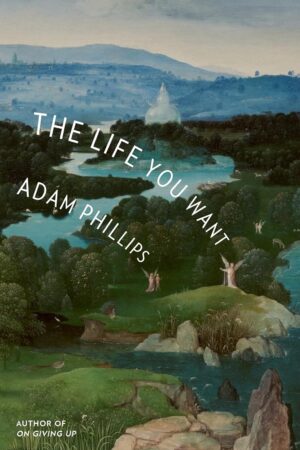
The Life You Want
by Adam Phillips
reviewed by Scott Schomburg
In his new collection of essays, The Life You Want, the British psychoanalyst Adam Phillips stages a conversation between Freudian psychoanalysis and the philosophical tradition of pragmatism, each of which addresses the lives we think we desire and how to go about getting them. Both psychoanalysis and pragmatism “assume that we are what we want,” Phillips writes, “but tell very different stories about what our wanting involves, and involves us in.”
Freud’s idea of the unconscious, for instance—which says that a critical part of us operates without our awareness or control—tells us we are fundamentally unknown to ourselves. In Freud’s story, Phillips says, we are driven by our unconscious instincts, which determine much of who we are and how we are able to be in the world. We live our lives largely governed by an unknown inner censor, our conscious desires in conflict with our more powerful hidden drives, and thus we forever remain ambivalent creatures. In this story, Phillips writes, “what you think you want is where the problems start.”
The philosopher Richard Rorty’s pragmatism, as Phillips describes it, is a more optimistic story. It refuses to essentialize. If psychoanalysis tells us who we are, pragmatism tells us that “we can only know who we want to be.” Essentialist stories are unhelpful, explains Phillips, because they preempt experience. If we think we know who we are, we end up living in a way that confirms that story. But we don’t know what is possible for us, says pragmatism, until we try things out. In contrast to Freud, Rorty thought the unconscious could be our ally; what we don’t know about ourselves could help us. The unconscious might not be disturbing but companionable. According to pragmatism, writes Phillips, if we become Freudians—if we make psychoanalysis our founding story—we have handed our lives over to the authorities. We accept a fiction as the unquestionable truth of our lives.
In The Life You Want, Phillips prefers a third story, which combines psychoanalysis and pragmatism. While psychoanalysis, he argues, may overdetermine our lives, pragmatism, with its privileging of what we each individually want (instead of, say, a collective vision of the good life), is “always at risk of seeming to promote a kind of capricious, impulsive egotism.” If psychoanalysis gives the past (namely, childhood) too much power, pragmatism doesn’t give it enough. In the alternative Phillips presents, “the past informs everything and determines nothing.” We can’t start from scratch, but we also can’t know the future.
During a recent discussion of The Life You Want, Phillips, thinking back to his beginnings in psychoanalysis, said there was a “vale of tears” attitude among his analytic peers. You proved your depth by your suffering. Happiness was for the shallow. But Phillips said he is often in good spirits. He is interested in the richness of what he calls “unforbidden pleasures”—a morning cup of coffee, say, or a good conversation. Phillips wants psychoanalysis to help us find the company we enjoy, and describes how, in the version of conversation Freud gave us called psychoanalytic treatment, the patient is encouraged to freely float from one thought to the next. And Phillips has referred to psychoanalysis not as the talking cure but the listening cure, emphasizing the value of an analyst who genuinely wants to hear from you. For Phillips, psychoanalysis is not really about understanding; it is about curiosity. He calls psychoanalysis “a belated cure for self-knowledge.” The aim, in other words, is to become less interested in yourself, thus making more room for other people.
One of the more fascinating essays in The Life You Want, “On Not Being Taught,” wonders how teaching might change if it adopted Phillips’s combination of psychoanalysis and pragmatism. Here, as in much of Phillips’s psychoanalytic writing, the psychoanalyst Donald Winnicott is his guide. Winnicott’s goal in a lecture, for instance, was not to persuade or even instruct his students, but to present his ideas clearly enough so a student could work with them. He used words in the hope that a student might find themselves picking things out that were helpful to them in ways that neither the teacher nor the student could predict beforehand.
This way of being a student is less about taking things in, Phillips writes, “as though being lectured to or taught was a benign form of force feeding,” but instead about remaining open to the conversation and allowing oneself to be affected by it. The task for the student is to simply “notice what you find yourself noticing,” the way you might in a dream, since what surprises you might tell you something important about yourself. You might find a life you didn’t know you wanted, which, within Phillips’s moving, anti-essentialist, collaborative vision, might lead to people you didn’t know existed. How wonderful, if you’re lucky, to discover they do.
Published on June 12, 2026