
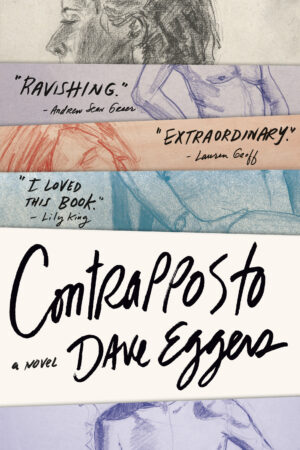
Contrapposto
by Dave Eggers
reviewed by Ioan Marc Jones
Fiction often pokes fun at reality. Dave Eggers is a master of that form. A Hologram for the King laughs at the tedium of international capitalism, updating Beckett for the age of corporate nomads. The Circle and The Every deride the tech industry and our tendency to moonwalk toward self-destruction. Characters in Eggers’s books are thrust into weird and often farcical situations. And readers, all too aware of human folly, all too cognizant of our collective stupidity, laugh along.
Contrapposto continues that proud tradition. We follow Robert Dibb, more commonly known as Cricket, as he navigates a dysfunctional home and finds respite in drawing. Cricket soon meets Olympia Argyros, known at various points as Pia, Limpy, Ollie, Lim, and Albert Camus. Olympia is a hurricane, a force everyone wants to reckon with, transforming the world in her path. As soon as she arrives, we are grateful for the company. She gets all the best lines, and she deserves them. “I have two stepdads,” Olympia tells Cricket. “One’s evil and the other’s in Honolulu.”
Contrapposto is the story of their sweeping friendship. The novel nods to the picaresque, to Tom Jones or Vanity Fair, as it follows Cricket and Olympia through various stages of their lives, across several continents and six decades. Each of the novel’s seven parts launches us forward in time.
Young Cricket loves Olympia, then life shapes and complicates that love. Eggers has a knack for rendering youthful affections, the way every small thing seems to mean everything. “She conveyed her ownership fluently and he loved her madly.” A little later he writes: “[Olympia] put her hand on his. It was very warm and his childhood ended.” And much later, Eggers shows us how love keeps us young, no matter how old: “We’re so young,” Olympia says toward the end, as the characters approach their sixties. “I never thought we’d be so young at this age.”
The world of art provides the novel’s backdrop. Olympia pushes Cricket to become an artist and suggests that they create a movement. Contrapposto is a portrait of the reluctant artist as an aging man. Readers witness this evolution, the fortuitous events that build an artist: drawing to escape dysfunction, joining a nude sketching class, receiving guidance from friends and elders. We watch as Cricket attempts not to sell out, a reluctance to seek either gainful employment or commercial success. Then we watch the two enter the adult art world, a world in which technique is demoted and the realm of “ideas” valorized.
Eggers, as a young man, wanted to be a painter. It is perhaps no surprise that he’s comfortable writing about the art world. Contrapposto highlights many of its absurdities. We see Cricket and Olympia in class at university, where students and teachers praise a blurry Polaroid for “attack[ing] commerce, capitalism, and what is true” while despising a work of technical brilliance, the collective critique of which is encapsulated by one student’s comment: “Sharon has to get away from putting down marks deliberately.” The elevation of theory over practice seems familiar, absurd, and absurdly familiar. A teacher stands up for technique, with an equally absurd defense. “We engage in a kind of upside-down artistic fascism that reminds me of Pol Pot purging his country of intellectuals.” The art world provides plenty of room for absurdity. But it remains all too real.
Eggers forces us to grapple with what constitutes an artist. Kyle, a university friend of Cricket and Olympia and the very man who displayed the blurry Polaroid, later becomes a famous artist. Kyle knows nothing of technique. And he relies on others for ideas. He is the artist as project manager, and we grapple with what that means for art. Marcel Duchamp said that artists of the future will simply point, and Kyle is an exceptional pointer. But he demands NDAs, demands the ideas belong to him. At times, I saw Kyle as a genius conduit. At other times, I considered him a well-organized thief. At all times, I found the art world a lot of fun.
Art provides a body for the book. Its heart lies in the relationship between Cricket and Olympia. Their relationship is not platonic. It is occasionally sexual, but not defined by sex. They love and need each other. But it remains above all a friendship. It has the desperation of friendship, in that certain moments mean little in the absence of a particular friend. Cricket and Olympia follow each other across America and around the world, from Turkey to Thailand to Paris, all in pursuit of that particular friend.
The book ends after more than sixty years of friendship. I worried, as we approached the final pages, that we’d nosedive into tragedy, or perhaps lean into the ease of happiness. But the book concludes in the right way, with the only permissible note: tenderness. Tender moments form the best parts of the book. We witness a mutual love in simple touches, small gestures, moments of sweetness, and in the end we let them get on with it, with whatever remains of a shared life.
Contrapposto is heartbreaking and heart-wrenching and heartwarming. It is often absurd, always moving, never boring. I’m an Eggers fan, and this novel is my favorite Eggers. He succeeds where so many of his characters fail: Contrapposto is both technically accomplished and full of ideas. But most of all it succeeds by the way it renders a long friendship, with all the complexities that entails.
Published on June 16, 2026