
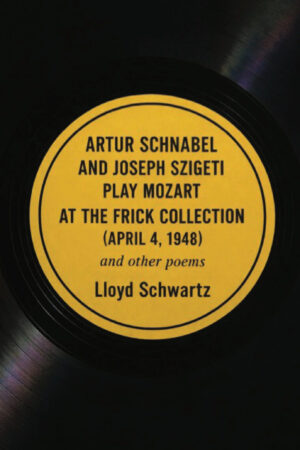
Artur Schnabel and Joseph Szigeti Play Mozart at the Frick Collection (April 4, 1948) and Other Poems by Lloyd Schwartz
by Lloyd Schwartz
reviewed by Maggie Wang
Lloyd Schwartz has been many things over the course of his career: Pulitzer Prize-winning classical music critic, noted scholar of Elizabeth Bishop, and Poet Laureate of Somerville, Massachusetts. These personalities converge felicitously in his latest collection, which is both a loving meditation on art and a fierce defense of art criticism. Despite its obscure title, Artur Schnabel and Joseph Szigeti Play Mozart at the Frick Collection (April 4, 1948) and other poems situates itself in a register both direct and accessible, inviting the reader into conversation.
Though art is Schwartz’s ultimate subject, the collection approaches this subject from a distance. Of particular importance is Schwartz’s implicit contention that history and language are the primary viewing frames through which we understand art. Several poems are therefore made exclusively of quotations. “Lucifer in New York”, for example, grapples with the aftermath of the 9/11 attacks, beginning with the composer Karlheinz Stockhausen’s inflammatory declaration that the attacks were “the greatest work of art ever.” The poem then traverses territory both familiar (George W. Bush’s “axis of evil”) and unknown (“It seems inappropriate to perform excerpts from an opera about a terrorist act right now,” as said conductor Robert Spano regarding the cancellation of a performance of excerpts from John Adams’s The Death of Klinghoffer by the Boston Symphony Orchestra, which he had been scheduled to conduct). Schwartz’s method here is documentary, even political, but its purpose is not merely to unearth material from the archive; it is also to highlight the differences in perspective that we each bring to our existence in a shared world—and, by extension, to our engagement with art.
This attention to things said also moves the three poems in the collection that are adaptations of other poets’ work. The most striking of these is “Fish,” adapted from a poem by the Ukrainian writer and critic Viktor Neborak. Though the poem was written several decades ago, Schwartz’s adaptation takes on a new significance in our time:
no fish is an island
this involves all of us, all of us
processing plants drip with their cold blood
some of us object in poems,
paintings, documentary films
still they make good eating
.
even while the fish spirits are watching
Knowing, too, of Schwartz’s work on Elizabeth Bishop (who, as it happens, appears in the collection as the subject of the poem “Intimate Visits”), one cannot help but think of Bishop’s poem “The Fish.” Though it deploys a drastically different voice, Bishop’s poem shares Schwartz’s and Neborak’s interest in the surreal, the uncanny, and the ways in which our humanity—or inhumanity—may be reflected at us on unexpected occasions.
This collection is mostly not about Schwartz, but it does include a few poems in which Schwartz the critic cedes the stage to Schwartz the person. “Corona Blues,” for example, recalls—among other things—getting married at the beginning of the Covid-19 pandemic. Here, Schwartz’s humor and candor are on display in a more immediate way than in the art-critical poems that fill the collection’s latter half:
Back at the Court House, we find two lines.
.
DIVORCE and PATERNITY.
.
A guard tells us to pick the line that’s shorter.
.
DIVORCE is shorter than PATERNITY.
.
The lady at the counter seems happy to see a couple who aren’t miserable yet.
.
She tells us we need to see a judge.
These personal poems, along with several poems in the collection that center on wordplay, develop techniques that emerged in Schwartz’s earlier books, including Cairo Traffic (2000) and Little Kisses (2017). Four poems in this new collection also appeared in Schwartz’s last book, Who’s on First?: New and Selected Poems (2021). But the bulk of the collection, and its strongest intellectual and creative intervention, marks a departure from Schwartz’s previous poetry. In these poems, which interpret works of painting, music, and film, Schwartz’s creative, scholarly, and critical abilities coalesce.
These poems, though, are not merely ekphrastic. They are arguments about art: about its importance, of course, but also about the proper ways of engaging with and understanding it. In “Lubitsch’s Angel”, for example, Schwartz takes on a reference to Wagner’s Tristan und Isolde in Ernst Lubitsch’s film Angel (1937):
It may be hard to remember, but there was once a time when Hollywood (or some people in Hollywood) could take for granted from the audience a certain level of cultural knowledge.
Art. Literature. Classical music.
But Schwartz is far from sounding like a cultural pessimist. Rather, he invites the reader to give a second look to art that may, on first impression, seem too difficult or different to be relevant to us. This art may, Schwartz insists, turn out to be a source of deep meaning. Of the Wagner reference, he writes:
Lacking this knowledge won’t ruin the movie.
But doesn’t some cultural understanding add a rich—a richer—layer of parallels and alternatives?
Isn’t the elaborate care with which Lubitsch sets up and then throws away these few telling seconds the true—maybe even the major— signature of his slippery genius?
Schwartz’s style and language are not complicated, but the precision and delicacy of his lines reward patient reading and reflection and a willingness to investigate and develop a personal relationship with the artists and works with which Schwartz places himself in conversation. Part of Schwartz’s project, after all, is to illustrate the value of art not merely as an object but rather as an interlocutor and a means of synthesizing our lived experiences. This showcase of his craft, then, affirms the ways in which great art permits, as he writes of a moment in Schnabel and Szigeti’s titular performance of Mozart, “a sudden easy acceptance of the possibility of goodness, of kindness in the world.”
Published on July 20, 2026