
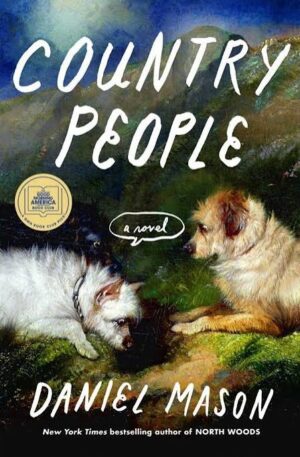
Country People
by Daniel Mason
reviewed by Habib Sabet
Reading Daniel Mason’s fiction, one gets the strong impression that the man has never found a rabbit hole that he won’t go down or at least poke his head into for a quick look. His stories and novels are often spun from threads of esoteric history or obscure science trivia, which Mason weaves into dazzling, kaleidoscopic tapestries of historical and speculative fiction. The stories in his 2020 collection A Registry of My Passage Upon this Earth, a Pulitzer Prize finalist, are about historical curiosities real and imagined, like a pioneering female hot-air balloonist and Alfred Russel Wallace, a real-life collaborator and competitor of Charles Darwin. Mason’s 2023 bestselling novel, North Woods, is a sweeping epic about the successive inhabitants of a house in the Massachusetts wilderness, told through a multitude of forms and voices that span four centuries.
It’s not as odd as it sounds, then, to say that Country People reads like an ambitious new departure for Mason, given that it’s comparatively simple and slow burning. A comic family drama cum campus novel, it’s the story of a single year in the life of a single contemporary household trying to start over in New England. If it doesn’t quite match the scope and intricacy of Mason’s previous fiction, it’s his first book to really reckon with the pitfalls of modernity, and it ranks as his warmest and funniest book to date.
At the story’s center is Miles Krzelewski, a loving father but aimless academic who has been struggling with his dissertation for almost fifteen years, owing to his own tendency to fall down rabbit holes and switch topics on a whim. His wife Kate, meanwhile, is something of an academic superstar, a Milton and Blake scholar whose students often confide that “her lectures made them cry, made them believe in humanity again.” As the novel opens, Kate has been offered a prestigious visiting professorship in Vermont, and we follow the city-dwelling academics, their two children, and their dog—a Lagotto Romagnolo named Giuseppe—on their cross-country drive from the Bay Area to the Green Mountains, where they move into a rustic house borrowed from a professor on sabbatical and settle into country life. The school year begins for Kate and the kids. Miles, unable to make progress on his dissertation, communes with nature and falls in with a band of eccentric locals, including a scooter-riding snowflake photographer and a flirtatious drama teacher named Nausicaä, who casts ten different Pucks in the elementary school Midsummer Night’s Dream production.
All of this takes place in an imagined Vermont town that’s enchanting and uncanny in equal parts. As always, Mason is very good at evoking the splendor of the natural world, but he’s surprisingly better at registering the ways in which the steamroller of urban modernity has begun to pave over the provinces. Yes, the forests here are thrumming with majestic bucks and birdsong, and the baseball fields are of “true grass, not drought-resistant AstroTurf.” But the family’s first hike is led by a conspiracy theorist wilderness expert who works for “a famed thousand-bucks-a-night wellness resort with its own helipad,” and the closest grocery store is a gas station, stocked not with farm-fresh eggs and local produce but with a cornucopia of novel junk food (“And to think that they had dreamed that they were going to be gathering their own eggs, milking their own goats!”). Then, too, the “country people” we meet include a wealthy homesteading “trad” influencer who secretly hails from Greenwich, Connecticut, and a biochemist turned orchardist whose plentiful apples, we are told, “were grown on rootstock raised in Ukraine, grafted in a Maine warehouse, pruned with Japanese clippers he had FedExed each time he lost them.”
The satire is sharp and well aimed, but the novel itself, like Miles, can suffer at times from a lack of direction. The family’s new life offers no shortage of novelties and challenges, but most are swiftly addressed and forgotten in what can feel like a long daisy chain of charming but occasionally unsatisfying set pieces. The borrowed house turns out to be crawling with mice, for example, occasioning a humorous visit from “the Rat Man of Vermont,” who informs them that the infestation is beyond help, but the rodents quickly fade into the novel’s background as little more than a recurring joke. After injuring his knee while cross-country skiing, Miles spends a night at an over-crowded country clinic, but he manages the rest of the novel on crutches without much fuss. Later on, he suspects that Katie has been conducting an affair with the local ski coach, but before any real drama can develop, a telltale text turns out to have been a false alarm.
The book finally shifts into a higher gear in its last third, after Miles receives an anonymous invitation to join the Jeremiah Wilkes Society, which is dedicated to a nineteenth-century pastor who claimed to have found a magical underground kingdom accessible via the network of caves in the region. The society’s members turn out to be the same loveable kooks that Miles has been encountering throughout the novel, and he follows them down the rabbit hole, eventually finding a sense of direction in the process.
These are the kinds of hazardously whimsical materials that, if mishandled, could easily melt into sentimentality and cliché—the real magical kingdom was the one in our hearts all along, and so forth—but Mason handles them with the same style and acuity that have elevated his most recent works. As the novel reaches a close, he performs a high-wire act between the sweet and the saccharine, between the fantastical and the real, between down-to-earth and pie-in-the-sky, and he emerges on the other side with a shining, heartwarming book.
Published on September 1, 2026