
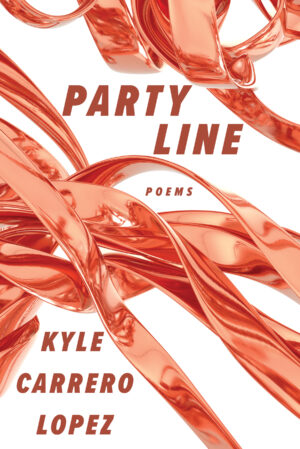
Party Line
by Kyle Carrero Lopez
reviewed by Imani Davis
If you’re reading this, you’re on the guest list. Kyle Carrero Lopez’s debut poetry collection Party Line might just be the literary event of the season. Both en vogue and in Vogue, Carrero Lopez’s work centers the personal and political ins and outs of contemporary queer nightlife in the context of the author’s rich Afro-Cuban heritage.
The title’s double (arguably quadruple, if you’re looking) entendre sparks multiple lightbulbs. Historically speaking, a “party line” refers to a loop of multiple landline telephones, which was a popular method of gossiping with one’s local community prior to the advent of social media. Then, of course, the title invokes the metaphysical “line” between political parties with opposing views. How does one make space for both of these definitions within one collection of poetry? For Kyle Carrero Lopez, the answer is simple: with humor, nuance, and poise.
A clear student of June Jordan’s insistence on the personal as inherently political, Carrero Lopez crafts speakers that will gladly kiki with the reader, but never without appropriate critical gravitas. “Elders,” a poem about a date on Fire Island, unfolds into a question of the ease and access of queer luxury; In “Gay Travel, or Music Makes the People Come Together,” mentions of leisurely trips essentialize reminders about colonized land; “Public Policy,” a lyric essay with a partygoing speaker, roves everywhere from darkroom functions at the club to the launch event for a socialist magazine. There’s a lot of levity in this book, but it never strays far from its anti-imperialist queer-as-in-liberation-oriented sentiment along the way. That’s one of the strengths of Party Line: it takes remarkable tonal skills—perhaps those befitting a seasoned party host—to not “harsh the vibe” for the reader while continually communicating political values, whether on the dance floor or in a debut.
Balance is key for a collection that engages serious themes, which is what makes the deployment of humor and tenderness in Party Line so functionally impressive. At live readings like the one at Cave Canem (a retreat for Black poets) in June, I’ve witnessed Carrero Lopez’s work hit audiences like a well-timed stand-up set with a queer leftist twist. Such prowess begs the question: what does it mean for a gay Black subject to use comedy to soften the hard truths that define them? And what does it mean to be self-aware of one’s own softening? “The Rules,” the opening poem of Party Line wastes no time before immediately engaging those questions:
1. I will always mean what I say
…….(In all things art, put quality first.
…….Being a dick can fly, to a point,
…….if you know they’ll coin it “sass.”
…….Shake the dice. Switch the code.
…….Girls and gays: that’s Bible. Pre-Bible, really—
…….a duo waaay back to cuneiform slabs. Not
…….really. It’s all too yum to make stuff like that up.
…….I been Mister Jester from the jump,
…….stay tellin’ tall tales. Stay worried
…….what could come if I stop being fun.
…….How the glances change, how they might do me,
…….what I might do.)
I’d be remiss not to mention the role Cuban history and culture play in Party Line. The collection smartly embraces a historical materialist perspective, underscoring the role that U.S. imperial history plays in determining the means by which we live (& party). However, Carrero Lopez doesn’t take his own well-informed perspective for granted. Rather, he knows better than to expect the average reader to be fluent in the complex truths of embargo, violence, and U.S. imperial control. Peppered with informative epigraphs, footnotes, and addendums, Party Line is a book that someone who has never heard of Cuba could pick up just as easily as a seasoned scholar. In one of my favorite movements in the text, the epigraph of “Untitled (Havana 2000)” informs the reader that “today, trans healthcare is provided to Cubans for free*” only for the following poem, “Embargo (ADDENDUM)” to challenge that notion with a line of materialist inquiry that reflects the ban on Cuban trade with the U.S. Smattered across the page in overlapping text, it asks:
With what anesthesia?
With what gauze?
With what syringes?
With what disinfectant?
With what hormones?
Such rigor comes at a cost, however: this isn’t a collection that easily lends itself to partial quotation. Were I to teach Party Line, I’d have to do so in full. Opening the text up to a random page doesn’t suffice; it begs for the full length and breadth of reader attention. Here’s the real tea: like any unforgettable party, when it comes to Kyle Carrero Lopez’s debut, you simply had to be there.
Published on September 20, 2026