
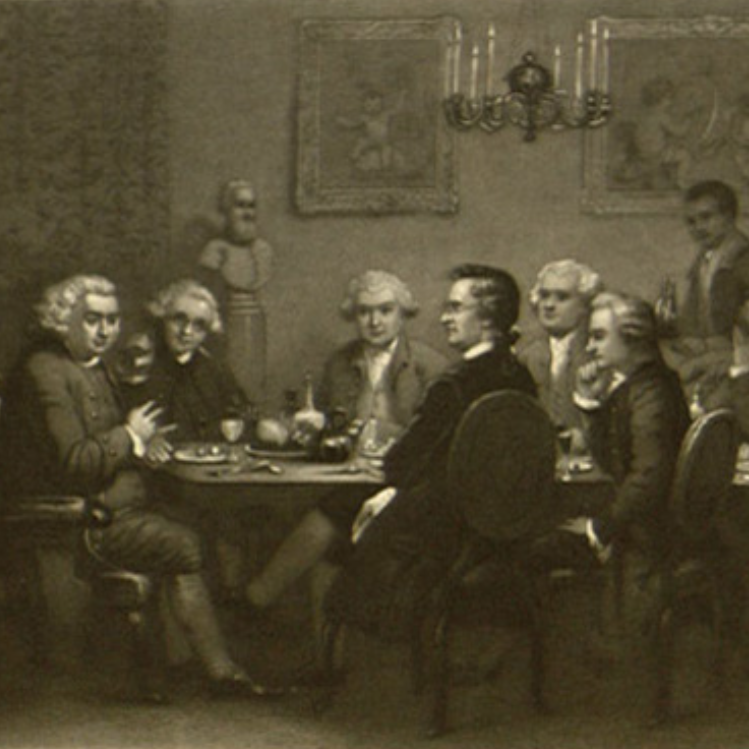
 Engraving by John Sartain after James William Edmund Doyle's "A Literary Party at Sir Joshua Reynolds’s," ca. 1850. Courtesy Houghton Library.
 Contributor Bio
Garret Keizer
A More Clubbable Man
by Garret Keizer
My longtime interest in Samuel Johnson can best be told as a story of friendships. I picture him not only at the center of his distinguished circle of acquaintances but also within a concentric circle of my own. Many of my Johnson-loving friends have been older than I, so that in time I was bound to outlive them—I am in my seventies now—though not all. The young Episcopal priest who first introduced me to Johnson in my mid-twenties, via a fortuitous loan of W. Jackson Bate’s then-new biography, is happily still alive and still in touch, though retired now and more my friend than the mentor he once was.
Most of the others, however, are gone, so that any time spent with Johnson these days can feel like a memorial gesture, as when I pull Hester Thrale’s Anecdotes of the Late Samuel Johnson from my bookshelf and a letter slips out from the master printer Freeman Keith, thanking me for the loan of the book. Freeman found some comments by Mrs. Thrale and her famous houseguest overly harsh, which Freeman’s seldom were, unless confronted with a poorly printed edition.
I am writing this only a few days before the seventh anniversary of the death of my dear friend and fellow writer Howard Frank Mosher, who more than once confided his opinion that “Boswell was probably the better writer, though Johnson was definitely the better man.” Howard was my better in both respects, but I could hold my own in any exchange of anecdotes about Johnson, the sort of exchange that might go on with us for the better part of an hour. “Come to me, my dear Bozzy, and let us be as happy as we can”—words that bring to mind Howard calling me from my desk for a day of trout fishing, or my former English professor Littleton Long asking me to accompany him to his favorite all-you-can-eat Chinese buffet. It was Littleton, a.k.a. “Tiny,” who made me aware of Johnson’s imperial nickname, “the Great Cham of Literature,” bestowed by a contemporary of Johnson’s and appropriately invoked over our third helping of Empress Chicken.
I suspect many others could tell their own versions of the same story, Johnson’s words and deeds mingled with remembrances of their Johnsonian friends. There are good reasons for this, I think, not the least being an abundance of conversational food. Thanks to James Boswell’s obsessive recording of his hero’s later life and Johnson’s own voluminous writings, it is simply not possible to “have all of Johnson” or to exhaust the many topics that might come up over a glass of wine or an afternoon’s ramble. If Donald and Mary Hyde, whose renowned collection of Johnsonia has been housed at Harvard’s Houghton Library since 2003, ever had occasion to talk curatorial shop over dinner, they could have sat a long time before finally clearing off the plates.
Given Johnson’s many pronouncements as critic, moralist, and general observer of life, it’s only natural for an admirer to speculate, “What would Dr. Johnson say?” about this or that—our warming planet, the war in Ukraine, artificial intelligence—thus providing another opportunity for friends to compare impressions. What I imagine Johnson would say is matched by what you imagine, and isn’t one of friendship’s delights that of two imaginations running side-by-side behind a shared theme, like two kids chasing a runaway ball?
I could say the same about the sense of intimacy that comes of sharing an interest not widely shared. You can meet a Red Sox fan anywhere in New England and a Beatles fan anywhere in the world, but to come upon a fellow lover of Johnson is a little like how it must feel for an immigrant to meet someone from his former village in a city strange to them both. Once, while having my computer repaired, a young technician mentioned a magazine piece in which I’d quoted Johnson, his familiarity with the source almost as gratifying as his awareness of my work. My broken tool was in a brother’s hands, and we had lore to swap while he fixed it.
In the first days of my acquaintance, however, after I’d taken up Bate’s Samuel Johnson, no friendships attached to the name. All I brought to the biography was a Victorian caricature of Johnson as a pompous arch-reactionary and a general ignorance of the eighteenth century, both of which Professor Bate would help to dispel. This was a time of some uncertainty in my life, both spiritual and vocational. I was just out of grad school, tentatively employed in a low-skill job, unpublished except for a few poems and fledgling attempts at scholarship, my wife and I without house, offspring, or professions. Johnson once spoke ironically of “towering in the confidence of twenty-one”; I was floundering in the shaken confidence of twenty-seven.
I was, in fact, roughly the same age as Johnson when he took his first fateful journey to London in company with his former pupil David Garrick, two hapless provincials hoping to make their way in the larger world. “Davey” was destined to become the premier English actor of his era and Johnson to give his name to the age, though both were unknowns at the time with but a single horse between them, walking and riding by turns. Johnson had recently failed as a schoolmaster after sinking most of his wife’s money into the founding of a short-lived school. Partially deaf and blind, his face bearing the scars of childhood scrofula, his body regularly convulsed by various tics and mannerisms, and his mind beset by periods of depression so severe that he feared being confined to a madhouse, he hardly seemed destined for success. If he bloomed at all, he would bloom late, and even after blooming with such notable achievements as his groundbreaking Dictionary and the moral essays of his celebrated Rambler, he would spend many years as a struggling hack before achieving anything like financial security or lasting eminence. He was, in short, the friend I needed even before I had come to think of him in connection with any friends. Like many a young writer before me, I felt I was trudging my chosen road behind Sam Johnson, with few prospects and little hope but not without a guide.
➺
That I should associate Johnson with an honor roll of old friends would be congenial to a man who valued friendship as much as Johnson did, who maintained that “a man should keep his friendship in a constant repair” and who counted “every day to be lost in which I do not make a new acquaintance.” Among the artifacts in the Donald and Mary Hyde collection is John Sartain’s engraved copy of an often-reproduced nineteenth-century painting by James William Edmund Doyle entitled “A Literary Party at Sir Joshua Reynolds.” It’s an imagined depiction of Johnson in the company of some notable friends, including his biographer Boswell, the painter Reynolds, the actor Garrick, the writer Oliver Goldsmith, and the statesman Edmund Burke. Of these, four were charter members of Johnson’s famous association, “The Club,” which began meeting weekly at the Turk’s Head Tavern in 1764 and would eventually grow from nine to thirty-five members and become, in the words of Johnson’s biographer Jeffrey Meyers, “the most brilliant concentration of genius in English literary history.”
The word “literary” might be taken as a needless qualifier, since The Club would in time include the historian Edward Gibbon, the naturalist Sir Joseph Banks (who accompanied James Cook on his voyage around the world), and the economist Adam Smith, as well as a linguist, a physician, a folklorist, and a bishop. On their trip to the Scottish Hebrides, Johnson and Boswell imagined founding a Scottish university with members of The Club taking charge of its various academic departments. The plan was entirely fanciful, but the university, had it existed, would surely have been one of the most prestigious of its time.
The idea for The Club was proposed by Joshua Reynolds when Johnson was in one of his gloomier periods, ostensibly as a way of giving diversion to his troubled friend. It was neither the first club over which Johnson would preside nor the last; clubs were not unusual in Johnson’s time and place. Eighteenth-century England featured Ugly Clubs, Surly Clubs, Farters’ Clubs, and so-called “Mollies’ Clubs” for cross-dressers. But The Club aimed to be true to its definite article, worthy of its worthiest member. As Johnson explained to a friend: “It was intended the Club should consist of such men, as that if only two of them chanced to meet, they should be able to entertain each other, without wanting the addition of more company to pass the evening agreeably.” Of “such men,” and according to such a criterion, Edmund Burke may have been Johnson’s paragon: “You could not stand five minutes with that man beneath a shed while it rained, but you must be convinced you had been standing with the greatest man you had ever yet seen.” No doubt Burke would have said the same of Johnson.
Other members merited fainter praises. Sir John Hawkins, who refused to pay for his dinner at the Turk’s Head on the grounds that he’d had to miss his dinner at home in order to attend the meeting, was once so rude to Burke that the other members cold-shouldered him until he stopped coming, thereby earning Johnson’s enduring epithet of “a very unclubbable man.” Oliver Goldsmith (whom Horace Walpole once characterized as “an inspired idiot”) was irritatingly jealous of Johnson—“nobody makes a Bustle when I come in or out of Town”—and so hungry for attention that he once injured himself in the act of jumping over a stick in order to outshine a puppet he felt unduly admired for the same feat. Boswell himself might not have gained admittance (because he was a Scot or because he could be a coxcomb) but for Johnson’s sponsorship—“They knew that if they refused you, they’d probably never have got in another. I’d have kept them all out”—and Johnson’s Lichfield homie David Garrick wasn’t admitted until 1773, partly because of Johnson’s fear that “he will disturb us by his buffoonery.” If we imagine The Club’s meetings as staid affairs, we lack either imagination or a knowledge of those in attendance.
It’s interesting that Boswell gives us a full account of only one meeting, and it’s tempting to speculate as to why. Had Johnson discouraged transcription, or had Boswell been so overcome by the richness of a single evening’s conversation that he was too daunted to record another? Was he smitten among so many noble minds by a rare fit of discretion? Whatever the reason, we can probably take his account as exemplary, the conversation covering such divergent topics as ancient art and the Irish language, travel writing and emigration, parliamentary speeches and the paradoxical human tendency to cheat one’s fellows but also to assist them—all ending with the passage of a resolution to have Johnson compose a letter to a gentleman who had kindly offered The Club a hogshead of claret.
A person today is both surprised and not surprised that The Club contained no female members—not surprised because this was eighteenth-century England and Johnson could oink with the best of his patriarchal contemporaries (“The woman’s a whore, and there’s an end on ’t”), surprised because of Johnson’s “eccentric” views on the nature of the sexes and his lifelong appreciation for “the endearing elegance of female friendship.” He felt it unjust and unwise to deprive girls of education and scoffed at the prevalent notion that a man did best to marry a woman less intelligent than her husband. He assisted no fewer than three women in publishing their work and even feted one, Charlotte Lennox, (in a tavern no less) after the publication of her first novel. His intense friendship with Hester Thrale shows him open to the intellectual company of women, and he grew peevishly disconsolate once deprived of hers. Perhaps because she was not part of The Club, Thrale thought Johnson’s veneration for it “a little less than ridiculous,” a descriptor arguably unfair to him but apt enough for The Club’s homogenous membership. Whether its meetings would have been more or less competitive, inhibited, or sublime with a feminine presence is anyone’s guess, though they would surely have been more interesting, not only to us but also, I’d wager, to Johnson.
When he came home from his club meetings, Johnson would find one of his motley collection of household dependents, the blind poet Anna Williams, waiting up for him to share a nightcap of tea. Williams was one of the women he assisted toward publication. Who knows but that she assisted him in a species of conversation his club, even at its most excellent, could not provide.
➺
Of the many items in the online archive of the Donald and Mary Hyde Collection, I’ve found only two that are not directly related to Johnson’s life and work, an autograph from the actor Peter Ustinov (who played Johnson in a 1957 television production called The Life of Samuel Johnson) and a photograph entitled “A Johnson Tea Party (1932).” The photo shows four people, including the couple who owned Johnson’s cherished teapot before it passed to the Hyde Collection, gathered around the venerable object, apparently less apprehensive than I would be in making private use of so irreplaceable a relic. Not that I can’t comprehend the impulse. It is probably impossible for any dyed-in-the-wool Johnsonian not to imagine convening his own version of The Club, if only to discuss Johnson with his fellow devotees. When W. Jackson Bate was feted by his Harvard colleagues on the occasion of his eightieth birthday, he was presented with his own print of “A Literary Party,” a gift both appropriate to the guest of honor and complimentary to the occasion.
Much as I admire Johnson, though, I am admittedly more like John Hawkins, not as surly but still “a very unclubbable man.” Most of my closest friendships have been with people of the same type. When she was still living at home with her mother and me, our daughter once wryly observed, “Dad, you and your closest men friends should form a club. You’d hold only one meeting a year, and all of you would refuse to attend it.”
So it must have surprised her—I think it surprised almost everyone who knew me—when I proposed holding a celebration of Johnson’s birthday at our house, inviting most of the men referred to in my daughter’s tongue-in-cheek proposal. I would invite Howard, “Tiny,” and Freeman; I would invite Addison, the priest who’d introduced me to the Bate biography. I would invite my old college friend and correspondent, John, who wrote his master’s thesis on a comparison between Johnson’s Rasselas and Voltaire’s Candide, cheekily choosing a standard undergraduate essay assignment and taking it to new heights. I would invite my beloved neighbor Jimmy, a retired professor who, as a poor Harvard graduate student, had borrowed Johnson’s Prayers and Meditations from a library and photocopied the pages in the office where he held a night watchman’s job. (He later acquired his own commercially bound copy, which now resides in my office along with his Ethiopian cushion, his Greek Orthodox wafer press, and his well-thumbed collection of books by or about Simone Weil.) I would invite one of Jimmy’s emeritus colleagues, a teacher of philosophy whose nine lives included harsh years on his father’s farm and, later, time as a controversial minister. I would approach that computer technician, first asking his name, and I would invite a fellow high school English teacher whose fondness for Johnson I didn’t exactly know but whose appetite for books and book-inspired talk was insatiable.
I would also break with Club precedent and invite a woman, an English émigré who’d found her somewhat zany way to northeastern Vermont. Jean was the only woman I knew given to dropping Johnson quotes into her conversation. I worried less about her feeling awkward at being the sole woman than I did about her relishing it too much—all those distinguished gentlemen contemporaries for her to charm and be charmed by. She too was a compulsive talker, who spent the last years of our acquaintance in a French castle from which she would phone us at odd hours, never minding the long-distance charges or the penury she risked by the length of her monologues. But I decided I’d be just as daring and put her on the guest list.
To this day I marvel at my motivations. Certainly, the strongest had to do with gathering my far-flung friends into one place, and possibly with increasing their esteem for me and for themselves by noting the company I kept. House pride may also have played a part: my wife and I had finally mustered the gumption and the funds to redo our dreary kitchen. What better way to mark the completed project than with a party? Our daughter’s enthusiasm for the event greatly piqued mine. It was rare for us to host gatherings of more than a few people—our biggest would be for her high school graduation and her wedding—and I knew she would have liked more. She helped me design the invitations and set about planning the menu. I believe she imagined herself in the role of underage serving wench, not in costume but in high spirits to see her dad so convivial and her kitchen so uncharacteristically occupied. I’ve always felt more disappointed on her behalf than on mine that the event never took place.
Cracks began to show as soon as we received the first RSVPs. A few of the invitees were understandably tentative given the distance to be traveled, and we were not equipped to put up more than a single overnight guest in our house. Though I’d addressed the invitations individually to each Johnson-lover of my acquaintance, it became clear that some of the recipients interpreted this to mean “Johnson-lover plus lover,” which was fine by me but meant we might not have enough chairs or leaves for the table. The final straw and the official reason for the “postponement” was that the renovations to the kitchen, in the tradition of all renovations, were taking longer than we anticipated and would not be finished in time for Johnson’s birthday on September 18.
It may have been no more than the projection of my own feelings, but I had the sense of a general sigh of relief when I called off the party. Everyone understood—I mean graciously and profoundly understood.
Looking back, I wonder that I didn’t think to convene my “club” at some kind of bar or restaurant, though those establishments are by no means plentiful in our neck of the woods. I suppose a church basement or an American Legion hall might have served, but the closest approximation to a tavern would have been best. Hadn’t Johnson pronounced “a tavern chair” to be “the throne of human felicity,” and remarked that “There is nothing which has yet been contrived by man by which so much happiness is produced as by a good tavern or inn”? I may have been too determined to hold the party on my own turf and my own terms, too convinced that the exposed beams and plaster walls of our 1832 farmhouse more closely matched the décor of the Turk’s Head than anything in town. I may have wanted a memory of the evening to become one more happy association with our house. I seemed to feel that holding the celebration away from home would have meant leaving too much of my homebody self behind—what I was probably doing just by planning such an event. “Scarce any man becomes eminently disagreeable but by a departure from his real character.” So said Dr. Johnson, but he might have been talking about me.
I spoke vaguely of a rain date, but quite soon it became clear that there could be no such thing. In a relatively short time, disease and death would deprive me of most of my guests, and of those that remained, estrangement would reduce the list by two. I eventually lost touch with the lady in the castle, assuming that she too must have died. I had failed to launch my project when time and tide were the most favorable, and I did not keep all my friendships in good repair.
➺
My club might have been a flop even had it happened, and Johnson might have judged it a flop even had it worked. “Sir, you have but two topics, yourself and me,” he once exclaimed to Boswell, clearly out of patience. “I am sick of both.” He might have said the same to us. After all, Johnson had meant The Club to be far-ranging, a society for talk without limits, whereas I had deliberately sought to restrict my gathering by my choice of topic and my selection of guests. Take it as one of the few rules set in stone: fans and followers are always narrowing the vision of the one they follow (and setting their narrower visions in stone).
Johnson’s own club might have proved a disappointment; it too might have fallen short of what it promised. How often does the attempt to create the all-star team, the ideal convocation, the perfect blind date ever succeed? The happy chance of instant compatibility is often less than happy in the absence of chance. And when talented individuals are concerned, it may be possible to have too much of a good thing. I think of those rock-and-roll “super groups,” assembled from the star members of older groups and rarely quite as super as expected. It almost defies comprehension to think of Roy Orbison, Bob Dylan, Tom Petty, and George Harrison on the same album—that voice, those words, that bass and guitar—yet how many songs can you name by The Traveling Wilburys? Perhaps The Club, even with members like Burke and Johnson, was never as good as they would have been, just the two of them, thrown together under a shed to shelter from the rain.
Johnson himself might have marred the proceedings on more than one occasion. His reputation as a verbal brawler is well known. “That is the happiest conversation where there is no competition, no vanity, but a calm, quiet interchange of sentiments”—this from a man of whom Oliver Goldsmith remarked, “If his pistol misses fire, he knocks you down with the butt-end of it.” Talking to Boswell after one gathering, Johnson mused with clueless complacency, “Well, we had good talk,” to which Boswell couldn’t resist replying, “Yes, Sir; you tossed and gored several persons.”
But if The Club was ever a letdown, whether for Johnson or because of Johnson, the philosopher-poet who wrote The Vanity of Human Wishes would have been able to take the disappointment in stride. He never looked for perfection in human beings or failed to admit its absence in himself. It was characteristic of him to make amends with those he’d offended, and he was sufficiently self-aware not to take umbrage with people less brilliant than he. A member’s affectionate companionship would have counted more with him than their verbal performance. Hester Thrale confided to her journal that she doubted many of Johnson’s friends loved him, but of his love for them there can be little doubt. Even the envious Goldsmith conceded that “no man alive has a more tender heart.” One of The Club’s less famous members was Christopher Nugent, a Roman Catholic physician whose Friday night dinners at the Turk’s Head were devoutly meatless. In the years after Nugent’s death, Johnson would be moved to tears by the sight of an omelet, exclaiming, “Ah, my dear friend, I shall never eat omelette with thee again.”
Others went the way of Nugent, including “Goldie,” nevermore to contradict Johnson, at least in this life; and Garrick, whose death, Johnson said, “has eclipsed the gaiety of nations, and impoverished the public stock of harmless pleasure.” (It seems that a friend’s “buffoonery” can come to be missed after he’s gone.) To grow old is inevitably to multiply one’s bereavements. As a child I found it peculiar how my grandmother would take up a local newspaper and turn to the obituaries first; years later, I find that I’ve developed the same habit. “Night cometh when no man can work,” a verse from the Bible engraved on Johnson’s watch, is often in my thoughts—along with those occasions when I regrettably did not take the saying to heart.
My failure to convene my Johnson club is but one example. I’m glad that I did at least write to W. Jackson Bate before he died, commending his biography and enclosing a poem I’d written about Johnson. His reply will occasionally flutter out from one of his books, token of a good intention I followed through on. The other day I found the last remaining invitation to my aborted party and thought, “I got that far anyway.” At least some people knew that if ever I formed a club, whether or not it met, I would want them for members. At least my daughter saw her father try to be a more clubbable man.
Also to my credit: I have wrested this remembrance from the jaws of procrastination. After a few fits and starts it draws toward its close. The editor who assigned it has kindly said that if ever I have a mind to, I can come down to see the Hyde Collection with her as my guide. One of Johnson’s better-known quips has to do with the difference between an attraction merely “worth seeing” and one “worth going to see”—a trip to the Houghton Library would surely count as the latter. Not that I’m ready to go right away. Driving in Boston has always felt intimidating to me, and I’m generally less inclined to travel than I once was. Then again, given the generosity of the offer, the excellence of the collection, and the nearness of the coming night, I probably shouldn’t wait too long.
Published on October 6, 2026