
Meringue and Mountains
by Karen E. Bender
My father was dying. Mostly, he slept but sometimes he awoke with a fierce, determined expression, as though we all were foolish and all this—the hospital bed, the wheelchair, the nurses dropping by—was an unnecessary dream. He was ninety-two and did not think he would die, or did not plan on it, and he was so convincing that we didn’t think he would either. He was a psychoanalyst who, until recently, had maintained a practice of several patients, having sessions with them on the phone, until, with a sudden decline, he could not.
My father was slowly dying and I could not say the word for many months, even after he asked me, once when he was in the hospital, “I’m slowly dying. How do you feel about that?”
I was startled, unprepared. But, in the manner of an analyst’s child, I said, “Um. Well. How do you feel about that?”
“I’m sad,” he said.
“I’m sad, too,” I said, and there it was, the absolute, terrible inadequacy of words.
That was our discussion about his mortality. We spent the next several months avoiding the subject, hoping he would get back to talking to his patients and tweeting encouragement or advice to members of Congress.
I wanted to be helpful, which meant that I had spent much of the last year jumping on planes and hurtling toward my father, across the curve of the earth, sitting in hospital rooms, watching the monitor, calling food service to put in another dreary order for dinner, picking up refill prescriptions at CVS, and trying to bring joy into the house in whatever way was possible, standing with my sisters and mother singing the soundtrack to The Sound of Music over and over, the words of which we all somehow knew.
In this long, bent stretch of time, when I had this fierce desire to be helpful, I also found myself thinking a lot about food and yummy things. I liked to try to cook things my father would eat. He ate borscht, that wildly beautiful magenta soup, for a while, until he didn’t. But mostly he ate the same foods, which my mother diligently prepared to fit his incredibly restricted diet: a French toast concoction made of a frozen Eggo waffle, egg whites, and maple syrup; or ground chicken; or Oatly ice cream or raspberry sorbet. Just watching the sameness of it depressed me. How could we bring joy to our weakening father, who would pump his fist to the tune of The Sound of Music and bellow “We’ll beat this!” as his numbers became increasingly grim.
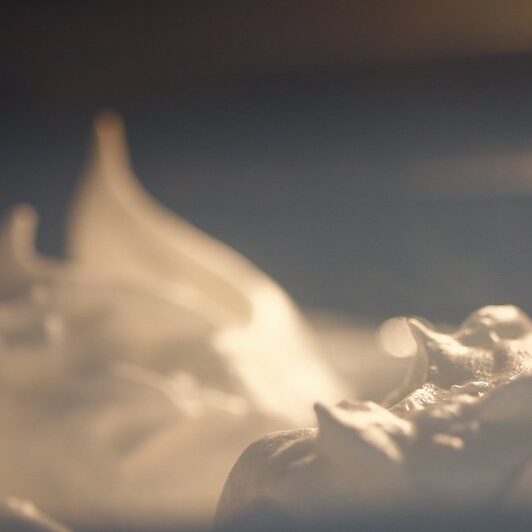
We were all crouching under this tidal wave of sorrow. But now I wanted, somehow, to find meaning in something, and I wanted to eat a lot of whatever was good. I found myself interested in one of my favorite foods: meringue. How pretty meringue was and how profound, in a way. I was a sloppy, impatient cook, who never waited for the stove to fully preheat and never salted things enough, but I did love the process of making meringue, the transformation—the way the egg whites sat like spit, or mucus, at the bottom of the bowl, how when I started to beat them, the engine of the beater shrieked and they became foam, they became the sea, and then at the end they became a cloud. A meringue was the world. It was the one interesting dessert I could sort of make.
You want tasks when sitting with the dying. I stood in the kitchen, beating those sad gloppy eggs into foam, sifting the sugar into the bowl. I felt godlike looking into the clouds of the egg whites, the way they radiated into circular ripples. Then they thickened, slowed down. The moment they lifted off the metal beaters, the piece of sweet cloud. The way spoonfuls dropped onto a pan in the oven, rows of little breasts, in the heat, becoming solid. I sometimes felt my role in the family was the jester; a jester created a food like meringue.
I found myself at odd hours reading meringue recipes, along with the readers’ comments. I loved these comments, the collage of outrage and confusion and bossiness and culinary knowledge and eagerness to help other cooks. The comments were soothing in their desire to master the chaotic eggs. It was so practical and hopeful and had nothing to do with what was happening in my world; thus, I loved them.
✢
If your egg whites have accidental yolks, do not despair. Dip half an eggshell into the whites and the yolks will magically gravitate into it. Problem solved.
—Pat, comment on “How to Make the Best Meringues” by Melissa Clark, New York Times
.
This resulted in a gluey white mass that would not hold any kind of shape, never mind peaks. Research on other sites says to whip egg whites BEFORE adding the sugar, and in fact the result of not whipping them enough is exactly what I got here.
—Henry, comment on “Classic Meringue” by Molly O’Neill, New York Times
.
I turn the oven back on for at least half an hour after they cool in the oven. When you take them out, try tapping them on the bottom with your nail. If they’re not firm, like foam, they need more time.
—fulton800, comment on “Vanilla Meringue Cookies,” foodnetwork.com
✢
I sat in my parents’ living room, where the furniture—golden velour chairs that twirled, a huge brass lamp that looked pregnant—had not changed much over fifty years. It felt like a museum to my parents’ nostalgia for our childhood, which I had always scoffed at, but now I understood their desire to preserve the time when we were all young. I saw my father walking across the carpet as a young psychiatrist, his exchange calling, rushing to his bedroom where he would shut the door and talk to his patients; my father, older, asking me about college, my first job, asking his grandchildren about their friends at school; my father, in recent years, walking through the living room to the computer, where he would send impassioned tweets. Where were the people he had been, and, just as strange, where were the people I had been? How did the furniture trick us by being (amazingly!) the same? I sat in the living room while he slept, and I tried to will the other versions of him to walk through the room. I imagined him able to get up from his bed, walk to me and sit down and tell me about the advice he had just tweeted to Nancy Pelosi. But my thoughts did nothing.
✢
There were two things going on: my father and meringue. And then there was the rest of life. There was my daughter, in college, and a trip. A trip to Switzerland, no less. A trip my daughter and I had planned months earlier, before my father’s descent, a plan that happened by accident, after a flubbed-up trip when my daughter was supposed to join her college friends there one winter break. There was the consolation of the unused ticket, which was nonrefundable, that terrifying word. But she could change it. My husband sweetly suggested, maybe Mom would want to go.
And one day she asked, “Do you want to go with me?”
I was deeply touched. A trip with my twenty-year-old daughter? Oh, yes, I did.
But what would we do?
There was, bizarrely, a town called Meringen in Switzerland where meringue had supposedly been invented. This seemed like a sign.
“We have to go to Meringen,” I told my daughter. Perhaps there could be another reason for the trip. I would learn to make a better meringue. I would bring back some expertly made meringues for my father. There was a nice arc to this; I was desperate for the protection of a narrative arc. He would eat them; we would share a moment of sweetness amid the horror. He would take a bite and there would be that tremulous gift: joy.
I hoped my daughter would be impressed by the uniqueness of this idea. She was not enthusiastic. “No one goes to Meringen,” she said. “We need to hike up a mountain.” I knew she was right. She was determined to go up a mountain, which sounded ambitious and fun. But while she wanted the scenery, I had a more focused, gluttonous pilgrimage to pursue.
I imagined going from gleaming bakery to bakery, sampling a multitude of sweet iterations of meringue, the glossy, the crumbly. I wanted them all. We would participate in an orgy of sugar, which would perhaps distract us; plus, we would return with something to offer my father. My daughter was usually on board with a sugar escapade, but this time she was craving landscape. She wanted to be moving through the world, climbing. I was afraid of this in some way and wanted some sort of purpose, to feel like I wasn’t constantly floating in a miasma of anticipatory grief.
I reached out to the Visitors Center of Meringen, I looked up restaurants in the town. I tried to find the many bakeries in Meringen that would show me the possibilities of meringue. Surely there would be several. But the visitor’s center never wrote back. The hotel where we were staying suggested just one place where there was notable meringue: Frutal Versandbackerei.
✢
I had a dream a couple months before we went to Switzerland. I was on the subway crossing the Brooklyn Bridge, a moment that always makes my heart glossy and full. I looked out over the flat, gleaming expanse of the Hudson River; I saw the curved edge of Brooklyn Heights, the merry-go-round glowing, a circle of gold pearls; I saw the approach of the buildings of downtown New York. But in the dream I saw the Alps, the bridge crossing, the great, impossibly massive mountains rising around me. How beautiful they were. And then I saw a black spy balloon floating amid the Alps, and it was gathering data. It was gathering data on me.
What was the dream? I couldn’t stop thinking about it. The Alps were the part of me that wanted expansiveness, that wanted to explore the world. The balloon was my father, watching me, as he always had, voluminous with advice. I couldn’t tell if this data-gathering was ominous (What are you doing? Don’t eat that!) or if it was protective (I see you. You are okay.). It seemed completely predictable that my father would become a data balloon, floating where the wind blew, suspended. I felt the dream was a premonition that he would die while we were away and we shouldn’t go.
I woke up panicked. How could I go at this moment? We should reschedule, I said to my sisters. We had all been helping out our mother during these months in various ways, alternating visits to California. Was this the wrong time? Should I cancel it?
No, my sisters said, with sweet and generous permission: he’s stable. It’s just a few days. Go.
✢
We sat on the whooshing train, me caught between two generations, one leaving, one rising, heading toward metaphor and the hapless idea of a travel article, grasping at some sort of normalcy. How terrible it seemed to be thinking of a pitch, and I thought of titles: On Meringue and Mountains, A Trip to Meringen, or worse, Gluttony Before a Parental Death. I was thinking of this, of headlines, of the idea of a pitch, which made me feel weirdly that the whole world was a sort of pitch. Which may in some ways be true.
I sat on the train to Meringen with my daughter, the Swiss landscape scattered with chalets that looked like they belonged on a hot cocoa box. It was green, a boastful, confident green, and scattered across it were small herds of cows. If she had hesitation about traveling at this strange moment, she hid it. She had some work to do for school and texted and gazed at the landscape with a wise and thoughtful expression. As a teen during the pandemic, she was forced to follow intense restrictions to protect aging relatives, and she was now focused on the claiming of joy in a way I admired and wanted to learn. Joy itself felt sometimes like a land that was impossibly distant.
We FaceTimed my father, and there he was, himself, now in the rectangle of the phone.
“We’re in Switzerland,” I said, feeling embarrassed. “We’ll be home in a few days.”
He nodded; I didn’t know what he was absorbing. He said to my daughter, “Parlez-vous Français?”
We didn’t know he knew any French! Even now, he could surprise us. She laughed and tried to answer back.
We talked, haltingly, about nothing, for a few moments. The terrible red X we eventually pressed to end the call.
We got off the train at Meringen, the town in Switzerland named for this type of cookie, a place that harbored an admiration for this concoction even greater than mine. I expected a monument to meringue, a statue, perhaps, a museum, something. Why would the town name itself this, essentially declaring itself an international meringue center, with no visible meringue on the street?
Then we saw the beacon, the plastic meringue statue outside of Frutal Versandbackerei.
The window held what seemed like an audience made up of meringue: Plain, coffee flavor, Bailey’s flavor. Some were large, like mini footballs. Here was someone fully committed to the significance of meringue. They did look yummy.
“Let’s do it,” my daughter said.
We went in.
The Frutal Versandbackerei billed itself as a tea house, but it felt more like a coffee shop, with a small binder that was a menu with laminated pages and square wooden tables. There were a couple meringue options: Mit Schlagrahm (whipped cream—the most delicious word for it), and Mit frischen Fruchten und Schlagrahm (with fresh fruit and whipped cream). My daughter got the meringue vermicelli with schlagrahm, which meant meringue with vermicelli and whipped cream.
I saw people eating and conversing, like this was a regular coffee shop.
It seemed so ordinary, and strange, the world.
My meringue concoction filled an entire plate, like a kind of meal. It came with the unlikely fruit combination of green grapes, kiwi slices and pear slices. It was covered by what resembled three breasts of whipped cream. And the meringue itself, a little pale wreath in the middle.
I tapped the meringue with my fork, listened for a little clink. There wasn’t really a clink, but the meringue was solid, certainty in itself. I put my fork in and the inside was light and there was the cloud of whipped cream and, oddly, a grape.
It was an authoritative, perhaps even a bureaucratic meringue, a meringue that had been made the same way, over time, a sense of order and regularity. I wrote this down, imagining myself as a travel writer, but not knowing what I meant.
My daughter was working her way through the meringue with the vermicelli, which resembled brown worms. It seemed to me a culinary car wreck. They tasted vaguely like chestnut and had a texture like toothpaste, and we agreed that they seemed an unnecessary addition to the dish. She looked skeptical but was trying to go with the program, and carefully took her Instagram photo.
We went to the store and bought several bags of meringues, vanilla and Bailey’s flavored, trying to figure out which one my father would like. I guessed any—this strange dessert that he could still eat. This mission was complete.
What was the experience of joy when a person beloved to you was unable to be with you, was slowly returning to earth? There is, in the description of travel, an illusion of forgetting—that a new and adventurous action will be a moment of pretending this does not exist—and the forgetting, the freedom, is a triumph. But it is a lie, there is no real forgetting, and this is not the goal, in any case. The dread of loss hovers, and joy and sorrow are bound together.
I walked with my daughter by the mountains, a silver mist floating below them, in an unearthly, beautiful way. “We need to be outside,” she said determinedly, having researched a good view from the Harder Klum mountain in Interlaken. Tomorrow we needed to take a funicular to the top and look out.
✢
The next day, my daughter made the plan. We took the train to Interlaken, where the lakes were wide, silent mirrors made of blue-green. There was the feeling of being released, the strange, compressed experience of time that happens when you walk through a distant landscape you never thought you would see and may never see again. The air was damp and cool and thrilling on my arms, and I wanted to wrap this feeling up and somehow give it to my father. There was the flat gray plane of the sky, a dark, winter light above it, and between the cold green lakes and the sky, the mist, hanging still above the glassy water, lacy around the Alps.
My daughter wanted to stand on top of a mountain and see the expanse of the world, and I wanted to at least get a good view, so we walked to the entrance of the funicular where there was a long line and then a warning of “technical difficulties” that needed to be addressed. The words “funicular” and “technical difficulties” should not be spoken together. We would address these technical difficulties by avoiding them.
“Okay, let’s just try and walk,” I said. She looked up at the mountain, a little wary, but we were going to try and get as far on the mountain as we could.
We found the start of the trail up to the Harder Klum. The sky was a chill gray, and the air trembled, on the edge of rain. Or the sky was deciding whether to rain or just descend and float over us; silver clouds hovered as though asleep in the air. The ground was mushy cereal wet and the trail was empty. Each time we got to a bend and looked out, there was the town, and the mountains, but mostly what we saw was the pure breath of the mist, the clouds balanced in the air, different pale continents, floating.
The two worlds, balanced, floating.
Each time we stopped at a bend and looked out at the world below, the mist lifted with us, silent, unearthly.
All this beauty felt like a gift and a puzzle; we did not quite know what to do with it. I tried to call my parents, to FaceTime them, but there was no cell service. My daughter wanted proof of her trip, which meant numerous photos, so we posed at every turn in the path, which took a while, and I did not take them at quite the right angle, or capture the right expression, so we ascended slowly, posing at each new bend in the road. The rain was starting, lightly, that soft tapping sound. We could hear it on the leaves, but it was faraway and gentle; we did not feel it yet, and we kept climbing. I listened to the soft sound we made together, our footsteps in the silence. Was it us or was it a squirrel or a bird? How beautiful it was. My daughter darted ahead and I watched her, admiring her speed, the way she was marching forward, the way she wanted to get to a higher and higher view, the yearning to see something new, and bigger; she was in a rush. I thought she was probably in a rush because of her knowledge of our briefness, or because it was just all here; I loved her determination. I could feel the beauty around us filling us, almost overwhelming. I wondered what she would remember from this trip, years later, if this walk, this mist, the quiet sound of our breath as we surged up the mountain, the mist we walked through together, was a memory that would remain within her.
I thought it was about to rain, but I didn’t want to be the lame-o who didn’t like mud, so I loped along in the quiet behind her. We wanted to track the mist and then we were on a slope and turned around.
“Look!” my daughter said, alarmed.
The path behind us was filled with mist. The path was vanishing, becoming cloud. It was a ridiculous and convenient symbol, both ethereal and creepy, and the mist looked like an animal, like a thing with its own mind and goals. My first thought was that I wanted to be able to get down before we couldn’t see anything. My daughter turned and had the same thought.
“Let’s get down, quick!” she said, and we plunged into the cloud. It was just fog as we walked through it. We hurtled down the mountain just as it began to rain, as the leaves bent with the force of the water. There were no hikers as we descended, and then there were determined tough hikers with their walking sticks and their rain gear, starting to ascend the mountain in the rain.
✢
My daughter and I rode the trains, and I peered out the windows, looking at the Alps. They were, astoundingly, as vast as they had been in my dreams. But as the train brushed close to them, I looked up, and when I saw their massive sides, I felt something familiar in me. I felt like a child, and the mountain felt like a parent. I had never felt this way about a rock formation; I had never looked at one with this sort of love. But I felt a strange tenderness and smallness as I looked up at the Alps; they were my father and I was two years old and looking up at his chest. I had transformed into the sort of person who believed my father would be a mountain, or perhaps had always been, but I believed (I hoped) that when he passed he would be here, in some way I couldn’t explain, as the train whizzed past the massive sides of the Alps, their sheer, fierce presence.
We sat together and looked out the window and each time the train turned a curve, to show another shining lake, another rising mountain, we gasped. It was one of those moments you wanted to hold, as long as you could hold a moment. We were held in this moment, my daughter and I, the mountains swishing past us. Each time, it seemed a sort of magic trick, each time almost impossible—the bounty of the world.
“It’s just so beautiful,” my daughter said.
✢
As it turns out, undercooking and overcooking can both cause weeping meringue and unwanted moisture on top of your pie (aka beading). Overcooking meringue causes those little sugary drops of moisture on top of baked meringues.
—from “How to Keep Meringue from Weeping on Top of Your Pie,” Better Homes and Gardens
✢
A few weeks after we returned, I visited my father, who did not want to transform into anything else. He wanted to be who he was. “Time to get cracking!” he said, awaking from a nap, and for twenty minutes he had us lift his legs in a sort of exercise, pressed against my arm in a rather admirable arm wrestle, and then conked out. I didn’t know where my sorrow was, it was hiding somewhere in me, it erupted at random moments, but I gazed at him, trying to locate the fragments of him that I knew, that were still him. Or, really, it was all still him. The way he raised a fist in a gesture of triumph or solidarity was him. The way he sang along to “Climb Every Mountain” was him. It was the small gestures that made you know that the person inside was the person. He was terribly thin, he could not walk, he did not talk the way he used to, he mostly slept, but in some deep way, he was not transformed.
I glanced at the bags of meringues, which had sat merrily in the window of Frutal Versandbackerei. Buying them, I felt full of purpose, like I was completing an important mission. Now they seemed absurd, here, in my parents’ kitchen, even (shockingly!) touristy. My mother examined them, though she was more excited about the Swiss chocolate bars I had also brought.
I needed an action, to finish the narrative arc of this trip by presenting a meringue to my father. It wasn’t clear that he wanted one, but he was getting one anyway—my desire to press something I liked into his hands, to have him taste that sweetness, to give him all the world’s sweetness overruling all other considerations.
I put a couple of meringues on a plate and brought them to him in his hospital bed. “I brought you these from our trip,” I said.
His soft, thin fingers, picked one up. His presence, how I wanted him to be here, just in this house, on this street, in this city, unending. This was the real gluttony, the sugariness of ourselves.
My father quietly chewed the meringue. He raised his hand in a gesture: eh.
To him, the meringue was just a cookie, and maybe a puzzling one.
My father and I sat in the quiet together, in our shared glutton-ness. I tried to tell him about moments from the trip, as though I was trying to acknowledge and apologize for our separateness. He seemed to listen while I went on about the town of Meringen and mist and whipped cream.
Then he fell asleep.
My mother, however, liked the meringues. While my father slept, we sat in the kitchen and ate them together, the little crumbs of sweetness floating in the air.
✢
My daughter’s Instagram after the trip was a travelogue of the Swiss landscape: the silver clouds floating over the lake at Interlaken. The lake itself, an impossible, candied blue, a slice of golden light on a trail. And a photo of two seats on the train, empty, facing each other, between them a square of window holding a farmhouse standing on a bright slant of green. We must have been sitting across from these seats. I thought of her lifting her phone to catch this. The view from the window that flashed by as the train roared past it, almost a dream but not a dream, the green, the blue, everything, held for a moment, glorious, in the light.
Published on October 20, 2026