
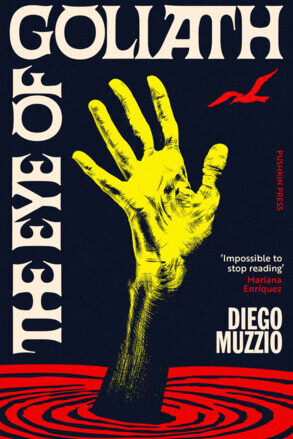
The Eye of Goliath
by Diego Muzzio, translated by Rahul Bery
reviewed by Jade Bailey Brock
To suggest that someone’s past moral transgressions and feelings of guilt might cause a psychotic break is risky. Today, the connection between morality and mental illness is viewed with skepticism. But in Diego Muzzio’s The Eye of Goliath, we are transported to the aftermath of the First World War, when thousands of shell-shocked soldiers returned from the trenches and the rapidly developing field of psychoanalysis offered new ways of understanding the relationship between trauma, guilt, and psychosis. Muzzio’s gothic literary thriller explores this connection through David Bradley, an engineer and former reserve lieutenant whose crime during the Battle of the Somme eventually brings him under the care of Dr. Edward Pierce, psychiatrist and head of St. Bartholomew Sanatorium in Edinburgh.
First published in 2022 and translated from the Spanish by Rahul Bery, The Eye of Goliath follows the interwoven lives of Bradley and Pierce, moving between their experiences on the Western Front and their present selves as each loses his grip on reality and becomes the unwitting echo of the other. From the Bible, Dante, and Virgil to Samuel Taylor Coleridge, Lewis Carroll, and Robert Louis Stevensen, Muzzio weaves numerous literary works into his narrative, deepening its treatment of guilt, echoes and doubles, and the psychological disturbances which emerge in response to “[e]xtreme situations—seemingly anodyne occurrences, personal tragedies or, for instance, a cataclysm like the one that had recently shaken the world, shattering the foundations of supposedly civilized societies.”
Muzzio’s interest in the gothic predates The Eye of Goliath. His 2015 collection of novellas, Las Esferas Invisibles, is set in Buenos Aires during the yellow fever epidemic and similarly explores the relationship between individual suffering and historical catastrophe through gothic themes. His other works include two short story collections, eight collections of poetry, and ten children’s books. But The Eye of Goliath, winner of the 2023 Fundación Medifé Filba Award and the 2024 Konex Award, is Muzzio’s first novel for adults.
The Eye of Goliath opens with the arrival of Bradley at the “exclusive, almost secretive” St. Bartholomew Sanatorium in 1922. He has recently been rescued from The Eye of Goliath, a lighthouse on an islet east of Ushuaia, Argentina, where he became stranded for three weeks while on a mission to survey lighthouses in the territories of Patagonia and Tierra del Fuego. His time there reawakened the traumas he incurred during a gas attack at the Somme. And he cannot stop swimming in thin air:
His legs went up and down, taking on a particular synchronic rhythm, while a hoarse whistle, almost a death rattle, came from his mouth, as if his lungs were not expelling air but stones and sand. It was extremely unsettling: the engineer resembled an automaton stuffed with invisible cogs, a mechanical Lazarus who, under that glass dome, was swimming away from death.
The novel’s second section uses Bradley’s diary entries to detail the horrors he endured at The Eye of Goliath. Religious artifacts, spectral hauntings, and a sinister black albatross that “squawks the message of the Creator” pepper his fractured perception. As he mistakes the lighthouse for the Western Front, his murder of a fellow soldier during the gas attack at the Somme emerges as the source of the guilt that now drives his illegible diary entries, conversations with the dead, and hallucinatory visions.
The diary also showcases Muzzio’s elaborate intertextuality. At one point, Bradley transcribes an article by the Uruguayan writer Horacio Quiroga, within which Quiroga tells a story about Evans, a former caretaker of The Eye of Goliath, who saved Quiroga from being struck by a poisonous rattlesnake. Which is to say that we suddenly find ourselves reading a story within an article within a journal entry within the very novel in our hands. The effect leaves us feeling as unmoored as Bradley. This recursive structure becomes even more significant when we remember that both Bradley and Pierce distrust fiction (for they are echoes of each other), even as fiction ultimately becomes Pierce’s chosen instrument for revealing Bradley’s illness.
Faced with the task of curing Bradley in The Eye of Goliath’s third and final section, Pierce begins a course of hypnosis and a staged re-enactment of the gas attack at the Somme—the site of Bradley’s crime and the root of his present war neurosis. But like Bradley, Pierce has a guilty conscience. Hoping to impress the German psychiatrists who are treating shell-shocked soldiers with more conventional methods, he falsifies the results of Bradley’s treatment, omitting from his report his patient’s fixation on taxidermy and his refusal to discard his botched creations. As Pierce loses his grip on reality, we are left to wonder whether his breakdown is partly driven by the guilt he carries for his professional misconduct—misconduct that places him in Dante’s eighth circle of hell, “where sins related to fraud are punished.”
Muzzio is an astute observer of the human condition at its most dire, bringing psychoanalytic theory, gothic themes, and classic literature together in an engrossing story. His clear prose is sometimes as funny as it is horrifying: a dead man with two tombs is said to have “[e]xactly twice what any man deserves,” while Pierce’s archnemesis, after comparing Pierce’s “pseudoscientific” methods to a conjurer who hypnotises chickens on stage, hastens to clarify that he does “not mean to belittle chickens, which are of course birds of a rather limited intellect.” But the novel’s symbolism can feel overdetermined. Muzzio repeatedly draws attention to echoes and doubles, making explicit a pattern that might be better appreciated if it were allowed to emerge more organically. The irony is that a novel so interested in the unconscious occasionally seems too conscious of its own designs.
Published on November 24, 2026