
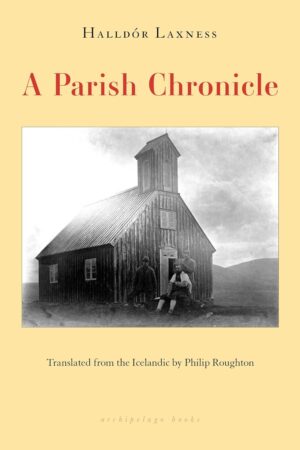
A Parish Chronicle
by Halldor Laxness, translated by Philip Roughton
reviewed by Justin Taylor
That Icelandic Nobel laureate Halldor Laxness was one of the twentieth century’s greatest novelists is to me so self-evident that it almost feels redundant to say so. This claim could be made solely upon the strength of Independent People (1934), the story of a pathologically stubborn sheep farmer that is as much epic (fortunes rise and fall, wars are fought, generations pass) as it is mock epic (a self-sabotaging asshole spends his life knee-deep in sheep shit). It’s the novel that first brought me into the Laxness cult, where I was pleased to find myself in the company of Ernest Hemingway, Susan Sontag, Jane Smiley, E. Annie Proulx, Jonathan Franzen, and Eileen Myles, just to name a few. But there is much more to Laxness than Independent People and there has never been more of it available in English all at once.
A Parish Chronicle (1970) is a slim, elegiac, unprepossessing novel from late in Laxness’ career. It is the fourth of his fictions to be published by Archipelago Books. Six more, including Independent People, are available from Vintage Contemporaries. Salvatore Scibona, another veteran Laxness head, tells us in his introduction to this volume that Laxness drafted A Parish Chronicle in 1963 but then set it aside. He returned to the manuscript in a fit of whimsey or inspiration while on a trip to Rome in late 1969. It was published in Iceland the following year but appears in English for the first time only now, in a characteristically sure-handed translation by Philip Roughton, who is responsible for all of the Archipelago Laxness, as well as the Vintage edition of Iceland’s Bell. (I reviewed Roughton’s excellent translation of Wayward Heroes for Harper’s in 2016.)
A Parish Chronicle draws on all Laxness’ signature themes: Icelandic culture and tradition; the ambivalent inheritance of the Sagas; small lives lived against the merciless current of history. His wry, laconic voice is as unmistakable here as it is inimitable. The novel begins with the exhumation of some bones believed to belong to Egill Skallagrimsson, the warrior-poet antihero of Egill’s Saga, itself the foundational text of that vast body of writing that chronicles Iceland from its earliest settlement (circa 870 AD) to roughly the time of its conversion to Christianity (1000 AD). (Though the sagas do their share of mythologizing, they were written in a realist mode, mostly in the 1200s and 1300s. Their errors, elisions, and flights of fancy notwithstanding, they still function fairly ably as documentary history.) Egill, who happily died a heathen, is nevertheless a sort of bootleg saint. He’s not just a national figure but a local folk hero in the Mosfell district where his bones (probably) are recovered when, in the twelfth century, an old church is razed and relocated. The bones are reinterred at the edge of the new churchyard, the better for the parish to keep quiet vigil over its patriarch—and vice versa, perhaps—down the ensuing centuries.
The bulk of A Parish Chronicle takes place in the 1880s, when an order to close the church, issued by the Danish king back in the 1770s, is finally enforced. Defense against the closure is mounted by a farmer named Olafur of Hrisbru, who may be a descendent of Egill’s, and by Gudrun Jonsdottir, an indigent serving-girl who “lived and worked her whole long life in this district, without ever taking any pay for her labor,” preferring instead to rely on barter and charity. “She was in fact a capitalist because she was never formally employed at any particular farm, but instead worked on her own terms, free of obligation to whomever hired her—what in those days was called a ‘freewoman.’ That title had an air of distinction, even if it may have been imaginary. In any case, she certainly was independent.” Gudrun, through her very obduracy and idiosyncrasy, is emblematic of something fundamental to the Icelandic character. At one point she gets lost in the wilderness for three days but refuses to eat the loaf of bread she is carrying on the grounds that it was intended not for her but for the local priest. By the time she gets it to him it’s fit only to be fed to horses.
It has been argued that Icelanders are swayed little by rational arguments, and hardly economic ones, either, yet even less by religious rationale, but solve their problems by splitting hairs and arguing over irrelevant trifles, and become terrified and dumbstruck when it comes to the heart of the matter. On the other hand, they take on herculean tasks to oblige their friends and relatives, were it not so, Iceland’s rural communities would have collapsed many centuries ago. Yet there is one type of reasoning that Icelanders willingly submit to as a last resort, and that is humor, even of the most imbecilic sort. At a ludicrous cock-and-bull story, Icelanders soften and start beaming; the soil of their souls grows fertile.
Thus the spirit of this novel, and indeed the whole Laxness oeuvre, which I cannot recommend highly enough. Here’s Scibona again: “If Laxness often wrote about what was wicked, ugly, even horrifying, he did so out of a habit of finding beauty in little else. But his heart never leaves these people, and the experience of reading him is of a singular, wry, unstinting sympathy especially for characters at their most blockheaded or deranged.” I suspect, as Scibona also seems to, that for most readers A Parish Chronicle will be a stepping-stone to the bigger novels. Independent People, World Light, and Wayward Heroes are my personal holy trinity, though it’s worth mentioning that Under the Glacier enjoys a robust cult of its own. The present novel, in any case, is no less charming, nor its appearance any less cause for celebration, for the fact of its being a minor work. Laxness had, by this point in his life, already made his major statements. Here he turns his attention to the ephemera of the everyday, burnishing them in memory so that—like the Mosfell church—they are never fully lost but always ripe for resurrection, as in this brief breathtaking description of the sound of Olafur honing his scythe:
The hammering rang out like a rather high-pitched bell, carrying well even to distant places in the still of night. The peal of metal striking metal was most welcome to the newly woken thrushes, which rooted for earthworms in the scythe tracks of those men while the grass was still damp. This is the music you remember when you live to be a hundred.
Published on February 12, 2026