
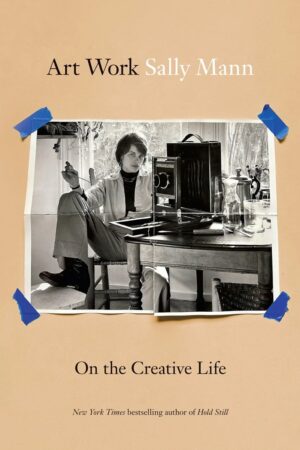
Art Work
by Sally Mann
reviewed by Scott Schomburg
Throughout Sally Mann’s Art Work, a meditation on the creative life, the photographer addresses younger artists from the end, “or something very like the end,” of a path on which they are just beginning. Mann is in her eighth decade, and she’s been writing or taking pictures since she was seventeen years old, nurturing an obsession with her ancestral lands in Virginia’s Shenandoah Valley. With camera or pen, she has been making indelible images for the bulk of her life, and she hopes the lessons she has learned over the years (while dragging her emotions “from the back rooms of my heart’s rag-and-bone shop” and “putting them out onto the street”) might prepare others for what lies ahead. She can write such a book, Mann says, because she has finally earned the right to call herself an artist. How did she earn it? By working, world without end. That’s what Art Work is about: “how to get shit done” on a path that is never done until it is.
There is nothing special about the artist’s job, she writes, nothing lofty about the day-to-day mundanity of making art. Mann calls her work “little somethings,” a phrase she got from a New Yorker cartoon in which a group of people are playing Lifeboat, deciding who to throw overboard to save the rest. One suggests it should be the artist, of course, since she just makes “some little something.” In borrowing this phrase, Mann seems to warn that while art may be seen as inessential it also might get you killed. In one of her early experiences, it almost did. As a child, Mann was captivated by Wynn Bullock’s photograph Child in Forest, a serene image of a naked girl lying face down in a grove of ivy, surrounded by trees that protect her. Mann felt drawn to the sylvan scene, so much so that she tried to recreate it one day when she was with her father, a doctor, on a house call. He told her to wait for him in the car, but when Mann saw what looked like the lush ivy from the picture, she got out of the car, took off her clothes, and lay down on the ground. But the ivy was actually stinging nettle, and when her father returned, Mann was in anaphylactic shock. He scooped her up with one arm and rushed her to the car, grabbing the epinephrine from his medical bag.
The arc of this drama has repeated several times in Mann’s life, and it structures other stories in Art Work. Chapter by chapter, she flings herself into the world, suffers, and is helped by an outreached hand. Once, she happens to sit by Mr. Winston—the jeweler Harry Winston—on a plane to New York. When she finds herself stranded in the city, he lets her stay in his mansion. On a different trip, a gallerist rejects her prints, and Mann rushes to the apartment of a friend who then tells her a parable that gives her strength to move forward. (“Now is when you stuff the dog into the umbrella stand,” he says, then proceeds to narrate the story of a man who repeatedly makes a mess of things—once sitting on a dog he mistook for a pillow in the guest room of a host—and resolves each time to flee the scene and not look back.) Throughout the book, Mann includes fragments of letters with her friend Ted Orland, the photographer and co-author of the bestselling Art and Fear, whom she met at a photography workshop while she was looking for Ansel Adams. Many of her letters to Orland express her despair at making work that doesn’t satisfy her and the “tenacious fuckupery” of life’s everyday tasks that keep her from her art. Having an artist friend, a true friend, is crucial, Mann writes, because they “can identify when that despair reaches the point where it is not merely an excuse for an entertaining anecdote, but real despair.” A friend, in other words, who will save you in time from the stinging nettle.
A particularly crushing example of this pattern comes after Mann purchases a pristine trailer in a magical grove of old-growth trees. Hoping to make it an artist’s retreat, she rents it to a couple that seem at first glance to be the perfect tenants. Instead, they trash the trailer, dig holes to burn piles and piles of trash, and damage the grove by installing security cameras in the trees. Mann wasn’t living in the trailer, but when she visits the ruined rental, the scene of destruction unsettles her, and when she evicts them for not paying rent, Mann finds a homemade bomb inside. During those terrified months, Mann didn’t take “a single meaningful photograph,” perhaps because, as she puts it, pictures that contain that “smokily mysterious” element require her to look long enough at the world for wonder to do its work—and that cannot happen while living with fear. This patient observation requires a kind of fearlessness because, while the artist watches, she is vulnerable. Anything can happen.
Mann is clear-eyed about the suffering in her life and in the world—the tedium, the cruelty, the loss, the environmental devastation all around us—but she never loses faith in beauty, art’s highest aim. This trust allows her to work, and the work casts out fear. She didn’t have her camera at the trailer, but she kept observing. When the bulldozers demolish the structure after the tenants have left, Mann notices among the wreckage “two miraculous daffodils protected by god knows what.” Mann admits it is odd to include—in a book about making art—a long chapter about a time when she didn’t make anything at all. But it shows us what writing can do, rendering through memory what she can no longer photograph.
Amidst a scene of destruction, those two daffodils are, to her, a sign of grace. Mann belongs among artists and writers who believe that enchantment is not a distortion of reality but (as Marilynne Robinson once put it) “reality clearly perceived.” In those moments, “the scene is charged for just that instant with a numinous shimmer—no longer commonplace but alive with a transformative razzle-dazzle.” She isn’t spiritual, she says, “but I have experienced, convincingly, the ineffable magic by which obsession, frustration, repetition, and serendipity miraculously transfigure that thin, Nabokovian slice of time, that tenth of a second, into something eternal.”
One day, after taking several failed photographs of a scarred tree, Mann saw it shrouded in fog and rushed to set up her camera. Until then the pictures had shown just another tree; in the fog, during a brief moment caught by her camera, the scarred tree was sublime. In Sally Mann’s artistic universe, the latter, not the former, tells more of a truth: the artist’s job is ordinary, but the world we observe, if we can stay with it long enough, is anything but.
Published on December 10, 2025