
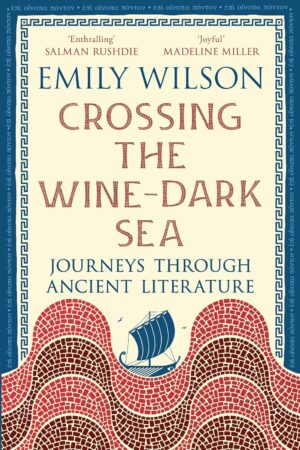
Crossing the Wine-Dark Sea: Journeys Through Ancient Literature
by Emily Wilson
reviewed by Alisyn Amant
Every few years, a general-interest publication, whether it’s The New Yorker or Vox, releases an
article that says something along the lines of, “No, really. Many ancient Greek and Roman
statues were painted with bright, almost-garish colors.” They’re right, of course. Science proved
it decades ago. Still, the misconception persists. As recently as July 2026, Christopher Nolan’s
adaptation of The Odyssey had floods of moviegoers watch as Odysseus (a rugged Matt Damon)
chops off the head of a white, smooth, marble Athena during his conquest of Troy.
Indeed, whitewashed Athenas may appear natural—historically accurate, even—to the average
(American) twenty-first-century mind. What seems like tradition, though, is often a cultural
concoction born of a time “much more recent than we think,” writes Emily Wilson in a new
collection of essays, Crossing the Wine-Dark Sea: Journeys Through Ancient Literature.
Perhaps no one is more qualified to dispel myths about ancient Greece and Rome than
Wilson—a classicist at the University of Pennsylvania and the first woman to publish a
complete, full-length English translation of Homer’s Odyssey in verse. And Wilson, with
Crossing the Wine-Dark Sea, sets the record straight in a manner that proves much more
successful than the usual attempts by specialists and non-specialists alike, for the experience of
reading Crossing the Wine-Dark Sea feels akin to the experience of sitting down for coffee with
a friend one deeply admires—a friend whose wholehearted passion for and knowledge of a
single topic charges the people around her with surplus excitement over something that, prior to
that very moment, they’d probably never even thought about before.
Each of the thirteen essays in the collection—seven of which are adapted from Wilson’s previous
contributions to The New Republic, the Times Literary Supplement, the New York Review of
Books, and other publications—vary in subject. She dissects Terence’s comedies and Sappho’s
fragments of poetry, explains the Roman absorption of Greek culture, wonders at the pure luck
that allowed Catullus’ poetry to survive until 2026 and beyond.
They don’t vary in quality, however. Wilson follows the same advice she doles out to other
classicists in one of the collection’s later essays, “Ancient Worlds: Edith Hamilton and the
Popularization of the Classics:” “show members of the intelligent reading public the respect they
deserve, by offering nuanced, clear, interesting analyses of antiquity in all its glorious, alien
complexity.” It’s a philosophy that creates a fact-based dialogue between past and present, minus the sort of pretension that leads one to assume the author occupies some grander plane of
existence, isolated from the lowly plebeians and their “popular culture.” Wilson exists in 2026, too: she’s heard Megan Thee Stallion and Cardi B’s 2020 “WAP” and she’s read Aristophanes’
plays in the original ancient Greek.
Imagine “WAP” in prose, she suggests. Imagine it stripped of its “artful manipulation of rhythm
and sound in words and imagery.” Conduct the same thought experiment with the decidedly
obscene Old Comedy of Aristophanes, often translated into “safer,” “grander” language for
modern audiences. Imagine it stripped of its “lyrical flow” and obscene innuendos. Now, Wilson
argues, “you get the problem.”
It’s a somewhat common one for translators, she contends. In “Translating the Odyssey,” the
final (and best) essay of Crossing the Wine-Dark Sea, she meticulously close reads selections
from Homer’s Odyssey and compares translations of a few lines by different scholars. Every
example reveals the inevitable: Translators let era-specific social values, personal histories,
literary trends, and a lot more creep, unannounced and unnoticed, onto the page.
Hence the toned-down Aristophanes and Alexander Pope—a prominent poet and translator of the English Enlightenment—putting a blush on the goddess Dawn’s face as she rises from the bed she shares with her mortal lover in his translation of Homer. While a woman of seventeenth- or eighteenth-century Europe might be (expected to be) shy about her sexuality, no “archaic Greek goddess would feel the need to blush about being sexually active”—and nowhere in the original Greek is it suggested she does, Wilson writes. Even Richard Lattimore’s translation of the passage—published in the 1960s and widely regarded as the most “faithful” to Homer’s language—relies on participles, whereas Wilson argues the original relies on “finite verbs that create a far more energetic effect.” Successors to Pope and Lattimore (and many others) followed suit. And, along the way, they solidified the association of ancient literature with “[g]rand vocabulary words and archaisms … regardless of the lexical register of the original.”
In no uncertain terms, Wilson emphasizes that there is “no obvious solution” to the complicated
task of translating a text’s words and its senses. There is no “single ‘correct’ translation of a
specific word, phrase, sentence or passage”—including her own, which she dissects just as she
does those of others.
Crossing the Wine-Dark Sea is the nudge needed to shed twenty-first-century presumptions
about the ancient world, and Wilson demonstrates the far-more wondrousness of historical
reality: Ancient poets depict sirens with the legs and claws of birds, not the seductive ones of the
real-life women their successors lusted after. In Homer’s eyes, Polyphemus is no monster, but a
man who happens to be larger and to have one less eye than Odysseus. Marble Athenas aren’t a
natural, delicate white—but vibrant and colorful.
Published on September 24, 2026