
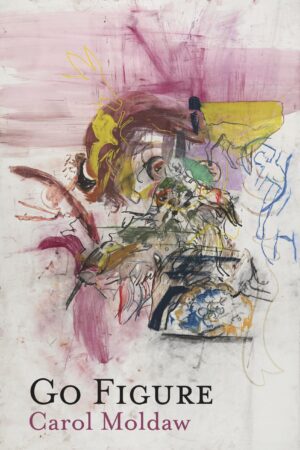
Go Figure
by Carol Moldaw
reviewed by Jennifer Barber
Carol Moldaw is the author of six previous collections of poetry, including So Late, So Soon: New and Selected Poems, and The Widening, a novel. The poems in her seventh book of poetry, Go Figure, gaze outward and inward with equal descriptive power. Her collection examines what it is to have a muse and to be a muse; to raise a daughter and to be a daughter; and to be a writer in relation to troubled and troubling times.
The collection’s second poem, “On Being Mused Upon,” contains the writerly pun of the verb muse with the noun muse; to this, one might add the idea of bemusement. Married to the poet Arthur Sze, Moldaw conveys how it feels to be represented by another or to be, on occasion, “material.” Here are the first two stanzas:
Reading his poems, you recognize yourself
in intermittent isolated images—your scent,
your nape, your hair, an arrangement of flowers
you once placed at the center of a long table.
It adds to evidence that you are being seen,
which is not, you hope, the same as being watched,
a thing you don’t want. Still, you wonder
whether the piecemeal you and she
resemble at all your version of who you are.
In these stanzas, Moldaw is not objecting to being portrayed as much as she is analyzing the experience. Part of the complication is that the poet is engaged in looking at the one who is looking at her. A subsequent poem, “Raccoons,” sees the marriage of two writers in a more humorous vein, as poet-husband and poet-wife contend over the same fodder for a poem—a raccoon in the yard who opens a water spigot with dexterous paws.
The book’s title poem further elaborates facets of gazing. The speaker embarks on a whirlwind tour of art history, placing herself as the female figure in numerous works: she sees herself as “carved sandstone, a voluptuary / … on a narrow ledge high up / the temple’s façade,” and “stepping over the tub’s rim, sideways / into the easel like a towel.” The poet layers her own sensibility on top of that of male artists, becoming a co-creator. Later in the poem, she surveys her mirrored reflection, “examining eye, / lip, brow: brush and palette in hand.” As she becomes the artist of herself, an abyss opens; she peers “as into a church’s / perpetual dusk, cinema’s blackout velvet.”
Later in the collection, Moldaw turns her gaze to her complex relationship with her mother. Writing about the vulnerabilities of one’s parents in their old age has become ubiquitous among contemporary poets. Moldaw’s poem “Arthritis” differs in that she envisions, through her mother’s arthritis, her own future. Her hands, she tells us, are already beginning to resemble her mother’s stricken ones:
… I look down now
at my knuckly thumbs, my index finger
permanently askew in the same classic
crook as hers, called a swan’s neck,
as if snapped, it’s that pronounced.
Even as I type, I’m wondering how long
I’ll be able to—each joint in my left hand
needing to be hoisted, prodded, into place,
one knuckle like a clock’s dial clicking
as it’s turned to open, bend or unbend.
These minutely observed details of the hand serve to reduce the distance between mother and daughter, submerging their many conflicts over the years into this physical similarity. The poem ends with a tender gesture:
… I reached across
the gulf my father left, to her side
of their bed and stroked my future hand.
The book title Go Figure, apart from its reference to works of art and application to the puzzlements of family life, also evokes our topsy-turvy, destructive political moment. What is the role of writers at such times? To increase their own political involvement? To write poems of witness?
“Richter Scale” opens with these lines: “If this were a crowd-sourced blueprint for the resistance / it would tell you what action to take, but it won’t, / it can’t, isn’t, I’m afraid, built that way … ” The tone is rueful. The speaker might like to be the author of a poem that can tell us exactly what to do to resist, but neither she nor the poem is “built that way.” It’s a reminder that a poem by its nature is not a “message.” It must have the freedom to go where it will:
… It wants,
instead, to daydream, to remember a sunset
where a bevy of deer vogued in the meadow,
all looking up at the same time while grazing …
That verb “vogued”—unusual in English, a descendant of the Latin vagor (to wander, roam)—captivates us the same way that the deer are captivated by something they perceive, all looking up with one accord, alert to what comes next.
In the concluding stanza, we see the poet scrolling news the way her father used to follow the stock market. The next lines merge a deep musing with the act of gazing: “ … In slow motion, / who can tell which way things will fall? History, / in real time. The deer scatter when I blink.”
Moldaw’s characteristic clarity means that we are always fully oriented as we read; we accompany her and are accompanied by her, poem by poem. Go Figure speaks with a voice that expresses the mysterious dimensions of experience by asking questions and refusing easy answers. Moldaw’s exactness of language and her skill at conveying complexity lead us through our own “figuring” of our collective and individual lives.
Published on January 1, 2026