
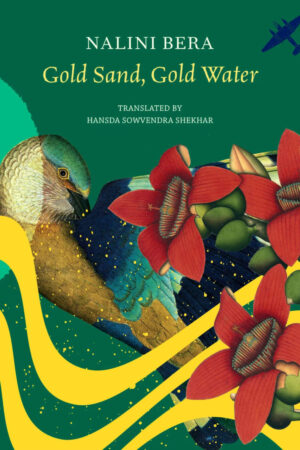
Gold Sand, Gold Water
by Nalina Bera, translated by Hansda Sowvendra Shekhar
reviewed by Zara Karschay
Within Nalini Bera’s rich and contemplative Gold Sand, Gold Water floats a protean body of battles and partitions, romances and family sagas. Set along West Bengal’s Subarnarekha River, legends run alongside daily life, propped up by native Hatua villagers who whisper their own mythologies into the novel’s chapters: “As humans started settling, so did the gods and spirits they believed in.” The river’s physical and metaphysical topography is captured by the young protagonist and narrator Lolin, one of the Hatua people’s “Clothless Kin”—a community inhabiting the river’s banks—and a Robin Hood devotee who marvels at each of the river’s bends, every new corner “stringing itself together before my eyes.”
Lolin is a bouncy child, prone to embarrassment, and in a hurry to grow up. He lives with seven siblings in a bakhul (a hamlet) south of the river, a place so remote that he must orient himself via rice paddies and potters’ wheels. We first meet him at a point when the family hopes he will succeed his uncle as a medicine man. But Lolin fears the snakes for whose bites he must find salves, and so his “one chance of becoming a kobrej went kaput.” Instead, we follow him through episodes that marry the levity of childish wonder with the gravity of surviving in remote environments: solving ghost stories, spending the night in abandoned train carriages, falling in love, and finding new adventures along the river with its ruins of past kingdoms, spectral bandits, and deadly fauna. Chapter boundaries become as porous as those between the Subarnarekha’s (hi)stories, and reality and fantasy seem to emulsify: In one chapter, a nose ring is lost in the Subarnarekha, seemingly forever, only for a cobra to emerge from the river in another chapter, “wearing a nose ring on its snout.”
Bera pays close attention to the way the young and naive gather stories, and he skilfully casts the history of the riverine Hatua community, a marginalized group united under an ethnolinguistic identity, under the golden aspect of a boy unbroken by the wisdom of experience. A man who Lolin finds stealing rice seeks to persuade the boy to look the other way by flattering him with a false lineage that goes back to his “grandfather’s grandfather” poaching the king’s peacock: “Lolin, you’re not a low caste. You are a Brahman. […] You were thrown down from the position of a Brahman and made into a low caste. Here, this is your family history. I wrote it for you.” To this man, an illusory past association with the Brahman caste should tantalize a boy like Lolin and stop him from alerting the authorities. The novel quickly reveals the irony of caste ideology when Lolin discovers this thief used a poita, a consecrated thread belonging to the thief himself and worn by so-called higher castes, to tie his bag of stolen items.
Gold Sand, Gold Water bears the load of contemporary discussions around caste identity in West Bengal. The visibility and rights of marginalized communities in the state have been spotlighted by its government’s recent re-verification of caste certificates, opening up questions of representation and belonging in the political sphere. Even along this remote stretch of river, India’s strict social strata are invoked to bargain with others and justify place. Episodes with boatmen Mona Bisoi and Hanshi Nauria, the latter of whom becomes Lolin’s fiercest friend, reveal the harms of rigid hierarchies well beyond the city. Whatever affection Lolin may have for them, the boatmen are always conscious of their lower status: “What is inside your head is more precious than what I have inside mine,” Mona tells Lolin, preferring to give the boy his umbrella and brave the roiling sun himself.
In 2019, Gold Sand, Gold Water received the Ananda Puraskar prize, a prestigious award for literary works written in Bengali, and this year marks the release of its English translation. The novel’s English-language translator, Hansda Sowvendra Shekhar, grew up by the Subarnarekha river, and she suffuses into the text her own memories of its communities “fishing, swimming, boating.” “I felt as if I had come home,” she says of her translation work, and this warmth of familiarity courses through the novel. We are treated to transliterated lines of poetry that can be read alongside the English, and extensive lists of flowers and plants, recorded by their local names, contribute to the effect of physical remoteness. The villagers’ Hatua dialect borrows from Bengali, native to the Bengal region, and Odia, the language of the Indian state of Odisha, but it remains distinct from both.
The river’s name translates to “golden streak,” and is so named for its alluvial gold deposits—to this day, people pan for gold along its banks, ever hopeful. Yet Lolin’s interests seem focused on the metaphorical qualities of a river’s flow. His boyish yearning for a Robin Hood style of adventure will find a more ideological outlet one day; while Lolin attends a wedding ceremony, we slip into a future where he has become the rebellious spirit he so revered as a child: “Years later, I would, while being followed by the police, stuff my copy of The Communist Manifesto—bearing that famous line, ‘Workers of the world, unite’—into an empty tin box and bury it in one of the paddies.” But this future is gone as quickly as it came, and the translator’s words of homecoming echo here, though now knowing what we do of Lolin’s future, the present is suddenly, distinctly, off-kilter, and we are reminded of the aphorism that we can never step into the same river twice. In Gold Sand, Gold Water, characters present to the river their dreams, and the Subarnarekha reflects back the consequences of human imagination; vast histories and mythologies, the slipstreams of time and story in perpetual motion.
Published on November 3, 2026