
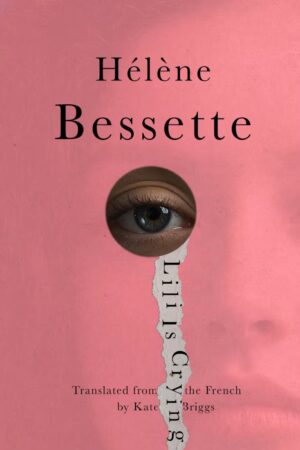
Lili Is Crying
by Hélène Bessette, translated by Kate Briggs
reviewed by Catherine Sawoski
We’re in the era of the rediscovered classic. Books like John Williams’s Stoner, left to collect dust for decades, have been pulled out of archives and attics and reprinted to wild success. Back covers speak of unrecognized innovation and writers dying in tragic obscurity.
Hélène Bessette’s Lili Is Crying, translated by Kate Briggs into English for the first time, hopes to place itself in this genre. The book, originally published in France in 1953, heralds itself as the work of a “forgotten midcentury genius” championed by the likes of Marguerite Duras and Raymond Queneau. Bessette, who would go on to found an organization called Le Gang du roman poétique (The Gang of the Poetic Novel), wanted to invent a new genre: the poetic novel. Lili is Crying is the result. The novel—if it can be called that—is an exercise in form, using stanzas and line breaks as a vehicle for narrating the melodramatic relationship between a mother and daughter in 1940s Provence.
Bessette’s experiments with form are striking. Her poetic lineation creates an unpredictable staccato, heavy with uneven line lengths and halting fragments. The formal tone of her writing doesn’t try for realism and instead stylizes moments of Provençal life. “It’s eggplants-and-tomatos time, figs-and-pomegranate time, capers-and-peppers time,” the narrative repeats as a refrain, defamiliarizing the moments lived by Lili and her mother Charlotte with a distended, almost mystical air. It’s the first of many examples of Bessette repeating the same idea over and over with slight variation, almost as if it were the chorus of a song.
This song, however, is not very soothing. Lili does cry in this book—extensively—but an alternate title might instead choose to mention her copious amounts of yelling. All of the characters—Charlotte, Lili, Lil’s friends, husband, and lover—treat every situation with climactic stakes that clamor ever higher. The result is a plot that careens from one crisis to the next. Charlotte doesn’t just dislike Lili’s husband, she loathes him, spending pages upon pages explicating how villainous he is for taking her away. A screw not far enough into the wall becomes the basis of a chapter of a screaming meltdown, and in the space of a few sentences, three different characters threaten to kill themselves. There is little to balance the drama out or give it a basis in regularity.
The novel works best in the instances where a scene’s emotional height matches the situation at hand. When Lili’s husband returns from Dachau, for example, the stylized staccato takes on a new weight, as every extremely literal description of his gaze or eyes feels worth lingering on. The long, song-like repetitions feel appropriately meditative, earning the space they take up. Similarly, during the dramatic climax at the close of the book (a love triangle confrontation, among other fun histrionics) the form feels earned, as the tensions of all the characters merge indistinguishably into one.
Briggs writes in The Yale Review that Lili Is Crying is a “phenomenological reduction” of a novel, stripped down to its barest assets. This explains the unusual phrasing in many of the book’s most emblematic lines, which, in surreal, defamiliarizing language, state explicitly what another book may leave to be discovered. “Shut the shutters, my girl, and the sun slanting across the faded couch of our intimacy,” for example, is repeated several times throughout. The couch, tied so indelibly to Lili and her mother, symbolizes the ever-present domesticity of their relationship. Intimacies don’t usually have couches, of course, but Lili is Crying uses these strange, almost off-putting metaphors to encapsulate their bond in physical, claustrophobic space. Bessette’s style is direct in its abstractions.
At the time of Bessette’s death in 2000, every one of her thirteen novels was out of print. Literary promise largely overlooked, she spent much of her life struggling to make ends meet, working as a teacher or housekeeper to put food on the table. Yet, decades later, her literary career has lived on. Her admirers, including Duras and Simone de Beauvoir, wrote that she stood singularly in all of French literature for developing the unique poetic-novel form. With all its formal innovations and unique narration—at best touching, at worst clumsy—Lili is Crying is certainly a genre all its own.
Published on February 5, 2026