
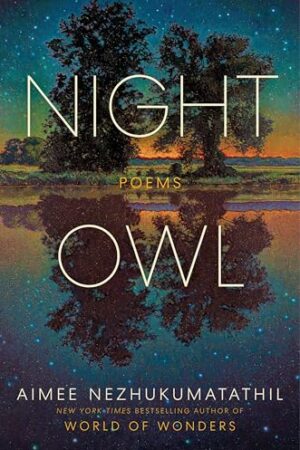
Night Owl
by Aimee Nezhukumatathil
reviewed by Josh A. Brewer
Aimee Nezhukumatathil has long written as if lyric perception were both a mode of attention and an ethic: to notice the world closely is to begin caring for it. In Night Owl, she returns to poetry with a book steeped in darkness—not as negation, but as habitat, atmosphere, and occasion. Night is more than a setting. It is a medium in which intimacy thickens, strangeness becomes legible, and the natural world reveals itself in altered scale. This collection lives in moonlight, shoreline, blood, memory, and the body’s own nocturnal knowledge. What emerges is a poetics of after-hours encounter, where tenderness and ferocity, study and pleasure, often share a line.
That doubleness has always been central to Nezhukumatathil’s work. Her poems teach, but they do not lecture; they transmit knowledge through delight, surprise, and sensuous pressure. Information becomes a form of courtship. Birds sleep “under a giraffe’s dusky armpit.” “Tweeblaarkanniedood” means “a plant / that never dies.” The fact in a Nezhukumatathil poem is rarely inert. It sparks, pivots, uncurls. It enters as datum and leaves as relation.
Night Owl also reminds us that Nezhukumatathil is a poet of appetite—visual, tactile, sonic. Her lines crowd textures upon motions nearly too vivid for paraphrase. The “flip and hook-twist of a spotted / wolf fish gnashing at the line” has the compact violence of documentary footage slowed down and made musical. A speaker finds “a scallop tambourine with dark stars of shark teeth along the wrack,” which captures both the beachcomber’s delight and the sea’s leftover menace. Such images establish a world in which beauty and oddity are inseparable, and in which metaphor often arrives not to soften reality but to sharpen its edges.
The collection’s humor has that same sharpening effect. Nezhukumatathil can play without thinning a poem’s stakes, which are grotesque, comic, or faintly allegorical. A rat in an ATM devours “a million paper rupees. It died after / that spitty wad of bills.” Elsewhere, the weirdness turns intimate. In “When I was a Vampire,” the speaker recalls when she wore those cheap plastic Halloween fangs. She “clicked them open” and “felt a shiver of blood just under my gums.” The poem enacts gender rehearsal, costume memory, bodily thrill, camp performance but never announces them too heavily. It thrusts a shivering image in the mouth. That trust is one of the book’s strengths. Nezhukumatathil lets the image carry thought rather than merely illustrate it.
If Night Owl were only a book of striking lines, it would already be pleasurable. But one of its largest ambitions is formal. My main complaint with Night Owl is that I could never hope to recreate its “concrete” poetry in this book review. The poems’ shapes create meaning. The appendix helpfully defines some of these poems as carmina figurata, poems “that employs shape using the words themselves.” A poem about a cat takes the actual shape of a cat, and a poem called “Punctuation” is a large circle (a period). The poem “Big Night” spirals around a celestial orb. A poem about the periodic table appears in an actual table. “Arches National Park Sunset Haibun” is rendered archly: an aperture opens in the middle of the poem so that the page itself seems to become stone, frame, and view. Graphic design plays the role of a character in the narrative.
Although the book’s main form is the nocturne, it also introduces us to several familiar and obscure forms—abecedarians, ars poetica, epistles, found poetry, haibun, invective, ode, tondo, zuihitsu. A lesser poet might display this range as virtuosity for its own sake. But Nezhukumatathil’s formal variety feels less like a parade of accomplishment than an extension of her curiosity.
That formal openness also helps explain why this may be Nezhukumatathil’s most subtly political book. Its politics emerge through pressure: on the body, on the family, on language, on who is seen as belonging where. “One Vote” discusses her parents’ origins and then bends outward toward eagle feathers, “stronger / than an airplane wing.” The comparison places cultural inheritance, national symbolism, and natural fact into the same field of force.
Elsewhere, the ugliness of surveillance is rendered with characteristic economy. A “nosy neighbor” worries “over ‘The / Hindoo’ … doing yardwork,” and the speaker’s response lands with clipped precision: “I’m Methodist.” The line exposes the bluntness of racialized curiosity and the absurd taxonomies by which others attempt to fix a person in place. The larger architecture of Night Owl, however, resists that kind of fixity; images recur, gathering meaning through repetition. For example, one poem’s motif reruns several poems later: “Bloodflower” ends with a speaker who forgets something about nature and needs to “look it up. The stain of it. The rain of it. / It sloshes inside of me. Inside of you too.” Then, in “To See the Veins,” a gardener cannot identify a leaf and holds “it up to the light to see the veins inside. Like my veins. Like Dustin’s. Like our sons’. And yours and yours too.”
Those two “yours” become you two, too: poet and reader. In these tight turns toward the second person perspective, I picture the poet pointing to an audience member at a poetry reading. You are welcome here with me on this page or stage, she beckons. I answered the call to join her there. Will you too?
Published on August 9, 2026