
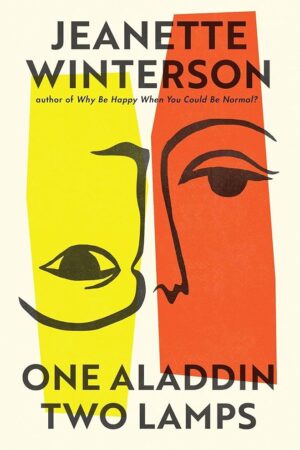
One Aladdin Two Lamps
by Jeanette Winterson
reviewed by Gabrielle Stecher Woodward
In One Thousand and One Nights, Shahrazad famously filibusters for her life. In her latest genre-defying work One Aladdin Two Lamps, so does Jeanette Winterson. But unlike the vizier’s daughter, Winterson isn’t strategically delaying her murder at the hands of a paranoid, insecure serial killer. Her meandering discourse on topics ranging from eugenics and algebra to photography and the politics of seeing, crypto, and the AI revolution reads like an attempt to buy us more time to prevent our collective demise at the hands of the tech bros who long ago sold their souls. At times funny and playful but more often urgent and serious, One Aladdin Two Lamps is a defense of the necessity of storytelling, especially when we are unsure how technological advancements will shape how “we go on telling” the “story of us.”
One Aladdin Two Lamps opens as a sort of biblio-memoir, in that Winterson traces the profound legacy of books—particularly One Thousand and One Nights—on herself as an adoptive child in a working-class family from Manchester. She found the book at the Accrington Public Library, one of the many endowed Carnegie libraries around the world. Winterson, who “felt more like Aladdin than Andrew Carnegie,” initially feels trapped by the building’s moralizing reminder “Industry and Prudence Conquer” displayed in the stained-glass windows. But Carnegie’s library affords Winterson the opportunity to experience both the abridged and complete text of the Arabic folktales for the first time. The library and its holdings became an escape, a site for refuge and for discovering “other ways of being” that existed outside of her strictly Pentecostal household.
Readers anticipating greater detail about the author’s personal experiences may quickly become disenchanted by this text’s kaleidoscopic, fast-paced personal and intellectual digressions that are framed by retellings of Shahrazad’s stories; however, Winterson explicitly invites us to read her previous memoirs when we require greater context for particular periods in her life. In this way, One Aladdin Two Lamps is positioned as the latest installment in the “one long continuous piece of work” that she has said, in an interview with Margaret Reynolds, her previous books make up.
Nevertheless, what makes this latest work memorable is Winterson’s willingness to offer an intimate glimpse , stocked not only with Shahrazad’s tales but with characters, plots, and comforts from worlds as diverse as Henry Fielding’s The History of Tom Jones and Terry Pratchett’s Discworld. This is both a lifelong endeavor of love and a survival mechanism. Indeed, no one could blame her for keeping this beloved cache of stories fiercely guarded, given the circumstances of its conception: “Even if I never saw a book again,” she writes, “no one can take away what I have … This strategy of building a library on the inside started because my mother, Mrs. Winterson, did try to take my books away.”
We are witnessing a moment with a perhaps unexpected convergence of two social forces: the literati who have long bemoaned book banning, and a subset of Gen Z who are starting a public crusade against brain rot by platforming diverse Booktubers and “personal curriculum”—rigorously structured, self-assessed independent study and learning—evangelists. But it is not enough to simply consume well-intended, values-driven bookish content. After all, as Winterson provokes:
No, your TikTok videos won’t bring you meaning, neither will social media’s weapons of mass distraction, that shrink the human mind to its smallest scope … It’s a strategy of discontent, and it makes it harder to settle down with a text that asks for our complete attention. Complete attention on the book might be a bit scary—because the next thing that happens is that you start to pay attention to your own inner life: Have you got one?
Our private libraries—the stories, language, and characters that we commit to memory and read against our lived experiences—require investments of time, attention, and reflection. Their construction and persistence depend on quiet meditation instead of the performativity that underlies attempts to romanticize academic life. Winterson reminds us that what we reap from our reading, what she deems an “intimacy not found elsewhere,” is the antidote not just for our intellectual malaise but for our loneliness.
“Prepare to marvel at my words,” says the Merchant to the Ifrit, a tease that marks the end of Shahrazad’s second night and with it the guarantee of another day and the promise of narrative closure. So, too, do we marvel at Winterson’s. One Aladdin Two Lamps may defy our desires for neat generic classification or for tidy answers to the many major philosophical questions it poses. But its diversions mean that the text feels endlessly excerptable: pull any single paragraph, and you have the makings for a fierce classroom debate or a conversation starter that can make any dinner party roar back to life.
Published on March 24, 2026