
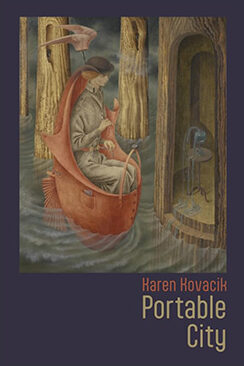
Portable City
by Karen Kovacik
reviewed by Josh A. Brewer
What if every foreign city were a poem, every word a unique language? Karen Kovacik’s Portable City asks such questions in beguiling poetic lineation. Before we map this book’s streets, a quick compass of Kovacik’s métier: she’s best known as a poet–translator who has helped bridge American and Polish letters, serving as Indiana’s Poet Laureate (2012–2013) and teaching at Indiana University—Indianapolis. Her translation of Jacek Dehnel’s Aperture was a finalist for the PEN Award for Poetry in Translation; she co-translated Krystyna Dąbrowska’s Tideline (long listed for the National Translation Award and a Derek Walcott Prize finalist); and she edited the landmark anthology Scattering the Dark: An Anthology of Polish Women Poets. This new collection by turns continues and diverges from her poetry in Metropolis Burning and her translation of Agnieszka Kuciak’s Distant Lands: An Anthology of Poets Who Don’t Exist. I situate Kovacik’s Portable City within a career devoted to crossing borders—linguistic, national, and formal.
Kovacik turns the atlas into a living archive, rendering maps in the vernacular of poetry. In these poems, cities don’t behave like mere backdrops. They act, instead, like interlocutors: stubborn, flirtatious, and withholding; they traffic in memory, testing what we can carry. Formally, the work moves with a transit system’s sly logic. Lines accelerate, brake, and turn; stanzas function like border crossings where meaning must show its passport to icy agents. Kovacik’s wandering eye exacts without being predatory, alert to ethical looking—how quickly tourism becomes appetite, appetite becomes misreading. Her poems negotiate that edge. Kovacik knows what she should say versus what the speaker should evoke, what to leave unglossed, and what to let remain, beautifully, untranslated.
The book structures four movements: “Atlas,” “Alphabets,” “Hours,” and “Ithaka.” The first poem, the titular “Portable City,” unpacks a surreal suitcase that “has its own airport, / planes, and terrorists.” It’s safe to call the collection’s conceit “baggage.” The speaker has either brought with her the cities of France, China, and Mexico, or the poet has brought Indianapolis and Warsaw to them—these two-way streets of baggage persist.
The next section launches an atlas of language itself. The speaker sails from ancient Greece and nineteenth century German sources to find her muse, Zbigniew Herbert, near the border of Poland and Ukraine. She treks via the Persian form of the ghazal into a history, a linguistic genealogy, or a timeline through origins, etymologies, and memory. We travel through Anglo-Saxon kennings, Viking incursions, and the Norman Conquest (before exploring Dr. Johnson’s dictionary and the entire globe with the British Empire). We learn of “crannog-builders” in “Angle-land,” Bede’s Latin, Lindisfarne’s fall, the Norman Conquest. We learn of Chaucer’s Prioress, “jobbernowl,” Noah Webster—each section keyed to a significant date—down to 1913: “From Delhi to Toronto, Johannesburg to Canberra, / Boston to Oahu, the sun didn’t set on English.” The twentieth century blurs by: Gandhi, Doo-wop, “Afrikaans textbooks—linguistic apartheid,” Nuyorican rhymes. By 9/11/01 she’s combined public tragedy, familiar foreignness, and her personal poetic influences: “In pace requiescat. Amen. Shantih shantih shantih. / Heed the fates of Latin and Sanskrit, O my brash English.” In 2025, we find “Karen Kovacik, your odd moniker means ‘pure blacksmith.’ / In the forge of languages, pound these lines into English.”
Despite the globetrotting lexicon here, we don’t get lost in the itinerary. Kovacik recently agreed with an interviewer in the Indianapolis Review that she doesn’t “see the book so much as a travelogue…. I feel like it is my most naked and my most vulnerable book.” Portable City launches candid discussions of sex and death in the final sections with such splendid poems as “Barbarella” and “Elegy for my Sex Life.” Kovacik also explores perimenopause, remnants of her Catholicism, and elegies to a lost husband.
The author has a knack for the tragicomic title: “Reading about Harvey Weinstein in The New Yorker while waiting for trick-or-treaters to show up” or “Death and TurboTax.” When we arrive in the last section, “Ithaka,” this final contrapuntal poem echoes with the resilience found throughout the collection. It rings with endurance and resistance as well, touchstones of Kovacik’s career.
Portable City is a companionable, challenging collection: you close it and find a small, meticulously folded map in your pocket. You unfold it to find it’s your city now—penciled annotations in your own hand.
Published on March 9, 2026