
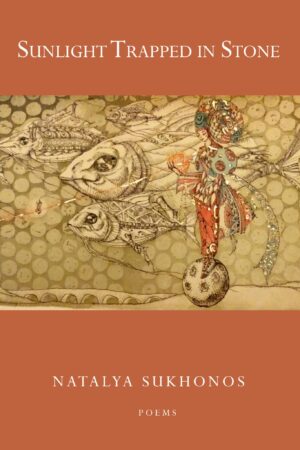
Sunlight Trapped in Stone
by Natalya Sukhonos
reviewed by Cal Freeman
Natalya Sukhonos’ new collection, Sunlight Trapped in Stone, engages themes of personal and collective loss, geographical displacement, and the violent cruelty that has typified much of human history. Sukhonos is a proud Odesan and the tragedies faced by the Ukrainian people—from the Holodomor of the early 1930s to the annexation of Crimea in 2014 and the Russian invasion of 2022—are ever-present in her work. These poems don’t merely map her personal history onto this collective history; they give voice to those living through the brutal present in a series of dramatic monologues based upon oral histories of everyday Ukrainian people.
In poems like “Dreaming Odesa” and “After Bishop,” Sukhonos is a child in Odesa, and we get the sense that leaving the city, leaving Ukraine, was the first real loss Sukhonos experienced. In other words, this was a loss of place. In “After Bishop,” she writes:
… At nine, I lost
………….a country. Books, tickets,
wallets, documents, would slip between
………….unruly fingers.
Sometimes Russian words
………….for things I love—the way night brings
fullness to the trees—would flee like strays
………….in the blue-black of night.
There’s a Lacanian notion that language takes place over a loss, that—in the words of the poet Robert Hass—“a word is elegy to what it signifies.” In “Dreaming Odesa” there is a different anxiety at work; not the fear that language will fail to capture lived experience, but the fear that the poet will lose access to her bank of language. Sukhonos’s conception is that language constitutes presence and inheres with joy and love.
Food and gustatory joy are repeating themes throughout the collection. In “After Bishop,” apricot ice cream makes an appearance alongside pirozhki, a popular street food in Ukraine that Sukhonos associates with her grandfather—“Handsome in his fedora,” he “scavenged old Odesa streets” in search of the best versions of these treats. Sukhonos lost her grandfather, an important connection to the old world, at twenty-one, but when she incants the names of these alimentary treats, we feel his presence. Sukhonos’s construction of her memory palace is Proustian, and her memory preserves a vital version of Odesa that no longer exists.
In the middle section, “Border Crossings,” the narrative arc becomes expansive in a new historical sense. Sukhonos demonstrates her skills not only as a poet, but also as a dramatist as she rescues peoples’ narratives from the deleterious forces of history. Beginning with her own emigration narrative in “Tunnel Vision,” she describes her family’s move to Brooklyn:
Our huge family is a broken kaleidoscope, its pieces off-kilter.
In the evening, my sister and I are startled
by green flashes of light from fireflies
as we idle in the backyard.
Eventually we find jobs, go to school,
go back to borsch.
We’re all intact, but barely.
Food and cooking ground this poet, reminding her of where she’s from. This section turns to Sukhonos’s personal history, but it also engages historical figures alongside lesser-known people who continue to live in the shadow of the current Russian aggression. In “Journey Through Ladoga,” we encounter the oral history of a woman named Maryna from Kyiv. It’s a tragic poem that highlights the banal and brutal repetitions that history enacts as Maryna must journey over Lake Ladoga for the same reasons and same slim hopes that her grandfather did nearly seventy years previously. Another standout poem from this section is “1939, Lights Twinkling on the Water. Margaret Crossing the Atlantic,” which turns to the Canadian radio pioneer Margaret Smolensky, who emigrated to Canada from England during World War II in conjunction with the Children’s Overseas Reception Board. Sukhonos follows Smolensky’s journey to Canada and her career as a broadcaster with a deft narrative ability. She sees something of her own journey in Smolensky’s when she writes, “To offset the sinking feeling / of home as an empty shell, / Margaret fills herself with the new: / licorice, peanut butter, and corn.” Once again, food becomes much more than sustenance.
Sukhonos has lived in many places: Odesa, Brooklyn, and San Francisco. They all show up in her poems, and she treats these treasured cities with vivid understanding. In “Trapped in Amber,” Sukhonos reflects on her time in San Francisco. “In Muir Woods after a long hike, / my father touches a redwood, / leans into it and whispers, It’s alive!” the poem begins. This isn’t the first time the poet’s father appears in the collection, but it is the most flattering rendering of him. The penultimate stanza seems to function both as forgiveness and valediction, a reckoning with familial grief that’s stunning and necessary: “Our hike ended. The sap of the redwood oozed and congealed / like a dirty icicle. My mother is further away from the earth / than the end of thought, and my dad—alone / in a city of gray girded bridges.”
Sukhonos’s writing about intergenerational family life is dynamic and largely unsentimental. What lessons can we take from our own flawed parents? In a world marred by war, climate catastrophe, and displacement, how can we strike the right balance between strength, nurturing, and vulnerability for our own children? In poems like “The Paper Mother” and “Golden Shovel for Nadia—After Mark Strand’s ‘Keeping Things Whole,’” Sukhonos explores these questions without answering them, punctuating her themes of displacement, language, memory, and joy with a poignance that can only be described as cathartic.
Sunlight Trapped in Stone is a truly important book. How often is it that we get to say that?
Published on April 22, 2026