
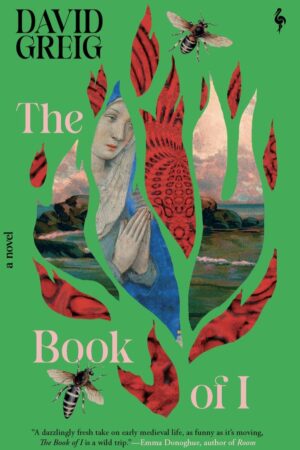
The Book of I
by David Greig
reviewed by Catherine Sawoski
In the first chapter of David Greig’s The Book of I, a band of Vikings—Buttercock, Gore Dog, Puffin Face, Fuck-a-Whale, among others—descend upon a Scottish isle with comic brutality. The villagers are slaughtered in a brief and barbarous raid, and the island’s monks are executed while still praising their merciful god. It should be a tragedy. And yet, buoyed by Greig’s irreverent humor and clean insights, it becomes, somehow, a heartwarming debut.
This romp of an introduction sets the tone for The Book of I, where we follow the raid’s survivors as unlikely allies rebuilding the abandoned isle. Grimur (a left-behind Viking), Brother Martin (the last remaining monk), and Una (a local mead wife) spend long slow days making porridge and discussing Christianity. How will they get along? Will the isle of I ever be the same again? Greig, an established Scottish playwright and first-time novelist, uses the next 150 pages to paint a quiet, thoughtful portrait of life in 825 AD.
Despite its historical quality, the novel is filled with a modern directness; Greig’s observations are sharp and incisive, and his sparse language is assured. “Grimur knew that anything he would ever achieve had been achieved already,” reads the first chapter, granting us immediate access into Grimur’s state of mind. Greig brings an especially easy lyricism to his descriptions, full of simple but carefully chosen words. We hear, for example, the soft “suck” of the tide and see birds that fly in the shape of a “raggedy cross.” These adjectives and verbs, common as they are, feel unique in this context, granting the island a special poignancy even after the Viking attack.
Beyond the first chapter’s raid, however, not much happens as the book takes on a more contemplative, mellow tone. Grimur reevaluates his relationship to Christianity, experimenting with his own version of faith. Brother Martin works on the titular “Book of I,” a biblical manuscript the monks were making before they were killed. A surprising romance between Una and Grimur—between a woman and the man who murdered her husband—springs up, though it doesn’t contain the emotional weight that the fraught relationship would seem to imply. No conflict ever truly invades The Book of I after the Viking attack; the book continues slowly and passively, bracketed by peaceful descriptions of the grass, water, and birds.
This languid feeling is only amplified by the mechanics of Greig’s scenes. Instead of using conventional plot progression, he writes in a series of almost-vignettes, none of which lasts longer than a few pages. There’s a moodiness about this, a kind of perpetual mise-en-scène that adds to the book’s dreamy quality. Greig, a revered playwright, is known for at least one “dream-like” theatrical work, and perhaps this explains the distended air about The Book of I. There are a few pages of rapid-fire conversation that show glimmers of more traditional drama-writing, but otherwise the novel revels more in thoughts and descriptions than dialogue, shining in moments of consciousness that you can’t find in the theater.
Greig’s plays are also full of humor, and this levity, excitingly, comes through in the novel as well, which treats its subject with refreshing absurdity. It feels modern despite its setting, humanizing its historical characters. The Book of I may contain some historical inaccuracies—the term “Viking,” for instance, wouldn’t be used for several hundred more years—and, for some, this may prove enough to break their suspension of disbelief. But I think it adds to Greig’s irreverent tone—we’re not here to get a textbook-factual portrait of medieval life. We’re following a story of connection and humanity; the year is a numbered backdrop.
The Book of I’s titular Christian masterpiece is ultimately not very important. By the time the novel reaches its climactic end, the reader has already realized that the creation of the book is not what the story is really about. What matters is what comes before it—quiet reflections and slow thoughtful moments—and an ending impossible to guess from the opening scene of Fuck-A-Whale slaughtering monks.
Published on March 5, 2026