
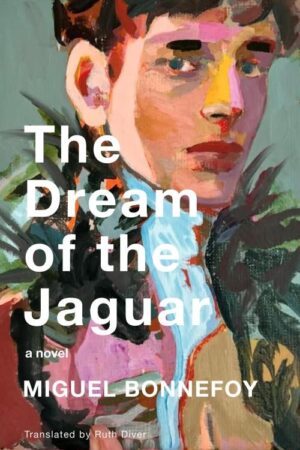
The Dream of the Jaguar
by Miguel Bonnefoy, translated by Ruth Diver
reviewed by Jade Bailey Brock
First published in French in 2024 and translated into English by Ruth Diver, Miguel Bonnefoy’s The Dream of the Jaguar traces Venezuela’s postcolonial upheaval from the oil boom of the 1920s to Chavez’s land reform program of the early 2000s through a magical realist, multigenerational narrative. The historical novel blurs memory, myth, and national narratives by following a Venezuelan family whose personal trajectories unfold alongside the country’s turbulent history. Winner of the prestigious Prix Femina and the Grand Prix du Roman de l’Académie française, The Dream of the Jaguar has earned apt comparisons to Gabriel García Márquez’s One Hundred Years of Solitude, but it would be remiss to overlook Bonnefoy’s singular approach to mapping his maternal ancestry against the rise and fall of a nation.
The novel tracks the Borjas Romero family across four generations, starting from Don Victor Emiro Montero and his orphaned nephew Antonio Borjas Romero (who becomes a celebrated surgeon) before moving through the lineage of Antonio’s descendants, whose ambitions compel them to cross national borders. Some leave Venezuela behind and others eventually find their way back. This includes characters such as Antonio’s son, Pedro Clavel, who goes to Peru and then Chile to participate in revolution; Antonio and Ana María’s daughter Venezuela, who has her sights set on moving to Paris; and Cristóbal, Venezuela’s son, who lives all over Europe and who brings the family’s story full circle in an unexpected final act. As the Borjas Romeros work to better their lives, Bonnefoy shows the costs of political upheaval, the weight of inherited legacies, and the ways history shapes the fates of individuals and the collective.
The Dream of the Jaguar is the second of Bonnefoy’s novels to tell a family saga through the history of a nation. Heritage, which won the 2021 Prix des libraires, draws on the author’s paternal ancestry to chart the lives of a French patriarch and his Franco-Chilean descendants. Both novels belong to the literary tradition of magical realism but diverge in their historical backdrop. While Heritage is set during the First and Second World Wars, Allende’s socialist rule, and Pinochet’s brutal dictatorship, The Dream of the Jaguar transports us to a nation where those who once lived beyond the clutch of colonization—“children who spoke with the dead and women who transformed themselves into salamanders”—are now slipped under the spell of autocrats and oil:
And since the rains were torrential and the palm-frond roofs needed to be protected, people bought old advertising billboards for Chevrolet, stolen at night along the highways, so that all the cladding of the shacks in the shantytowns, where people who could not drive slept, carried the words: “No happiness without Chevrolet.”
The novel’s structure hinges on its multigenerational layering. Over the course of Antonio and Ana María’s illustrious careers, they build a rural hospital to serve the poor, jeopardize their professions supporting women’s reproductive rights, organize a rebellion against President Marcos Pérez Jiménez’s dictatorship, and found a university that will later cement Antonio’s standing as a national hero. But as the story progresses, we see their children, Pedro Clavel and Venezuela, grappling with the egotistical aspirations and “ready-made dream” that their parents impose on them. How quickly one generation’s boon becomes its progeny’s burden.
Many of the Borjas Romeros circle around selves that are at odds with the futures their forebears envisioned for them. The height of these generational ruptures comes with Venezuela’s son, Cristóbal, whose decision to write a novel gives the lives of his forebears new meaning. Spanning from the seafaring adventures of Cristóbal’s great-grandfather, Élias, to Cristóbal’s own journeying back to his family’s homeland, Cristóbal’s novel memorializes the diasporic—but ultimately unified—Borjas Romeros family saga. In this way, Bonnefoy’s narrative enacts a kind of Jungian idea of personal evolution, in which the self does not develop by moving from A to B, but by spiralling inward toward an unrealized core. For The Dream of the Jaguar, this ouroboros-like process is both individual and familial. The novel’s last generation consumes and reorders the past, allowing the story to fold back upon itself while casting new light on what came before.
Yet for all its narrative ambition, the novel falters with its characters. Though the achievements of the Borjas Romeros are remarkable, The Dream of the Jaguar is replete with passages trumpeting everything from their good deeds and tastes to their extraordinary talents and determination, which may leave readers feeling as though they’re following static ideals instead of fully rendered human beings. Further, moments of interiority are often so choked with detail that Bonnefoy’s meaning gets lost in the lush prose. Antonio’s budding love for Ana María, for instance, is likened to his feelings for Leona, an enigmatic sex worker he knew from his days as a servant in a brothel. Yet when we flip back to that scene, we’re reminded that Antonio’s feelings for Leona hinge solely on her mystique and the pleasures she gives him by tying him to a bedstead: “he never forgot that exquisite pleasure, that astonishing fervor, and when he later thought back to that morning, all that he could recall was an intense memory of ships loaded with centaurs and cinnamon.” If only this profuse description told us something more about either of the psyches it tries to capture.
Despite its shortcomings, The Dream of the Jaguar vividly portrays the political realities of Venezuela, from its “influx of industrialists, entrepreneurs, bankers, engineers, and even movie stars, who drove around in cars that were like palaces on wheels” to its “insecurity and shortages, the beginnings of a massive exile, the unstoppable inflation.” This tumultuous postcolonial history both determines and is shaped by the novel’s multigenerational arc, asking us to consider how our individual actions ripple through circles wider than our own mere lives. True to its recursive structure, the story shows that neither selves nor collectives evolve without first confronting and transforming what they inherit.
Published on February 27, 2026