
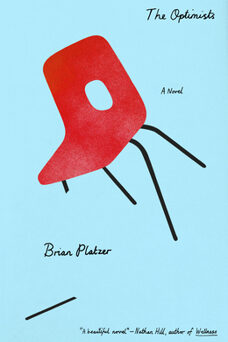
The Optimists
by Brian Platzer
reviewed by Collin Mitchell
A ready appeal of the so-called campus novel is the enduring fact that almost anyone reading the story at hand has attended school. It’s a world—unlike wartime Europe, wealthy beach enclaves, adult movie production, etc.—that requires little explanation. Moreover, school is insular, a rare place outside of the home where adults and children are obligated to cross paths. The Optimists, the exuberant new novel by Brian Platzer, draws on these hallmarks of the campus novel to create a tale about an ambitious teacher whose life is catastrophically remade by a talented young student and the adult she eventually becomes. The novel is, despite the ups and downs of campus life, and of life itself, justly optimistic.
Written in the first person over several decades, The Optimists is assuredly narrated by Rod Keating, a middle-aged private-school teacher who, while extrapolating on teaching, comedic theory, and romantic relationships, focuses his attention on Clara Hightower, an exceptionally bright pupil who serves as both foil and complement to Rod’s otherwise structured way of life. The novel’s events begin in 1988 in a Manhattan apartment at the sixth birthday party of Jacob Smeal, whose mother, Enid, is dating Rod at the time. It’s during the cake cutting that Rod notices five-year-old Clara pocketing several of Enid’s prized crystal figurines. He says nothing to Enid, noting that “something about the girl’s manner made me keep silent about the theft.” Soon after, Richard “Richy” Kingsley Madison IV, the vivacious headmaster of St. George’s, where Rod and Enid both teach, unhelpfully brings Jacob a puppy as a birthday present. While Enid mulls over the impossibility of raising the pup, Clara volunteers to take the dog as her own pet, assuring the grateful adults that her parents won’t care: “I’ll take care of the dog. The dog can take care of them.” Rod’s curiosity about Clara takes hold, as her otherwise odd plan for the dog belies what he calls her “unusual seriousness or calm.”
This early demonstration of Clara’s propensity to solve other people’s problems produces a soft spot in Rod, appealing to his interest in all things exceptional. He’s humored by her, and he continues to be over the years he knows her. “Her affection for the dog” and “her ability to find a solution” are winsome qualities for a dedicated teacher like Rod Keating. So, when Enid catches Clara with the stolen tchotchkes, Rod covers for her. “I lied,” Rod writes, because he didn’t want to see the girl get yelled at, adding, “it was clear she was different.” In other words, Rod has found himself a project.
These moments of moral obligation (later, Rob watches Clara destroy a classmate’s phone, and much later, do worse) are the novel’s galvanizing force, compelling Rod to assess his own abilities to actually do something about injustice in the real world. However, Rod’s reflections are not strenuous exercises in self-criticism but rather opportunities for him to enjoy the process of reaffirming his place in the world. Rod rightly looks back at his behavior at the birthday party with trepidation, observing that, in all, he was a “fumbling, nonparental adult teller of jokes,” and yet he moves on, unabated. Years later, even Clara will have her own version of the figurine incident, one that logically justifies her actions, confirming that both she and Rod strive to insulate themselves from being wrong.
To this end, Rod’s ego gets the best of him, largely exhibited by the mythical “Ember Exam,” a set of questions of his own design where “test and person met and proved each other.” In truth, it’s an IQ test to pick favorites. “I knew it was silly,” Rod says of the exam, while continuing to abide by its veracity. Unsurprisingly, Clara, the first to reach the “Archon” level (the highest tier of Rod’s fabricated hierarchy), is also the first to call Rod out on his BS as a teacher—ironic given that Clara, he later admits, was the student “who made that calling most worthwhile.” Clara’s rejection of the Ember Exam puts Rod in his place, although Platzer is careful not to make Rod too aware of himself to completely change. Years later, Clara will reach out to Rod for help with a radical animal rights campaign, confirming his belief that she was a prized student whose talents were meant to be cultivated. It also confirms their unlikely and often rocky friendship. Like Clara, Rod is self-assured, but he often makes great mental effort to protect himself from criticism. Despite Clara’s flexibility with morality, we’re grateful to see her call him out. After all, this is a guy who by “explaining jokes ruined them,” thinking: “Telling people why things are funny can be funny too.”
It’s Platzer’s real-world experience in teaching that gives his characters and their dealings so much lift and fun insight. However, at times Rod’s enthusiasm for teaching feels forced and overly aspirational, while Clara and the other children are often too able to speak and think like adults, making for convenient scenes of honest reflection that feel more like the way we wish teenagers would behave rather than how they actually do. But overall, Platzer handily portrays the pains of growing up and the joy of being the adult who bears witness to that. In the end, The Optimists elucidates the inherent delight inside the strange and radiant relationship between teachers and students, confidently weaving a tale that is true to its name.
Published on June 8, 2026