
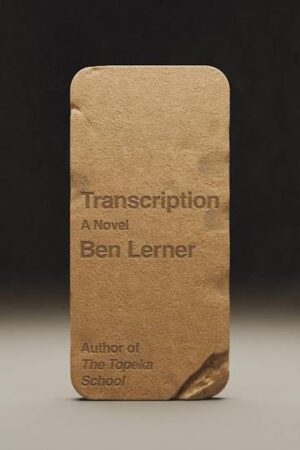
Transcription
by Ben Lerner
reviewed by Sarah Moorhouse
The German painter Gerhard Richter once said, “I don’t mistrust reality, of which I know next to nothing. I mistrust the picture of reality conveyed to us by our senses, which is imperfect and circumscribed.” I suspect that he and Ben Lerner would find a lot to talk about. The narrator of Transcription, Lerner’s latest novel, is also mistrustful of his senses. We encounter the nameless protagonist (who, as in the author’s previous books, functions as a stand-in for Lerner himself) as he travels by train to Providence, Rhode Island, to interview his mentor, Thomas. On arrival he drops his phone in the hotel sink. Having broken his intended recording device and unable to admit what has happened to Thomas, he conducts the interview knowing that he can only retain a circumscribed version of what the aged professor is saying. He notices a painting in Thomas’s house with “a mixture of verisimilitude and blur that recalled Gerhard Richter:” it seems fitting.
Like Richter, Lerner is interested in the territory between truth and fiction, between reality and its approximation. In Transcription, the word “fiction” does not simply refer to an invented story; it is the condition of our experience of the world. The narrator describes fiction as a “hinge in my looking …. ‘I could will myself,'” he says, “‘to see the rose and pink of a sunset as applied in touches or stains and then revert to seeing it as natural.’” Our senses transcribe reality imperfectly; art, then, exists at a further remove. It is, to paraphrase Plato’s Theory of Forms, a copy of a copy.
The narrator’s anxiety about his inability to accurately record his interview with Thomas is, therefore, a heightening of an existential problem: given our imperfect means of perceiving the world around us, what can we lay claim to as being true? This is one of Lerner’s central preoccupations. He began his writing career as a poet and is best known as the author of three exceptional works of autofiction: 10:04, The Topeka School, and Leaving the Atocha Station. In these novels, which form a trilogy of sorts, he deliberately blurs the line between his own life and imagined scenarios. Their central character, Adam Gordon, is a writer and, like the author, the child of psychoanalyst parents. In Transcription, though, Lerner seems much less interested in developing a protracted plotline. He still elides some fictional and real events: Thomas, for instance, is based at Brown University, where Lerner studied and became a devotee of the writer and professor Keith Waldrop, whom Thomas resembles.
Mostly, though, the book serves as an opportunity for Lerner to demonstrate how any attempt at representing sensory experience involves a kind of fictionalizing. This makes the book a philosophical novel, but it’s one that feels relevant, urgent even, because Lerner addresses how screens have only widened the gap between us and what we call “reality.” If we experience the world through our screens—like when we look at an object through the viewfinder on an iPhone camera—then art becomes a copy of a copy of a copy.
Lerner’s narrator relies on his device for its mediating, or perhaps diluting, effect. He reflects, “I checked my phone whenever a transition presented itself, whenever I left one space for another, or changed from a standing to a sitting position (or vice versa), or started or stopped walking.” Here, Lerner manages to pin down something that few writers have done convincingly: how our phones have altered the nature of our movements through the world. He goes on to capture how screens have infiltrated the contours of life; they have come to punctuate our days so that without them we, as the narrator laments, end up “glitching, craving [our] cellular phone[s] on a cellular level.”
Lerner makes us newly aware of the gulf not only between reality and our sensory experience of it, but between the real world and the world as we experience it through the phones that accompany our every move. The accident with the narrator’s phone is elevated to the status of a pivotal narrative event because the device is for him a kind of scaffolding: it enables him to “not fully … be where I was; since at least 2008, to be where I was was too much for me, or too little.” We rely on technology, Lerner suggests, to transcribe the world for us into a digestible form, to contain it and make it manageable.
We see the implications of this for a younger generation in the final part of the novel, when we meet Thomas’s young granddaughter. She is suffering from what the doctors diagnose, in an “epistemological sleight of hand,” as ARFID, an eating disorder that limits food intake. She begins to get better only when her parents allow her to watch videos on an iPad while eating. It’s as if ingesting food, one of our basic needs, has become too intense, too real. Life without the phone is overwhelming: “the landscape [is] made strange, the stones stonier.”
Technology, Lerner argues, has altered our experience of our environment and each other in profound ways, but not straightforwardly negative ones. Toward the end of the novel, Thomas’s son Max recalls conducting what he thought would be his final conversation with his father on Zoom, when the latter was gravely ill in the hospital with Covid. (Thomas subsequently recovers, leading to an awkward coda between father and son.) The internet connection failed, so Max ended up conducting this “exit interview,” as he puts it, through a phone held by a nurse to his father’s ear. The distance enabled him to speak his mind fully: “things I never would have said if his image or his body were before me, or if anyone could see my face; I could only say them as a disembodied voice.” The device functions here as a kind of transistor, not so much transcribing as neutralizing an otherwise impossible interaction. T. S. Eliot once wrote that “humankind cannot bear very much reality.” In the age of screens, we can take less and less of it.
Published on August 26, 2026