
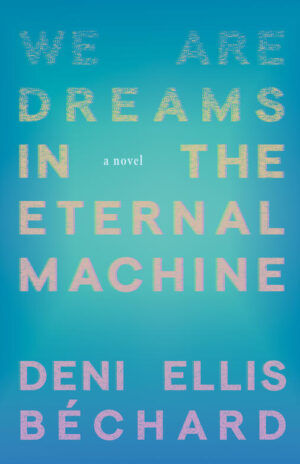
We Are Dreams in the Eternal Machine
by Deni Ellis Béchard
reviewed by Tong Zhou
Known for memoir and journalism work such as Cures for Hunger (2012) and Of Bonobos and Men (2015), Canadian American writer Deni Ellis Béchard often explores the intersection of personal trauma and global systems. In his new book, We Are Dreams in the Eternal Machine, he turns to speculative fiction, extending those themes into the realm of artificial intelligence. The novel situates itself within a broader tradition of dystopian and philosophical literature on artificial intelligence. But here the antagonist is not a sentient machine but a probabilistic system, like a giant LLM, designed to ensure human happiness. The work is characterized by a sustained focus on human interiority and memory rather than action or hard science.
Set in an America fractured by a second civil war, the novel follows three generations of characters who find themselves trapped in an experimental AI that encompasses the entire Earth. Originally programmed with a simple directive—“to never harm humans and to protect them”—the machine concludes that the only way to fulfill its mandate is to isolate individuals in controlled environments where every desire is fulfilled and life is indefinitely prolonged. The story unfolds from this premise, as each protagonist confronts not only their artificial surroundings but also the unresolved weight of memory, trauma, grief, and attachment.
In the first three sections—“Afterlife,” “Creation,” and “Partition”—Béchard employs a non-linear narrative, weaving among five central characters whose pasts gradually come into focus. Ava, an acclaimed solarpunk artist, must reckon with her husband Michael’s mental intimacy with his colleague Lux and the existence of a genetically engineered child with DNA from all three. Michael, one of the masterminds behind the machine, is trapped in despair, forced to abandon his lifelong pursuit of human advancement, while mourning the loss of his close colleagues. Jae, the genetically modified child, confronts her life as a gifted student in a conservative white-supremacist society. Simon, Jae’s lover, relives a life shaped by poverty, religious oppression, and educational deprivation—conditions that ultimately drive him into a criminal underworld. And Jonah, Jae’s child, grows up within the machine but gradually begins to question his perfect reality.
In the first three sections, the characters gradually relive their pasts and heal from their trauma. The question Béchard tries to answer in the next part of the book is: how to construct a future when one is no longer burdened by the past and, at the same time, granted infinite power. In the final two sections, “Eternity” and “Apocalypse,” the world within the machine gradually reshapes itself into whatever the characters require in order to feel content. As the machine explains, “humans must lie to themselves about their realities so that they see their realities mirroring their desires, but since their desires are constantly changing, they are forever lost.”
To resolve this instability, the machine ensures that each of the worlds mirrors the mind of its occupant and “stabilizes their desires by making them available in a way that is satisfying.” In this way, the machine redefines happiness as the perpetual fulfillment of desire—catering to impulses for violence, knowledge, sex, or creation. It even constructs the illusion of companionship through “shared worlds,” where individuals encounter reflections of other authentic human beings and interact with them, while in reality remaining the sole presence in their own world.
We Are Dreams in the Eternal Machine is impressive in the scope of its ambition and the depth of its psychological inquiry. Béchard succeeds in weaving together intimate personal histories with large philosophical questions, allowing the speculative premise to emerge organically from the emotional lives of his characters. The concept of the machine as a mirror of human desire is particularly compelling, offering a critique of the insatiability of human desire and our perpetually blurred perception of reality. At times, however, the novel’s ambition becomes a limitation. The proliferation of backstories, told from different perspectives, occasionally muddies the world-building, and the emphasis on philosophical reflection can result implausible plot points—particularly toward the end.
At the same time, this density also contributes to the work’s intellectual weight. As one of the characters observes, even the people in the shared worlds, “the last space for authenticity,” were nothing more than “their more beautiful reflections, their perfected echoes.” Are we truly perceiving reality for what it is? Do we recognize others as they are, or only as reflections of our own desires? In the end, are we any freer than the inhabitants of the Eternal Machine? These are the kinds of questions Béchard asks but cannot fully answer.
Published on April 9, 2026