
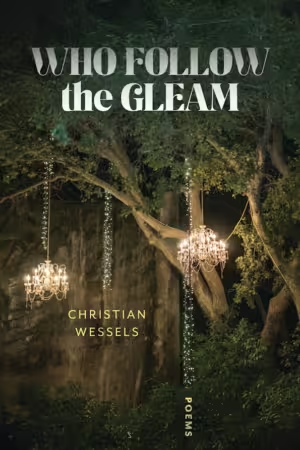
Who Follow the Gleam
by Christian Wessels
reviewed by Benjamin Paul
Two scenes of sorcery animate Christian Wessels’s debut collection Who Follow the Gleam. The first is Alfred Tennyson’s vision of a dying Merlin passing on his art in “Merlin and the Gleam,” the poem from which the book takes its title. The second is from the 1942 supernatural rom-com I Married a Witch, whose leading lady (played by Veronica Lake) is a disembodied spirit who returns to flesh and blood in an enchanted hotel fire. The pairing illustrates Wessels’s trickster blend of medieval and contemporary mythology, and it provides a shared metaphor through which he approaches poetic voice. Merlin’s craft and Lake’s spirit must conjure the bodies through which they work their power, and Wessels builds the magic of his poems through their need to perform a similar ritual.
This is dramatized in the collection’s long opening poem, “Sympathetic Magic from the Black Forest.” The poem begins in an oracular mode:
Because every green cloud has a season,
every untouched pool, a spell
for the untouched season; because every
season has a green spell, untouched
by daylight; because the time for love
and the time for violence overlap
in the green night …
This is poetry as incantation, poetry that sounds far better than most contemporary poetry allows itself to. And it is through this timeless voice and its primeval scene that a more recognizable poet-figure takes bodily form, as the nesting clauses suddenly snag in the figure of an out-of-breath jogger:
because I engrave this magic onto
a stump, the ramblings of a dead tree,
in the middle of a long run
and need an excuse to stop, I need
an excuse to stop; I wheeze and out comes
death, I wheeze and into the air
an imitation of myself takes shape …
Sympathetic magic is magic rooted in likeness, and this is how Wessels imagines the poem’s speaking I. That figure becomes an effigy who might at times (we imagine) resemble Wessels, but whom the reader is asked to inhabit in turn: “When I speak / your mouth moves.” Passed openly between reader and poet, Wessels’s voice moves thrillingly between the private and collective registers, each shift inviting the reader to perform a different spell. The Black Forest of the opening poem is both the “green night” of primeval nature and a region in Germany, in which the poet stand-in studies family lore and visits tourist traps with his young daughter. Yet Wessels refuses any stable boundary between the universal and the particular. Instead, the collection’s everyday moments invite us to witness the act of breathing them precariously into life, knowing that they will fade.
The characteristic form of Who Follow the Gleam is the multi-segmented long poem, one of which anchors the transitions between each of the book’s four sections. This is a rarely mastered form (two poems nod to the influential precursor of W. B. Yeats’s The Tower), yet it proves a natural fit for the multiple registers that Wessels holds side by side. After the first section’s conjuring of a poetic voice, the second section concludes with an unofficial ars poetica. “Little Ice Age” responds to W. H. Auden’s famous line in his elegy for William Butler Yeats: “For poetry makes nothing happen.” Those words have too often been taken out of context as a thesis on political art, to be cosigned or refuted. Wessels responds to the idea in its full poetic resonance by reframing it as a positive claim. “Say nothing is a verb,” begins “Little Ice Age”:
When I nothing, this bright counterpoint
resembles a body.
When I nothing, the archaic tunic does not represent
but transforms desire.
When I nothing again, a belligerent chorus narrates the war.
This is the kind of magic that Who Follow the Gleam aims at. We marvel when Wessels’s bright counterpoint resembles a body, but—just as impressively—we also learn how to receive its blend of voices when it no longer does. The art of resemblance is inexact, and Wessels prefers to catch it wavering: “There are no categories, // just proximities,” is the counter presented by “Little Ice Age” to the idea that a poem must be about something. And at the places where categories fail, we begin to see the enchantment that allows language to transform our past and our desires.
If language’s sympathetic magic finds its most spectacular expression in poetry, it finds its most indisputable power in the act of raising a child. The tender obverse of Who Follow the Gleam ’s incantations are its recurring scenes of fatherhood and childhood, which capture moments in which the world is shaped and received through language. The book’s final section begins with a long poem, “Frog Lessons for Lola,” which gathers these moments, tracing the transfiguration of a young girl’s experience into spoken and unspoken knowledge. The first lesson begins playfully:
……………………………………………… Frogs begin their lives as
tadpoles, Lola, you’ve watched them swim with strange tails.
You will not grow a tail. You will one day transform into other Lolas:
one will swim without inflatables, another will learn to spot weather
symptomatic of violent tides and avoid swimming.
The poem then ominously shifts to the story of a teenage boy who was found dead on the nearby dunes, having failed perhaps to practice this or some other necessary skill. How does this boy’s spirit live on, and in what—and whose—words? “Like // that story language circulates the village only partly in memoriam,” the poem continues:
Publicly, the boy turns into a lesson: Don’t be like him. Do everything
you can to never be like him says nobody. Nobody repeats
themself again. Nobody says Describe to me what you’ve learned.
The lesson that the poem arrives at isn’t to avoid being like the dead boy, but rather that these kinds of unspoken stories and commands are in constant circulation. “Nobody” is the speaker of public language just as “nothing” is its action, and Wessels crafts his poetry to make both visible. This affirmation through negation is the collection’s signature move, and it is how Wessels achieves the wavering effect between knowledge and ignorance, presence and absence, the public and the private. His speakers emerge to deny that they were ever there, and they lie to prove themselves capable of truth. The effect is that of a magician pulling back the curtain—except, of course, that nobody is behind it, and nothing keeps on happening.
Published on May 21, 2026