
Brooklyn the Unknowable
by Phillip Lopate
I sing of Brooklyn, the fruited plain, cradle of literary genius and standup comedy, awash in history, relics from Indian mounds, Dutch farms, Revolutionary War battles, breweries and baseball. In Brooklyn, miles of glorious townhouses and brownstones, among the most architecturally effective residential neighborhoods in urban America, coexist not far from dismal slums with some of the highest infant mortality rates in the country. Brooklyn is home to millions of immigrants, many of whom never learn to speak proper English, so surrounded are they by Brooklynese, a curious hardy dialect. Brooklyn is my hometown.
There must be some mercury in the water that promotes a need to recount, show off, or intimidate. Brooklyn breeds writers, performers, and gangsters as effortlessly as Detroit turns out convertibles, coupes, hatchbacks. Malamud and Mailer, Stanwyck and Streisand, Woody Allen and Mel Brooks, the Miller Boys (Henry and Arthur), Al Capone and the Amboy Dukes, Red Auerbach and Spike Lee, all came up in the encouraging yet fanatically competitive atmosphere of Brooklyn schoolyards. Even more numerous are the illustrious who, though born elsewhere, took to the hospitality of Kings County: Marianne Moore, Walker Evans, Hart Crane, Richard Wright, Truman Capote, Gypsy Rose Lee, Carson McCullers, Thomas Wolfe . . .
Brooklyn is vast and unassimilable. Like the Great Wall of China, it mocks our hankering for finitude. For all its braggadocio, the place is so diffident and secretive that even a homeboy like me is hard pressed to characterize it. When you’ve said that it is the most populous borough in New York City, that some 2,300,000 people live here on eighty-one square miles, you haven’t begun to describe it. When you note that it’s a patchwork of neighborhoods on the southwestern tip of Long Island, and zero in on Crown Heights, Fort Greene, Williamsburg, Bensonhurst, Bay Ridge, Dyker Heights, you’re a little closer to the essence of Brooklyn, though not much. A friendly place (I knew more about the people on my block a few weeks after returning to Brooklyn than I had about the occupants in the next building after ten years on a Manhattan street), it can also exhibit a fortress mentality. How to explain the contradiction that Brooklynites can be so inviting to newcomers within the neighborhood enclave, yet so xenophobic and murderously guarded toward strangers from ten blocks away? Recall the sad episode of Yusuf Hawkins, a black youth killed for straying into the wrong white neighborhood while trying to buy a car. The novelist Pete Hamill recalled this Brooklyn territoriality in an interview:
Where I grew up there were hamlets that were sometimes two blocks wide in which everybody knew everybody . . . But they didn’t know people from the hamlet nine blocks away. Often they fought each other. All these fights that street gangs would have over turf, or girlfriends—they acted as if the people from 18th Street were totally different from the people from 9th Street.
If, as the pop song goes, there is a “New York state of mind,” what might be the Brooklyn equivalent? I would characterize it as combative, wry, and resilient. From General Washington’s strategic retreat over the East River to the present, it often consists in making a virtue of setbacks. Brooklyn Dodger fans were famous for their fortitude and their obstinate slogan: “Wait till next year.” It is no accident that when the Dodgers finally won a World Series, they quit the borough almost immediately for the sunnier climes of Los Angeles. The Brooklyn mentality is not that of a winner, but a stoic. Brooklyn likes a beautiful loser.
Perhaps the defining loss was municipal identity. In 1898, when Brooklyn was the third-largest metropolis in the United States, it amalgamated with spindly Manhattan and three other boroughs, Queens, Staten Island, and the Bronx, to form modern New York City. In amalgamating with Brooklyn, Manhattan became the python that swallowed the elephant. I am not one of those who rue consolidation; I rejoice that Brooklyn feeds the greater whole. But there are those who still speak of Brooklyn as its own city. Perhaps they have in mind a symbolic rivalry along the lines of Minneapolis and St. Paul. I am a realist, I consider it a borough. But what a borough! I will go so far as to say that the spicy character of Brooklyn derives in large part from its “co-dependent relationship” with Manhattan. Having relinquished its municipal birthright, it haunts Manhattan Island like a doppelgänger. Manhattan is the tower, Brooklyn the garden; Manhattan is Faustian will, Brooklyn, domestic life. Manhattan preens, disseminates opinion; Brooklyn is Uncle Vanya schlepping in the background to support his flamboyant relative.
For over a century, millions of men and women commuted every day to make their living in Manhattan, my father and mother among them. They spent their vital essence as clerks in the garment center, riding the subway into Times Square every weekday morning, coming back at night with the New York Post (then a liberal tabloid) in my father’s arms, relinquished to my brother and me for the sports pages. Before the Post it was the Brooklyn Eagle, a well-written local paper but lacking, as we say, an edge.
Brooklyn spirit remains a mixture of pride and provincialism. That its citizens have much to be proud of is an indisputable fact. But what’s odd, for such a world-renowned place, is the rinky-dink sound of its boosterism, the narrow perspective of its free newspapers, which reprint the police dockets and church bingo schedules like a small town gazette, the defensive character of its Borough President’s horn-tooting. Brooklyn’s provincialism, be it said, is not, or not entirely, a failure to achieve cosmopolitan worldliness; it is also a painstaking, willed achievement. It’s not easy to be situated next to the most au courant place on the planet and hold onto one’s rough edges.
*
Though Tiresias’s passage between genders has always struck me as exhausting, I seem to have conducted my life so as to crisscross the identity border between Manhattanite and Brooklynite. I grew up in Brooklyn, my family having resided just above the poverty line in the ghettoes of Williamsburg and Fort Greene/Bedford Stuyvesant, before clawing their way up the lower-middle-class ladder to Flatbush. When I went off to college in Manhattan, I vowed never to look back. Manhattan was the City, the Party, Heaven and Hell. When out-of-state friends (who didn’t know any better) settled in Brooklyn, championing its civility and lowkey grace, I took in the fact that they had more space and prettier apartments, but I did not envy them. For me, the borough carried a stigma. Brooklyn was the primeval ooze out of which I had crawled in order to make something of myself, and a move back would be a relapse, a defeat, a regression to childhood and family entrapment.
The rest of my family, including my parents curiously enough, followed me in time to Manhattan, except for my youngest sister, who chose to live on Cheever Place, a cul-de-sac in the backwaters of Cobble Hill. Each time I took the F train to visit, I pitied her for still living in Brooklyn. The wheel turns: I now live seven blocks from her old address. Just as I had expressed unconscious resistance to trekking to Brooklyn by never memorizing the directions there, asking her anew each time, so now my Manhattan friends toy the same way with me. It is as if they secretly hope to erode my patience with directional amnesia, until, in the midst of repeating these tedious instructions, I will break down and say, “Oh all right, let’s meet in the City.” (So Brooklynites call Manhattan, in spite of the fact that we are just as much a part of New York, technically speaking.)
On the face of it, the barrier between the two boroughs should not be so great: after all, it is quicker to hop from Wall Street across the river to Brooklyn Heights than to traverse the island all the way to northernmost Manhattan. Yet I have known many people who lived in Manhattan for years and never set foot in Brooklyn. I remember once asking a highly cultivated elderly couple if they might want to join me and my wife for a baroque opera at the Brooklyn Academy of Music (or BAM) only to be told, “My husband and I don’t go to Brooklyn.” These were people who had traveled all over the world and lived in Europe. Even the more intrepid downtown Manhattan types who, in the 1980s, started going to BAM for its avant-garde performances, would often travel in packs, emerging from the subway with a look of suppressed terror, clinging to their chums like roped mountaineers until they had reached the safety of the Brooklyn Academy.
As it happens, the area around BAM is rather choppy and unprepossessing, usually under construction or partly boarded up, a classic transitional zone caught between commercial, residential, and traffic conduit. I do not blame Manhattanites for being afraid to venture left or right into unknown streets. But there is more to their hesitation than fear of muggers. There is also profound confusion at the vagueness of Brooklyn’s urban design. They have moved from the clear, insular certitude of the Manhattan grid to the vaster landmass of Brooklyn, which is more like the continental United States in its potential for inspiring agoraphobia. Manhattan’s grid is like a tall menu offering a hierarchical suite of neighborhoods: the merest change in signage, street lighting, or fenestration signals to the trained local a world of information about income and class. Brooklyn is no less class-bound, but its cues may be harder to read, especially for the Manhattanite, so used to precisely calibrated progressions of luxury and distress.
Then, too, the arrival in Brooklyn brings with it a drop in sophistication and tension (Manhattanites often equate the two) that registers immediately in the body. I have experienced it myself as a kind of decompression: a weight lifting from my shoulders. The low-rise streetscape, compared to Manhattan, is like going from a tense verticality to a semiprone position. This unstiffening is eventually recognized as one of the delights of living in Brooklyn, but for the casual day-tripper it can be alarming, like the woozy onset of a tranquilizer. The Manhattanite has learned to convert wariness into a muscle, which twitches unhappily when not stimulated; the Brooklynite has adapted to greater quantities of boredom and is consequently less afraid of it. Everything on the Brooklyn side of the bridge is more casual, you see fewer fashion statements, the passersby seem like ordinary people rather than outof- work actors projecting a cameo-worthy intensity. Even the slackers in Brooklyn have less of an air of ideological anti-ambition than Manhattan dropouts. The furniture in a Brooklyn coffeehouse looks like throwaways from your aunt’s living room. There is, in short, a touch of the amateur, the voluntaristic, the homemade about the place.
I remember when my wife became pregnant and we began looking for larger living space than our one-bedroom fifth-floor walkup in the West Village. I was determined not to leave Manhattan but we looked uptown and down and grew fed up with the overpriced, jerry-built crawl-spaces pretending to be duplexes, or the penitential apartments darker than a jail cell. I had somehow forgotten to save several million dollars to purchase a brownstone in the Village, so we began, reluctantly, to consider buying a house in Brooklyn. On our second day of looking in that borough, we fell in love with a Carroll Gardens brownstone and made an offer, which was accepted. That night, we had second thoughts, stealing peeks up and down a near-deserted Court Street on a Saturday night. There was an emptiness in my stomach—the gut of a Manhattanite attuned to urban excitement. Were the quiet streets an omen of our soon-to-be dulled existence? Were we about to make a huge mistake? Fifteen years later, we have more than adjusted, while the surrounding neighborhood has accommodated us by growing livelier and hipper. We love our house, we love our block, and we love the borough of Brooklyn. Perhaps, like the pod people in Invasion of the Body Snatchers, we have simply been taken over by some Gowanus legume that insidiously makes us accept a blander life.
All I know is that, when I go into Manhattan, which I do on the average of three times a week, I enjoy the City but I do not miss living there. Not at all. Yet I realize I may never be whole: I have been both Manhattanite and Brooklynite, I have identified with the imperial contempt of the former and the complacent inferiority complex of the latter, I have sampled the champagne and the Ovaltine and will forever be split.
*
Not so much when world-weary as when feeling chipper, I sometimes saunter over from my house to the Union Street Bridge to take in the restorative waters of the much-maligned Gowanus Canal. To do so, I first go past the modest brick three-story homes of Union Street, with their stoops, stone angel fountains, patriotic American flags, and an occasional Italian tricolor—this being a longstanding Italian neighborhood, where immigrant stevedores labored to raise a roof over their families’ heads, with a renter downstairs. These are not the fancy brownstones selling for several million, but awkward, cozy row-houses, whose lack of cachet increases as you approach the canal.
No one of class ever wanted to live near the Gowanus, legendary for its stink and for the mobsters’ bodies fished out of the canal. The old Gowanus creek had been enlarged in the 1840s to service nearby factories and move construction materials for the burgeoning habitations of Brooklyn, and this dinky little canal, one hundred feet wide and less than a mile long, no deeper than fifteen feet in high water, became one of the most trafficked watercourses of nineteenthcentury America. In the twentieth century, it devolved into a one-use channel—a conveyer of heating oil, whose toxic leakage into the creek bottom and the nearby shores complicated any future development for recreational or residential uses. The daunting cleanup costs have not prevented local community planners from fantasizing the lowly Gowanus’s becoming a Little Venice, with outdoor cafés hugging the narrow banks. (Inshallah, it will never happen.) The tides being too sluggish to rid the channel of pollutants, a flushing tunnel has been installed, whose pumping action goes a long way toward alleviating the olfactory insult.
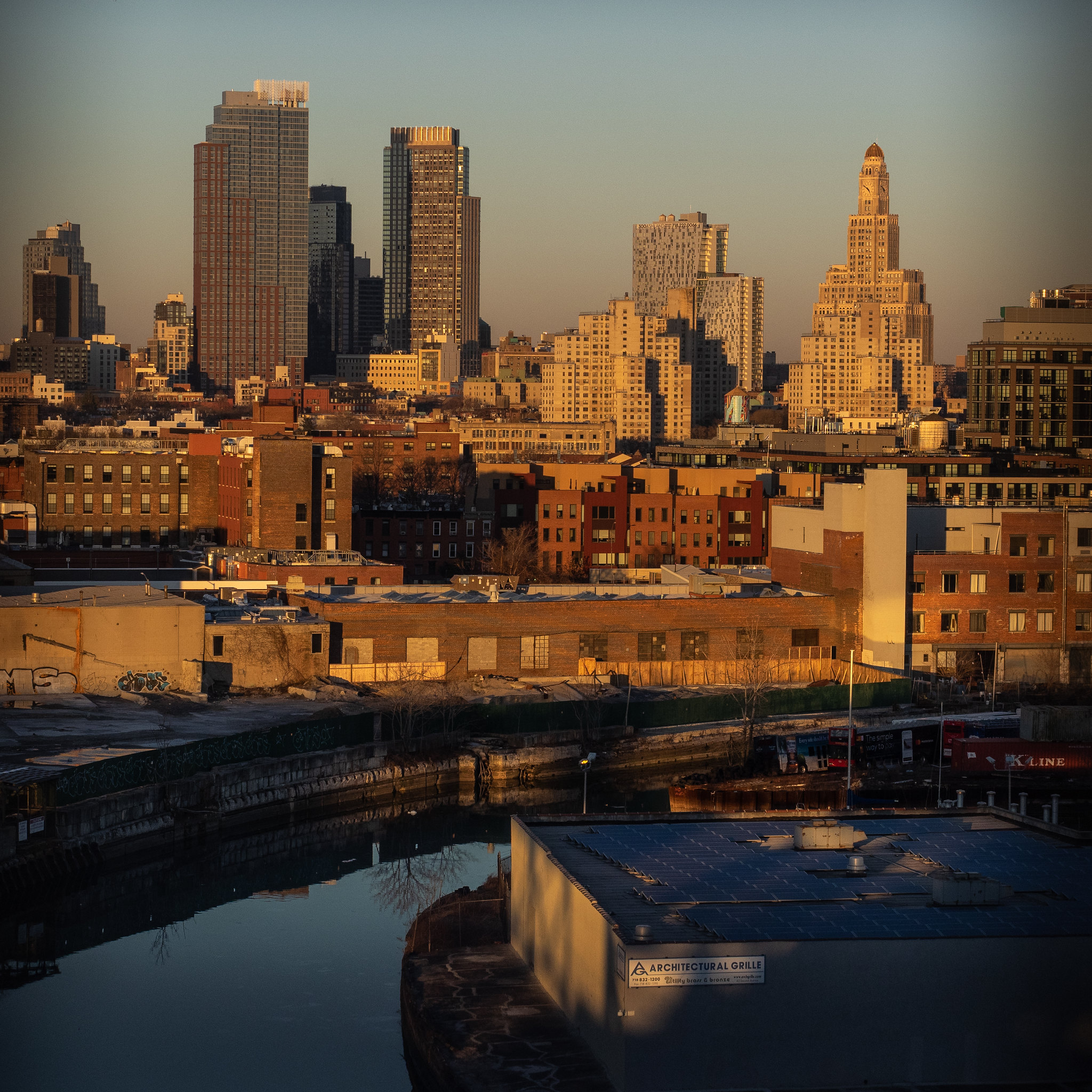
Standing on the span, looking outward toward the north, I see what is most astonishing for this city, a good deal of sky and clouds above low-scaled structures, and a vast sweeping view of Brooklyn that would have quickened the pulse of any Delft landscape painter. You can luxuriate in the profligate empty space (“waste” to a developer’s eye) framed by the canal. On the canal’s western bank, a small grassy meadow with wildflowers, bisected by oil pipes, slopes down to the greenish, petroleum- iridescent water. Along the eastern bank are lined the back ends of mostly abandoned factories, painted with graffiti and faded words like “Conklin Brass.” The thump-thump of cars passing over the bridge competes with the contemplative mood.
*
Looking south toward Red Hook, there is a parking lot filled with Verizon telephone trucks, in the distance the elevated trestle of the F train, and the Kentile Floors sign, and a factory placard which reads “Alex Figliola Contracting: Water Mains and Sewers.” All this prosaic attention to infrastructure and repair strewn haphazardly on either side of the canal amid weeds and ailanthus trees, this strange combination of industrial, residential, and bucolic, speaks to the poignantly somnolent essence of Brooklyn. The genius of Brooklyn has always been its homey atmosphere; it does not set out to awe, like skyscraper Manhattan, which is perhaps why one hears so much local alarm at the luxury apartment towers that are starting to sprout up in parts of the borough closest to Manhattan. Being a native Brooklynite, I never romanticized the place as immune from modernity, nor do I see why such an important piece of the metropolis should be protected from high-rise construction when the rest of the planet is not. But my feelings are mixed. For, if the sleeping giant which is Brooklyn were to wake and truly bestir itself and turn into a go-getter, I would deeply regret the loss of sky. Perhaps it is some deep-seated, native-son confidence that Brooklyn will never quite get it together that allows me to anticipate its bruited transformation with relative sanguinity.
Meanwhile, I stand on the Union Street Bridge, a fine place from which to contemplate the Brooklyn that was, that is, and that is to be.
*
Brooklyn occupies an oddly sentimental corner of the American consciousness. Recently I was in a breakfast place in Santa Fe called Bagelmania where the walls were covered with old, blown-up photographs of the Brooklyn Bridge and other quaint scenes from my native borough. I immediately became mistrustful. I thought also of the Brooklyn Diner on West 57th Street in Manhattan, yet another railroad-car-theme diner devoted to a bygone era. What is it about Brooklyn that makes it serve as such a ready hieroglyph of earthy reality to the outside world?
In the World War II era, when more battleships were built in the Brooklyn Navy Yard than in all of Japan, Brooklyn became the symbol of democratic, pluralistic tolerance and common decency—in short, the values for which we were fighting against the Fascists. Every war movie had its GI played by William Bendix or someone of his ilk, who swore that Flatbush was “the greatest spot on oith.” In the 1945 Anchors Aweigh, the chorine with a heart of gold is called simply “Brooklyn.” When soldier Robert Walker meets single girl Judy Garland at Pennsylvania Station in The Clock (also 1945) and they fall in love, the two, having only a weekend to commit to each other before he returns to action, and needing a glimpse of domesticity to inspire them, go to Brooklyn where they encounter a gruff, kindly milkman (James Gleason) and his family. Another Gleason, Jackie, immortalized the frustrated hopes and dreams of working-class Brooklyn in The Honeymooners. Just as British playwrights used to typecast Cockneys as working-class and proud, refusing to take any guff from superiors or even envy them (read: knowing their proper station in life), so American popular culture celebrated the Brooklynite as Everyman bittersweetly contented, in the end, to stay in that grubby lower-middle-class environment, with the El train rattling the windows, because somehow it was still “the greatest spot on oith.” All these Ralph Kramden caricatures may be condescending at the core, but they also contain a grain of truth. There is something earthy and appealing about folk Brooklyn. Or was.
Nostalgia can be a hazardous distortion. When Brooklyn Was the World is the schmaltzy title of a book by Elliot Willensky. But Brooklyn was never the world, except perhaps for those children who never left their neighborhood, so that to long for that time is to wish to stay arrested in a kingdom of egg creams and stickball, or at the very least, provinciality. And of course, Dem Bums: the Brooklyn Dodgers with their loyal fans, Hilda Chester and the cowbells. I’m so sick of hearing about Jackie Robinson and Pee Wee Reese with their arms around each other—how it satisfies our need to believe in a simplified myth of racial harmony; and team owner Walter O’Malley cast as Judas selling the team to Los Angeles with the connivance of arch-demon Robert Moses. I was ten years old in 1953 and a more passionate Dodger fan did not exist. I loved Jackie Robinson, Pee Wee Reese, Carl Furillo, and Duke Snider. But let’s be real: Dodger attendance figures were declining before Walter O’Malley moved the team to Los Angeles. The borough’s breweries started closing in the 1950s not the 1960s. So it’s stretching things to say that the ’50s were the heyday of Brooklyn and then blame everything bad on O’Malley.
As painful as the departure of the Dodgers may have been, the real decline in Brooklyn’s fortunes came about from the shifting of the port to New Jersey and the closing of the Navy Yard, along with the city’s loss of most of its manufacturing base. Ironically, the country was falling in love with white working-class ethnics at just that moment they were starting to leave the city, soon to be replaced by African-Americans, Hispanics, and Asians, who would find it much harder to obtain unskilled, entry-level jobs. I dislike Brooklyn sentimentality, but if I am sentimental about anything it is the working-class world of my childhood, and the opportunity it gave to millions of people without college degrees to work with their hands and take home a paycheck. All the candy stores and dairy cafeterias and delicatessens and trolleys that Brooklyn nostalgists lament were actually cogs of that functioning working-class culture. When several hundred thousand manufacturing jobs left Brooklyn in the 1950s and 1960s, never to return, it broke the back of the neighborhoods. Decades of massive disinvestment by redlining banks accompanied the de-industrialization process.
Fortunately, the tide has turned in the past fifteen years, and money has flooded back to Brooklyn. In retrospect, it’s hard to see how Brooklyn could have ever fallen out of favor for long, given its superb housing stock and proximity to Manhattan’s overheated real estate market, which makes it seem a relative bargain. However, Brooklyn’s new prosperity, with its bistros and boutiques, looks different: it’s no longer as homey and amateurish (which may be for the best), but a more self-consciously trendy, consumerist culture, driven by trust funds and the twin processes of globalization and gentrification.
At the same time, almost invisibly, a whole different, labor-driven Brooklyn is taking shape, fueled by recent immigration from India, China, the Dominican Republic, Russia, Israel, and Guyana. Presentday Brooklyn is both a more dynamic and a more perilous place than the cozy myths allow. Parts of Brooklyn are bursting with hidden economies, and sentimentality about Brooklyn’s past obscures this new, emerging reality with its opportunities and its dislocations.
*
“Only the Dead Know Brooklyn.” How often have I thought of that aptly grim title of Thomas Wolfe’s. What did Thomas Wolfe know, you may ask; he grew up in Asheville, North Carolina. True, but he put in his time here, he tried to grasp its true nature. In that short story, he gives his narrator a thick Brooklyn accent: “Dere’s no guy livin’ dat knows Brooklyn t’roo an’ t’roo, because it’d take a guy a lifetime just to find his way aroun’ duh f—— town.” Our narrator witnesses a debate after someone asks directions to “Eighteent’ Avenoo an’ Sixty-sevent’ Street.” Some say it’s in Bensonhurst, others, Flatbush. It turns out the direction-seeker is an oddball trying to master Brooklyn by traveling to random places with a map. The narrator tries to set him straight, telling him to stay out of Red Hook, but he won’t listen. “Walkin’ aroun’ t’roo Red Hook by himself at night an’ lookin’ at his map! . . . Maybe he’s found out by now dat he’ll neveh live long enough to know duh whole of Brooklyn.”
Only the dead know Brooklyn. Did Wolfe mean that we’re all stiffs here, or that the place itself is a morgue? I have to admit a good part of the borough’s terrain seems taken up by cemeteries. The border between Brooklyn and Queens alone has such a concentration of cemeteries it’s been called “the city of the dead.” And by the time you subtract all the smaller graveyards, funeral homes, mortuary headstone firms, etc., what are you left with? A sliver for the living.
Maybe I can’t help thinking this way because the neighborhood I reside in, Carroll Gardens, has an abundance of funeral parlors: Raccuglia’s, Scotto’s, Russo’s, Pastorelli’s, Cobble Hill Chapels, Cuccinella’s (which specializes in foreign shipping). What salt water taffy and casinos are to Atlantic City, burial arrangements are to Carroll Gardens. It’s an old Italian neighborhood with lots of old Italians, but not enough to keep six funeral parlors thriving. I leave my house in the morning and see the functionaries in black suits running interference for limousines, holding parking spots, helping the florists make deliveries, or just standing on the street corner looking dignified.
On top of that mortuary concentration, four blocks away from me, just over the Gowanus Canal, is the South Brooklyn Casket Company. Many is the time I’ve walked by that casket manufacturer and brooded on the brevity of glory.
In an effort to penetrate these terminal mysteries, I phoned the number of the South Brooklyn Casket Company and asked if I might ask a few questions for a magazine article. “We’re not interested in that kind of thing,” a gruff voice said. My suspicions were aroused: what were they shipping in those caskets? A recent tabloid scandal had exposed funeral parlors in the tri-state area hacking up corpses and selling body parts for transplants abroad. I decided to nose around.
On a warm day in March I strode up Union Street, crossed the verdigris, irenic waters of the Gowanus and stealthily approached my target. The South Brooklyn Casket Company occupies brick warehouses on both sides of the street. Its offices are located in a slender, aluminum-sided building topped by an American flag. I saw hard-bitten men wheeling caskets and loading them onto the backs of trucks. Trying to look nonchalant, I wandered over, eavesdropping on two workers speaking in Spanish.
“Where are you taking them?” I asked one of the men.
“All over,” he replied enigmatically.
There was little more to glean from him, so I headed around the corner, knowing that sometimes more can be learned from the back of a building than the front. I peered into its windows, seeing stacks of caskets polished and shiny like new sedans, champagne-colored, taupe, all the season’s popular colors. I would not like to be buried in such a metallic-looking sheath. A plain pine box, thank you. Around back stood a truck with Canadian plates; two men were unloading caskets. “Are those made in Canada?” I asked.
“Yes. We drove ’em down from there this morning,” said the trucker, with what I thought was a Cajun accent.
“So…South Brooklyn doesn’t manufacture its own caskets? It just distributes other companies’?”
“No, they make ’em too.”
I had nothing more to ask. My researches had led nowhere. None of it made sense. It was true, after all: I would have to wait until after I was dead to understand Brooklyn.
But there was one last hope: the Center for Thanatoptic Research. I had noticed the plaque for this morbid-sounding organization next to a big old church on Atlantic Avenue. I made an appointment by phone, but I knew not what to expect from an enterprise whose name invoked the God of Death. An altar with a stuffed black cat, presided over by a mad priestess? I rang the bell, and to my mixed relief and disappointment the door opened to reveal a sort of mail order business, offering pamphlets and publications about coping with death, grieving stages, burial practices, and the art of gravestone rubbing.
The director was a sensible, gray-haired woman in sneakers, a former art teacher who had stumbled on this emerging thanatoptic field and, sensing the public’s need for information, decided to supply it. She talked to me about the way death used to be a much more accepted visitor in Brooklynites’ homes: the second-story hallway niches often found in brownstones, for instance, were put there so that the casket could be more easily maneuvered down the staircase. She had much to say about the wonders of Green-Wood Cemetery, whose artistic landscaping had inspired Olmstead and Vaux’s Central Park. She led me over to her library, a wall of books on the subject of mortality, and tactfully left me alone with them.
Staring at the learned tomes, I began to feel giddy, the linoleum at my feet seemed to buckle underneath me, the book titles swirled faster and faster, I was seized by vertigo, an inner tornado, and at the conic base of the whirlwind’s funnel I suddenly experienced ahead of me a clearing, a rapture, an ecstatic release such as epileptics report in the midst of an attack, and I was flooded at once with illumination, the mysteries of the universe past and present were revealed to me in a pageant at my feet, Antony and Cleopatra, Robespierre and Danton, I understood the numerology of the Cabbala, Einstein’s theorem was as child’s play to me, but more important, I understood Brooklyn for the first time, the way it all fit together—of course East New York could only lead to Canarsie, and Canarsie had to be next to Flatlands, it made perfect sense—and there, by the edge of the Atlantic near Coney Island, was the key to it all, the Aleph, a precinct’s name so redolent and resonant with encrypted meaning I could barely bring myself to utter it . . . Gravesend! Someday soon, I knew, I would have to explore that area.
Published on April 7, 2026
First published in Harvard Review 37.