
Clouds and Eclipses
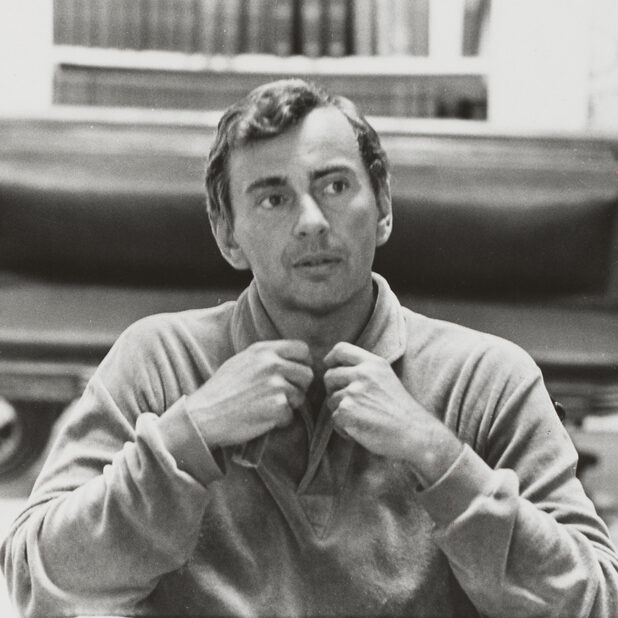
by Gore Vidal
EDITOR’S NOTE: In 2005, the Gore Vidal papers had fairly recently come to Harvard, and I thought there might be something in them, a letter perhaps or some scrap of writing, that we could publish in Harvard Review. What we found when we went to look, however, was a great deal better: on page forty-six of the catalogue was something identified as item 771: Clouds and eclipses: Ts [ca. 1945] 1 folder. With AMs annotation on front page: “A never published story — ’54.”
By Vidal’s own reckoning, he wrote a total of eight short stories in what he calls his “first phase as a prose writer.” Seven of these were published in 1956 in a collection called A Thirsty Evil. The story “Clouds and Eclipses,” which was published for the first time in Harvard Review 29, was the eighth. The intriguing tale of where this story came from and why it was not published for over fifty years was recounted in the following afterword by the author.
I had completely forgotten this story until an archivist at the Houghton Library discovered it among my papers. It was written about 1953 when I was still working on Messiah (1954), the last novel of what I like to think of as my first phase as a prose writer. Necessity obliged me to become a writer of dramas for the next dozen years. I wrote only eight short stories in phase one, and I published seven in the volume A Thirsty Evil (1956). I did not publish “Cloud and Eclipses” at Tennessee Williams’ request. His mother’s father, Reverend Dakin, was an Episcopal clergyman in Mississippi and when Tennessee was a boy his grandfather was blackmailed, as I describe in the story. Tennessee believed it had to do with a boy, which I changed to a girl. But this was not enough. The old man often joined Tennessee at Key West, where I sometimes visited. Nearly blind, he was unlikely to read a New Directions Anthology. Tennessee sighed and said, “No, but there is always Edwina,” better known to theatergoers as Amanda in The Glass Menagerie. So, I put the story away until its recent discovery among my papers. The title comes from Shakespeare’s 35th sonnet: “No more be grieved at that which thou hast done, / Roses have thorns, and silver foundations mud; / Clouds and eclipses stain both moon and sun, / And loathsome canker lives in sweetest bud.”
1.
The boy took a deep breath; then, chest full of air, he pressed his thumbs deep into his throat, and for one long moment outside time he was dead, engulfed by a wild green sea.
How wonderful it was! He thought, opening his eyes on the world again . . . on that dangerous familiar world which he would soon desert for good, to the dismay of those he had left behind to endure without him the parade of days, the repetitions of which, some time next Wednesday the Fourth of July, would end for him when he killed himself.
For a month now, since the day school ended and he had made his decision, he had staged rehearsals like the present one. By stopping the blood in his carotid arteries he could die for a little while; by sniffing ether he could die for even longer. Wednesday he would die for good. This knowledge made him happy, and he disliked his plain room less as he thought he glimpsed the green sea through the window, like a breaker suspended above the house, ready, when he chose, to fall, to flood, to drown, to carry him away. But, when he looked out the window, he saw the green was not the sea . . . only the high summer which billowed in the wind.
“What are you doing, Joe?”
“Nothing, Aunt Helen.” Her voice was as high as a choirboy’s when she called like that, from a distance, and ever since he’d come to live here she had communicated with him almost entirely at a distance, as though afraid that neither could quite survive a direct encounter. Those occasions (meal times, church) when they were thrown together, they communicated, if at all, through his uncle Joseph, the minister: an absolute saint in the eyes not only of his family but of his parishioners as well.
“Come down. Address envelopes for Uncle.” All nuance was omitted in their exchanges, since a voice which travels up three floors and through a locked door must, of necessity, be not only loud but limited in vocabulary, like an encounter at a prize fight.
“Right down.” His own voice this summer had assumed the resonance of manhood, to the mild alarm of his uncle and aunt, who had taken to studying him nervously, tentatively, as though afraid perhaps that, through some freak mutation, a barbarian had appeared among them, sprung from the discarded child’s body of their nephew to disrupt their gentle Christian circle with pagan deeds and sudden violence. But Joe, for all his deep voice and fourteen years, his small solid torso and blond bandit’s face (it has been recorded that nearly all the famous Western outlaws had blue eyes, blond hair), Joe, at the moment when a sharp new love of life was growing in his body, thought not of love or violence but of sainthood; and, all too aware that his midnight fantasies foretold grave sins before too many years, perhaps even months, had passed, he chose to be like his uncle, to be a true saint. But since he was unlike the minister in every way: irresolute, incapable of his idol’s self discipline . . . he had resolved, of his own accord, to surrender his relatively unblemished soul to God, confident that the sin of suicide would be cancelled out immediately by that love of virtue which was causing him to offer God a clean new soul, hardly more rumpled and soiled than a dinner napkin rolled and placed in its pewter ring for the first time.
Humming happily to himself, he clattered downstairs.
The saint’s study was not unlike himself: Victorian, dark, massive, solid, tasseled (yes, the saint at times gave the impression of rich red silk tassels) and hung with ancient curtains of the finest plush, worn but sturdy like the doctrines of that church which was so well served by its minister Joseph Pearson Mather.
“Ah, young Joseph.” The older man pushed his chair back from the heavy teakwood desk where he had been working on the next day’s sermon. Close by was a modern filing cabinet, the only twentieth-century note in this muted, last-century room; here was kept on file every sermon the Reverend Mather had delivered in the twenty-eight years he had been a minister in this town, in Rhineburg-on-Hudson. . . . Joe knew by heart the order of his uncle’s life: Born in Kansas of Good Stock, Attended a University Out There, Ordained a Minister of God, Married a Good Woman, Refused to Become a Bishop, Giving His Life to the Poor and, finally, noblest of all, He Had Never Given the Same Sermon Twice. Joe had more than once in church, remarked quite clearly a flickering gold nimbus about his uncle’s head.
“I wonder why you like to spend these glorious afternoons indoors.”
“I was reading, Uncle.”
“Ah! And what were you reading, Joseph?”
“Pilgrim’s Progress.” Now I’ve done it, he thought bitterly, hating himself . . . a few more lies like that and, suicide or not, he would find himself in hell. Lying was the worst of the second-string sins.
His uncle smiled and blinked his cloudy blue eyes, eyes in which the tears seemed ever ready to flow in pity for the world, for our Lord’s suffering . . . though Joe had never actually seen them fall: perhaps only alone at night could his uncle give way to compassionate grief. “I was your age . . . a little younger . . . when I read that great book. So many years ago . . .”
“In Kansas,” Joe completed, knowing the order of these reminiscences.
“In Topeka,” said his uncle softly. Then he cleared his throat and handed Joe a list of names and a box of envelopes. “Make these out, dear boy. You’d better print, very carefully.”
“Yes sir.” And Joe took the envelopes with him into the dining room where he always did jobs like this for his uncle: on sermon day the study was forbidden to everyone, except by appointment; then, too, the dining room had vaguely religious associations for him: food-flesh, blood-wine, transubstantiation . . . what a hell of a wonderful word that was! Then he scolded himself for having used an oath . . . oh, it was going to be difficult! He sighed as he printed a name on the first envelope: it might be a good idea to get it all over with tonight, if only because, at his present rate, he might very well find himself damned by Wednesday. Sin! How he hated it!
His aunt came into the dining room from the kitchen where she had been tyrannizing the new cook . . . as the swinging door opened she seemed to be riding upon the querulous voice of the cook, like a witch on a broomstick at Halloween . . . she was like a witch, he thought, looking up at her: she was long and thin with gray-black hair, gray eyes, and a body that was all yellowed skin and sharp angles beneath the flowered print dress she wore with summer bravery. In moments of weakness he often envied her closeness to his uncle; there were moments when he wanted to push her aside, declaring: “You’re only a woman. You can’t understand us saints.” And his uncle would nod gravely and place his hand on his head the way the Bishop had done at confirmation and say: “The boy speaks the truth, Helen. We are saints.”
Unaware of her exclusion from Heaven, she said, “Soon school will start.” She paused in the dining room door, her voice pitched high, a safe distance between them. Her eyes were like bits of quartz from his geology collection.
“Yes,” he replied, “five more weeks.”
“The year after you will go to Exeter, like your father.”
“The year after,” he repeated.
“You will like Exeter,” she said.
“I will.” Then he whispered fiercely to himself: hypocrite!
“Your father did,” and she disappeared. Joe’s father had been her brother and he had been killed in the war. His mother had died a long time before that, before memory, and so, since the day his father went into the army, nearly eight years ago, Joe had lived here in this small town of rose-red brick, of white frame houses . . . a town on a bluff near the broad silver Hudson, melancholy at every season yet always home, a set of vivid images soon to be forever lost: of gold summer, of blue water days among the rocks, swimming and fishing for perch, of winter when the banks were tarnished and rusty like old iron and the trees defoliaged like vertical bird tracks on snow, edged in that sky of snow which curved by day above the town, becoming by night a globe of arctic ocean frozen solid about the stars and constellations, those burning regions forbidden to all but the good dead, the virtuous Vessels of Grace . . . I am good, he thought . . . well, good enough, he added hastily to himself, trying not to think of what he would do Wednesday evening, not because he was afraid, far from it: he was impatient . . . rather, he did not want to seem too eager, to revel too much in the thought of his own virtue for it was well known that God liked humility more than almost anything else in the world . . . and I will be humble, I will, I will, he thought as he addressed the envelopes on the dining room table.
2.
Wednesday morning was cloudy and hot. Everyone spoke of the rain which was to come any minute and cool the air, but by lunchtime no rain had fallen and the dining room was unpleasantly humid; the odor of cold lamb and cabbage permeated the whole house. The saint-to-be decided, taking everything into account, this day, this lunch, the numerous unexpected pitfalls at every turn, that it would be a relief to go for, were he to live, there was little doubt that he’d be damned. As it was, tonight, quite certainly, he would be a sort of angel, one of the lesser ranks who decorate the edge of Heaven like white fluff on a blue counterpane. As he drank his milk, he pretended that it was iodine.
“What’s the matter, Joe? Are you sick?” His uncle looked at him curiously; his aunt paused in her chewing to answer for him, to disrupt if possible even this tenuous line of communication from saint to would-be saint.
“It’s the heat,” she said. “I don’t feel very well myself.” Then the foggy blue eyes were turned upon her . . . tears of sympathy brimmed between inflamed lids.
“These are the dog days,” said the minister softly, and this declaration made everyone feel much better: the trouble had at least been given a name. Joe wondered idly what a dog day was, and would there be dogs . . . but of course not: they had no souls. Milk, honey, and bracing clean air would soon be his for all eternity, an eternity spent in the company of the Good. But first there would be the burning ugliness of iodine. Should he perhaps mix it with the milk? He went through the various steps to paradise: the arranging of his room, the burning of his correspondence (five pencilled notes from a girl in his class at school and a number of Valentines) followed by a bath and meditation; then he would put on his blue suit and lie down on the bed and drink the iodine. From faraway he heard his aunt and uncle talking as they ate canned peaches.
“But you were in New York Friday before last, Joseph. I thought they wouldn’t want you this week.”
“So did I, my dear, but I have promised. I cannot break my given word.”
“You know I should never demand that of you.”
“Duty.”
“Yes, yes . . . even when it’s . . . inconvenient.”
“Especially then, Helen. You see it is only then that one really gives of oneself.”
“I’m selfish, Joseph. Be patient with me.”
“Only weak, my dear . . . like the rest of us.”
“Not you.”
“Oh, but I am! There are times on that train to New York when I find myself wishing with all my heart that I was here at home with you . . . and Joseph.” Joseph, hearing his name, looked up, brought his uncle into focus, listened now to the sense instead of merely to the sound of the words.
“That’s only natural.”
“Only my duty is natural,” said the saint in that gentle tone of admonishment which made even the good feel bad, an invaluable gift.
“We must recall that the Indigents’ Home is your finest work,” said Aunt Helen, bowing her head as though to acknowledge the presence of an angel in the house.
“It is my work,” said Uncle Joseph, folding his gravy-stained napkin and slipping it through a carved bone napkin ring.
“Yet, every Friday for two months seems awfully demanding . . .”
“Someone must care for the Indigents.” And the family, as one, left the table.
Since this was his uncle’s day of meditation and prayer, Joe had all afternoon to himself, to do as he pleased. But what could he do? What was the best way to spend his last few hours alive? Should he go to the movies? Or walk down to the river and join his gang? Those pagan friends from school who never thought of good and bad, not even in church. . . . They were of the earth, he decided scornfully; although, as he thought of them swimming off the rocks, he experienced a sudden inexplicable pang. Annoyed with himself, he walked quickly toward the graveyard which separated the rectory from the church.
This was better . . . all thoughts of profane pleasure were forgotten as he wandered reverently among the old stones with their worn markings. Some dated back to 1690 but most of them began 18-something and ended 19-something. His own tombstone would be one of the most modern.
Measuring his life now in terms of breaths, of steps, he walked slowly and carefully back to the house and sat down on a bench beneath his uncle’s study window. Inside, he heard the minister whistling hymns, loudly, a little off-key.
He looked at the sky, dull and gray, and he wondered if it was going to rain or not. There were signs that it might clear up . . . a break in the southwest where the darker clouds grew pale as though a wind was bearing down upon the valley from far-off deserts and equatorial jungles. If it did clear up, there would be fireworks tonight: Fourth of July; but he would not be on hand to see them.
While he was daydreaming, two men approached along the curving driveway from the street. They seemed uncertain of themselves; city people, he decided. They were dressed peculiarly and he was sure that he’d never seen either of them before. Both were fat. One was of medium height, almost bald, while the other was larger and entirely bald; they wore crumpled linen suits and pastel-colored shirts. Joe found himself admiring their neckties very much; one in particular was very beautiful: hand-painted palm trees in an orange sunset.
“This where the Reverend Mather lives?” asked the short one in a New York City accent.
“He lives here,” said Joe, standing up. “You want to see him?”
“He’s home, isn’t he?”
“Sure,” said Joe. “Come in. I’ll get him.” They followed him into the house, but before he could take them to the minister, his aunt appeared; she frowned when she saw them and Joe recalled her dislike of city people.
“Whom do you wish to see?” she asked coldly, moving resolutely toward the New Yorkers.
Both retreated several paces; then the short one dug his heels in and counter-attacked. “You Mrs. Mather?”
“I am she. Tell me whom . . .”
“We’re here to see the Reverend . . . a matter of business. We . . .” But at that moment the door to the study opened and Joseph Pearson Mather stood revealed in shirtsleeves, without his collar.
He looked startled; then he turned quickly to his wife and said, “They are from the Indigents’ Home, Helen. Allow me to present Mr. Peverini, Mr. Gray . . . my wife Mrs. Mather.”
The New Yorkers made harsh friendly noises while Mrs. Mather inclined the upper part of her body formally; she then excused herself and the city men followed the minister into his study. Joe went outside to the bench again.
A bird chattered. In the street a truck changed gears noisily. Far away a mother called a child named Mary. In the south the sky grew less lowering and a body-warm breeze trifled with the leaves of an elm overhead. Soon. Soon. Soon.
Above him they were talking in the study and he listened absently: the voices confused at first with his own thoughts, with the high treble of birds in the cemetery, with the sound of traffic in the streets.
“We missed you last Friday, Reverend.”
“I . . . wasn’t able to make it . . . other engagements.” At first he didn’t recognize his uncle’s voice; it sounded oddly uncertain.
“We thought you was to fix it so there’d be no other engagements on Fridays.”
“I did my best, I swear. I’d planned to make up for my lapse this Friday.”
“How was we to know that? You didn’t even phone. We got bothered and so since we had a little free time to kill today we thought it’d be nice to make you a visit up here.”
“A grueling train ride . . . I’m sorry you . . .”
“Now look here, Reverend, if you think maybe you’re going to be able to give us the old heave-ho and not come through you have another thought coming.”
“I swear that I had no intention . . .”
“Why didn’t you send it by mail?”
“I . . . was a bit embarrassed financially last week. I was short of money. It won’t happen again.”
“We’re sure of that.”
“I’m glad you . . .”
“Because we’re going to take said amount in question in one lump sum today.”
“You can’t! I haven’t got it.” Outside in the half-light, Joe listened bewildered, not understanding.
“You got twelve hundred dollars here in the bank in town. You give us that and our transaction will be finished once and for all and you won’t have to make that awful train trip every Friday again,” and the man’s voice mocked his uncle.
“I can’t let you have it.”
“Then you’re in for a rough time. We’ll send one of the pictures to the Bishop of this place and another to the paper and one to your wife . . .”
“Do your worst. I am prepared.”
“And then when we bring it to court and they find out the girl wasn’t even seventeen years old, you’ll go to jail for that, too . . . imagine an old devil like the Reverend here getting mixed up with a minor . . .”
There was no more talk in the study. Joe stared foolishly at the gray stone of the church, at the red tile on the steeple roof. From the south a strong wind was tearing up the clouds, revealing blue.
The screen door opened and shut loudly. He jumped to his feet as the New Yorkers walked down the graveled walk to the street. He couldn’t see their faces, only their wide square-tailored shoulders as they walked, in step, out of sight.
Then his uncle appeared in the door, his face red and shining and his hair uncombed; in his arms he held stacks of manila envelopes. Without looking at Joe, he rushed out into the yard and made a pile of them on the grass. After several attempts with a faulty cigarette lighter, he set fire to them. When he was sure they were burning, he went back into the house. A moment later he reappeared with a larger stack of envelopes which he threw on the blaze while Joe, a ghost, transfixed, invisible, unnoticed, like a stranger watched this fat little man in shirtsleeves poke a paper fire while ashes filled the wind like the feathers of the burning phoenix or the last leaves of a long-dead tree in winter.
An upstairs window opened. Joe heard his aunt’s voice, loud and thin, coming to him from a distance. “Joseph, what are you doing? What is he doing?” But her husband did not hear; he stood, head bowed, over the flames, his suspenders hanging behind him in two loops, like the skeletons of wings.
“Joe!” she called, seeing her nephew beneath the window. “What on earth is he doing?”
“He’s burning his sermons,” said the ghost . . . the ghost’s last words.
“He’s burning his . . . Joseph! Stop! Do you hear me? Joe, make him stop, do you hear? Make him stop! Joe! Joseph!” Her voice broke but neither uncle nor nephew, man nor boy heard her. Then as the last of the ashes blew across the lawn, Joe ran as fast as he could through the cemetery to the river to his friends the pagan fishermen, the golden bathers; and, as he ran, the green summer billowed all about him, like the sails of a galleon in a pirate story.
Published on April 7, 2026
First published in Harvard Review 29.