
The Lost Boys of Conantum
by Susan Bartlett
If we didn’t live by the river, my mother used to say, none of this would have happened. Concord, the river, our neighborhood, all of it, she believed, was bad for us, especially for my brother.
Conantum, with its affordable, glassy modern houses and common lands, was designed both to blend into the woods and to foster a sense of community. Everyone thought it was the ideal place to raise children: along with the ball field and neighborhood vegetable gardens, there were trails through the woods, a sledding hill, tennis courts, and a boat landing. Then there were the community projects, like building a tiny firehouse or planting trees along the river road. There was a garden club, a neighborhood newspaper, and big celebrations: Christmas caroling and open houses; a Fourth of July parade, picnic, and fair; a harvest supper for the grown-ups and the most decked-out Halloween in Concord. There were spontaneous canoe flotillas and skating parties and huge games of kick-the-can and softball. With 100 houses and 300 children, there were always people and dogs and the occasional goat, chicken, or horse roaming the yards and common lands, and everyone knew everyone—too well, my mother thought.
This was the problem, my mother would lament, the intimacy that could turn into cattiness fueled by gossip shared over the telephone party lines, and then, my mother would say, there was this sense of superiority among the neighborhood founders and the endless comparing of children. Many of the fathers and mothers were Harvard, Radcliffe, and MIT graduates and veterans of World War II. They were professors, architects, engineers, researchers, economists, designers working in the technology sector of Route 128 just outside Boston, building rockets, satellites, audio equipment, photocopiers, computers, and computing programs. Conantum boasted top prizes in computer engineering and a Nobel Prize in economics. The architect and engineers who designed the neighborhood had their own houses there. And yet, my mother would say, (in retaliation for what she felt was unfair scrutiny of my brother’s slow-blooming genius), with all this brainpower, you would think the children would be better off. “Something is wrong!” she would say, shaking her head. I didn’t know what she meant by that until much later.
In Concord we would always be outsiders. When Conantum was built in 1952, the town was still a colonial village surrounded by farms and woodlands with family roots dating back hundreds of years (several descendants still lived in the houses of their ancestors) and historical societies for each period of its history. There was Thoreau’s Walden Pond; the Old North Bridge, site of a Revolutionary War skirmish; “Author’s Ridge” in Sleepy Hollow Cemetery, where Emerson, Thoreau, and Louisa May Alcott were buried; the Alcott House where nothing was ever allowed to change; and monuments, plaques, and shrines all over town. The library had its marble busts of famous authors lurking in the shadows, Thoreau’s Journals faithfully opened to the day. To that Concord, this first modern development, full of Bohemian intellectuals and foreign scientists, was an invasion.
Then there was the river. The Sudbury and Assabet Rivers become the Concord River, once “Musketaquid,” an Algonquin name meaning “Grass River,” flowing northward into the Merrimack just south of the New Hampshire border. Our stretch of the Sudbury ran from Lee’s Bridge in the south to Heath’s Bridge in the north. Swarming with mosquitoes, or clouded with DDT the summers we were sprayed, the river’s pungent, damp vapors surrounded us, especially rank in late summer at its lowest flow, sediments exposed. The Sudbury River, my mother believed, was making us all sick. “Water, water everywhere, nor any drop to drink,” she’d quote from her vast repertoire.
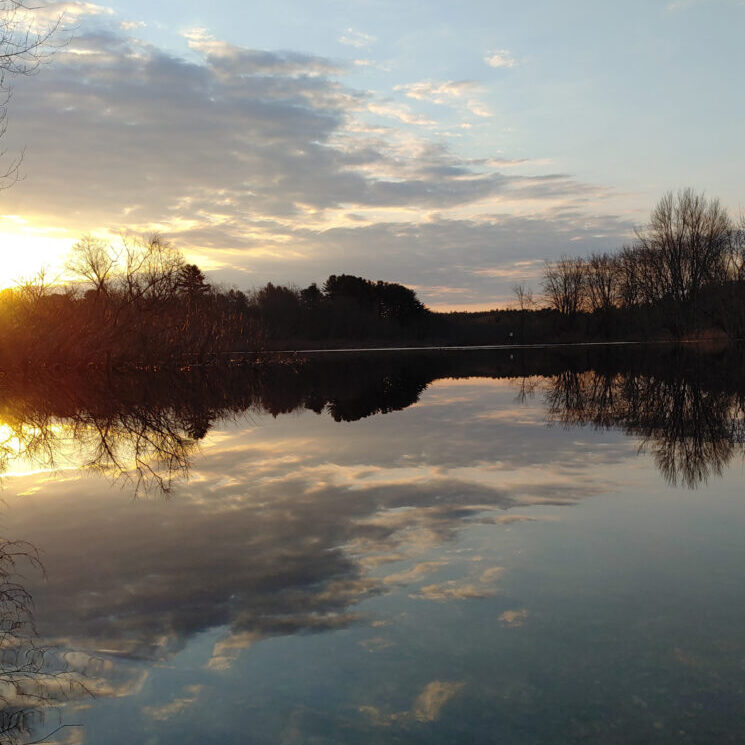
Our house was so close to the river it was like a moored boat, sitting on a clay bank above a sweeping curve, facing south. It was as if we were leaning into the river’s northward moving current, the water running straight into the house, filling the floor-to-ceiling windows with movement, shadows, and rippling, reflected light. Upriver there was the rocky promontory of Martha’s Point, then Fairhaven Bay and the Island, and across the river, hundreds of acres of woods leading to Walden Pond. This was the scene I woke to every morning, saturated with color, humming with life. The river: beguiling us with its mists, its flocks of migrating birds, the winds that reversed its slow pulse, the luminous silver frosts, and, in freezing winters, the ice you could skate on for miles away from home. This river was my refuge.
How could the river be bad for us? It offered hope, momentum, beauty, and a promise of all I ever yearned to see, the world downstream beyond everything I knew. Even when I was sick, as I often was in childhood, the view from my room under the eaves took me far away from the fevers and jangled asthmatic cacophony in my lungs, my heart beating in time to bullfrogs thrumming from the edge of the night river.
It was clear the river was polluted, “pol-LOO-ted” as my mother liked to say, as if this was the scandal that explained everything. In the early days, dead fish would stream by belly up in the spring die-offs, and as summer progressed, algae bloomed in massive, soupy mats of brilliant green duckweed. Invasive milfoil trailed its noxious leaves in giant swirls that choked the river and tangled our canoe paddles. And there was that smell that permeated everything: our clothing, our bedding, even our books and especially the tap water. And the grayish-yellow haze that sometimes blew in from the south, hovering over the surface of the water like the breath of everything unseen, menacing, dreaded. To keep us out of the river, my father unrolled a wire fence along the riverbank, curling the ends around oak trees and swamp maples. The fence stayed for years, sagging between the trees until it rusted into the bank. As if it could keep us out of the river. As if it could keep the river from us. As if the river was the problem.
The river was irresistible to us kids. We climbed over my father’s fence, eventually mashing it into the ground, or dodged it by going around to our neighbor’s waterfront. We brought our saplings, whittled down with bowie knives and fashioned into fishing poles with twine for line, safety pins for hooks, and hapless worms as bait. We took off our shoes and waded in to catch frogs. We threw rocks and spears and climbed the trees that leaned over the water, lying on the branches like Elsa the lioness in Born Free. There was a large rock on the edge of the river where we liked to sit, and one day I climbed on with my sisters and their friends, all clustered like turtles in a crowded row. I was the littlest at the end.
Someone began to sing: “There were ten in the bed and the little one said, roll over, roll over.”
Everyone chimed in: “So they all rolled over and one fell out!”
The next thing I knew I was bumped off into the water, my feet squelching in the leafy slime, arms swirling in stringy brown algae, while hoots of laughter rose above me. I crawled out and ran up to the house. My mother put me in a tub of hot water, scrubbing with Ivory Soap and a washcloth until my skin was red and shiny. She was trying to remove the taint, but I was beside myself with excitement: I had been in the river!
In spite of all the signs we lived with, everyone believed the river was getting cleaner. “They” were cleaning up the sources of the pollutants upstream, and it would just take time to flush it all downstream. Flushing? Was the river like a big sewage pipe? We learned too late that while there were the pollutants that evaporated and ones that dissolved, moving with the water’s flow and out to the sea, there were also some that accumulated in the sediments and sat there poisonously, forever.
Our parents talked about leaving; my mother always talked about leaving (“the river, the river” she would moan), but we never did move away. My father could never leave the scene he painted, year after year, canvas after canvas, trying to get the light just right: the way the afternoon sun shone on the trees across the river, the whole of it revealed in duplicate on the dark surface of the water.
ꕀ
There are mysteries we grow up with that become part of our essential being, that we only begin to question when we are so separated from them by time and space that memory becomes unreliable. What was wrong in our house by the river? What was wrong in Conantum, in Concord, in the 1960s? Back then this question was just part of my mother’s gloomy prognosticating, best to be ignored while running barefoot through the woods or paddling up the river. Because that was how I spent every spare moment of my childhood.
I would jump off the bus at the end of our long driveway and run down towards our house, throwing my book bag across my room, ripping off the stiff skirt and oxford shirt and pulling on boy dungarees and a sweatshirt. I would drag our battered aluminum canoe down through the weeds, drop a book on my seat, and paddle upriver until I couldn’t see the house. Then I would drift back down, reading and watching the late sunlight ripple up the trees, the turtles sliding off logs, to reach home, if the winds were blowing right, in time for dinner. Approaching the house I might hear my prodigy brother playing Moonlight Sonata on the piano while dusk fell around me and the sky and river dissolved into each other.
If I could distill all my memories into one moment that I dreamed would signify everything yet to come, it would be this one: paddling home at dusk to the strains of Beethoven. But I grew up and left the house by the river, and my brother descended into madness and never played the piano again. The neighborhood, our post-war idyll, lost a startling number of its sons, and some of its mothers, to mental illness and suicide. On our street alone, out of twenty-four families, four boys and young men, including my brother, were diagnosed with schizophrenia. Two of these young men (not including my brother) killed themselves; another with no history of mental illness also took his own life. Two women on our street, including my mother, were also diagnosed with schizophrenia. Our next-door neighbor’s son dropped out of an Ivy League school, came home and spent the afternoons in his rowboat on the river. At first, he rowed purposefully up and down, his blond hair haloed in light, strong arms straining. But over the weeks his hair grew wild, blowing straight out from his head like a dandelion going to seed, and his body expanded, rounding torso bursting his shirts. He no longer rowed up and down but stayed in one spot just below our house, occasionally dipping an oar and turning one way and then the other like he was caught in his own eddy, until one day we did not see him out there on the river and we heard he had taken his own life.
It wasn’t just our street. There were other suicides on other streets in Conantum: two women and four more sons, all by different methods spaced years apart, including a few who took their lives several years after leaving the neighborhood. There was no sense of this spread-out string as a cluster. Rather it seemed like random bad luck, a macabre coincidence, perhaps the consequence of too much brilliance, too many genetically unbalanced minds concentrated in one neighborhood. Or there were murmurings of a curse, brought down on us by the original suicide in 1959 of the founder of Conantum, an MIT economist who had saved the development from bankruptcy and then jumped to his death from the roof of the Sheraton Plaza Hotel in downtown Boston. Ten lost to suicide; three young men and two women left with schizophrenia.
When my brother and I were little, my mother read us an old book from her mother’s library, The Water Babies. In this Victorian-era tale, a miserable little chimney sweep named Tom drowns and finds himself in an underwater world of fairies, where he becomes a water baby and is shown a way to become clean before emerging back into the world. This made no sense to me. Why leave a warm place where you could swim and wear no clothes and live forever with the water fairies? What if there were water babies and fairies living right outside, in our river? If I wished hard enough before I went to sleep at night, maybe I could become a water baby of the Sudbury River.
Our river was so dark with slime that it was hard to imagine it cleaning anything, but in my magical dreams it was fresh and clear, with beautiful round rocks and rainbow fish. It was warm, too; I could walk across it and not feel cold. The dreams were so vivid that I believed they must be real, and in the morning, I would go down to the river to see if it had changed overnight. It was always its murky sameness. But was it? I hadn’t thought about what was in the water, flowing with it or resisting it, until the water babies. Theirs was an unseen world; maybe there was also an unseen world in our river: dark, murky, unknowable.
What was unknowable then but came to be known twenty years later was the extent of the contamination flowing through our neighborhood, layering with the sediments, rising and falling with the thaws, the rains, the droughts, seeping into the groundwater until the river gained notoriety for having the highest concentration of mercury of any waterway in North America. And while this was happening, children, especially boys, were falling mysteriously ill and some were later killing themselves. If there was any connection between these two catastrophes, the water fairies of the Sudbury River must have been the malevolent kind, wreaking havoc with suicides that, horrifying at first, eventually seemed inevitable. Unlike Tom in Water Babies, the lost boys of Conantum could never escape.
To us, they were always there. Back home for holidays, my sisters and I would walk around the neighborhood, passing the houses of those who had killed themselves and remembering their names, their friends, the times we skated with them, sat across a bonfire from them, smoked reefer with them, swam with them at Martha’s Point or watched them drive their first car, long hair blowing out the window. But for all of them, there came a time when the boat they were paddling stopped in the middle of the river and began to spin. The river, always my closest ally, my hope and yearning and everything I believed about the wholeness of life, not only could not save them but was maybe even an agent of their demise.
ꕀ
“Do you miss the river,” my mother asked me not long before she died, “since you moved away?” She had made her own peace with it, staying on in the house for almost thirty years after my father died. She was completely bedridden at the end, and we set her up by the windows so she could hear and watch the river go by. Her hospital bed was fitted with a pneumatic mattress, rhythmically pumping air like ripples under her frail body, like she was floating on the current. She hadn’t just made peace with the river, she now adamantly defended it. “Oh no,” she would protest when I claimed it was permanently contaminated. “It’s clean now. Perfectly clean.” Some hot summer days she thought the river looked so good she might get up and take a swim. She would crane her neck and push her elbows against the mattress, then slump back down, exhausted by the effort.
Did I miss the river? Her question startled me. It was so to the point, as if she were reading my mind just at that moment. We looked into each other’s eyes and for the first time in my life, I felt that my mother completely understood me. Her eyes had turned bright blue and clear. She was lucid, with little trace of her distractions: the wanderings of mind, her nerviness, her conversations with whatever cast of characters accompanied her while we were growing up—all of what I had escaped from in my canoe, paddling as hard as I could against the current to get away. Yes, I said, yes, I miss the river.
But in a way, the river is always with me. Even with all that I know now, nothing could ever diminish those afternoons when I felt so completely immersed in the bigness of the water, sky, the wind and birds that there was no separation between me and all of it. How could that ever be lost?
I still dream of the river. I am crossing it as if the water were air rippling around my legs, warm, clear enough to see to the bottom, the round rocks and rainbow fish. I wade across to the other side, to the paths up to Fairhaven Hill and Walden Pond. I turn to look behind and sometimes there is a boy there, watching me, maybe my brother, or one of the others.
Published on November 3, 2026
First published in Harvard Review 60.