
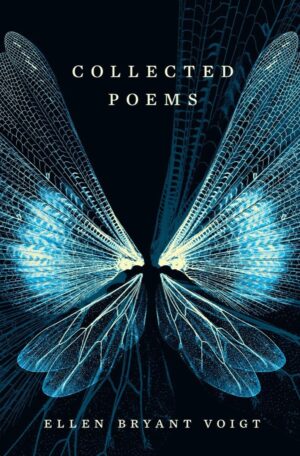
Collected Poems
by Ellen Bryant Voigt
reviewed by Sarah Kafatou
The poet Ellen Bryant Voigt, MacArthur and Guggenheim fellow, finalist for the National Book Award and Pulitzer Prize, founded the MFA Program for Writers at Warren Wilson College, where she taught for decades. Professionally active into the last weeks of her life, she died in October 2025 at the age of 82.
The local habitations, to which she was not limited, of her life and imagination were rural Virginia and Vermont. In “At the Movie, Virginia 1956” she writes, with telling line breaks, “This was rural Piedmont, upper south; / we lived on a farm, but not in poverty.” Such people, she adds, “would own the county, stores and farms, everything / but easy passage out of there.” This is a poem about segregation from the point of view of a white child in that time and place; in closing, it recruits the power of the child’s imagination to depict her own society as penned in: “trained bears / in a pit.” Voigt’s poems turn an equally critical eye to social wounds such as the suppression or frustration of women’s desires, insensitive treatment of a deaf child, and shaming of homosexuality. Yet she is above all a lyric poet, preoccupied with universal issues of life and, pervasively, death.
Music, her first vocation, nourished the keen attention to structure, pattern, and verbal craft that undergirds her work. In intensive, fine-grained essays (The Art of Syntax, from Graywolf; The Flexible Lyric, from Georgia University Press) on poems that served as models for her own practice, she encourages the reader to listen beneath the paraphraseable surface for the meaning of a poem. Her own poems share some affinities with those of Robert Frost, with their shrewd metric and sound of sense, as well as their insight into the hardships and savageries of rural life. Both poets also convey the satisfactions of that life, though there can creep into his voice a note of self-satisfaction that is not present in hers.
Voigt’s compassionate, communitarian temperament, evident in poems such as “The Lotus Flowers” and “Dancing With Poets,” coexists with a realist intellect alert to the implacable, estranging powers of nature and human nature. Her poems sound notes of despair, self-reproach, and grief, and yet find solace in the regeneration of nature or the reparative energy of art—as in the poem “Frog,” where a creature who “can’t help herself,” trapped between air and water, stares “down into her losses … fills her throat with air and sings.”
Of the eight books in the Collected Poems, the three most significant are The Lotus Flowers, Kyrie, and Headwaters. No book contains any poem not worth reading, and outstanding individual poems appear in every one. To appreciate Voigt’s entire endeavor one must read them all. But these three are especially cohesive, and each represents a decisive new departure and unique intent.
The Lotus Flowers is a collection of narrative poems in irregular blank verse, richly descriptive, superbly paced, and resonant, like all good poems, well beyond the limits of their ostensible subjects.
Kyrie, first published two decades before the Covid pandemic, is a documentary-like account of the Spanish flu of 1919 and its devastation of a small rural town. Under a title that evokes the choral prayer Kyrie, Eleison—Lord, Have Mercy—it follows, through a series of informal sonnets representing individual townspeople, the course of the epidemic from beginning to end. A chorus of bereavement arises from all their voices, including that of a surviving child: “terrible, / to be the one who should have died.”
Headwaters, Voigt’s last book, differs from all the others by being written in lines without punctuation, drastically enjambed, and in sentence fragments that clash disjunctively with one another within the lines. This train-of-thought manner, urgent and immediate, enables such a poem as “Stones,” written in commemoration both of a deceased friend and of the accumulated burdens of the poet’s own life: “who will save the living stones she loved I have so many already / in my yard half-in half-out of the earth immovable / she’d seen my yard she’d seen those heavy stones.” Here is a maximally flexible lyric, emancipated from distance and freed from the confident, coordinated, subordinating control that distinguished such earlier work as The Lotus Flowers. Of these last poems, I like particularly “Maestro,” her tribute to a piano teacher who kept his scores and instruments in his car and entered her life “in time / to loosen the bony grip of Mrs. Law who kept / the ledger of your mistakes … he took me everywhere in the Chevrolet he played / with flat fingers I do too.”
Published on February 7, 2026