
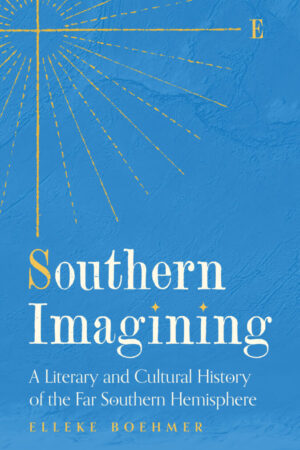
Southern Imagining
by Elleke Boehmer
reviewed by Carmen Bugan
The southern hemisphere holds only about ten percent of the world’s population: the rest is water, ice, and archipelagos. The seasons are different from the ones in the northern hemisphere: the landscape fills with flowers in October and with snow in June. Rounding the southernmost points of Africa (Cape of Good Hope) and South America (Cape Horn) opens extraordinary vistas little known to Europeans, who, as Elleke Boehmer demonstrates in her study Southern Imagining: A Literary and Cultural History of the Far Southern Hemisphere, have both subsumed and estranged the southern hemisphere by naming its territories in Latin and other European languages. The Southern Cross dominates the skies and keeps a hold on the imagination with the myth that its stars are eyes looking down on earth. There are excellent views of the Milky Way, one can see the Magellanic Clouds, and the seas are wild. To the northern traveler whose imagination conjures up seals, whales, kangaroos, eucalyptus trees, and icy winds, Elleke Boehmer’s literary and cultural history offers a deeply researched, masterfully crafted account of the southernmost parts of the world.
Born and raised in South Africa, Boehmer is a founding figure in postcolonial literature, an acclaimed novelist and short-story writer, and a professor of world literature in English at the University of Oxford who enjoys worldwide recognition for her research. Her long-standing expertise in the literature of the Global South informs the present study, which renews her connection to her birthplace under the Southern Cross. Boehmer’s gift as a writer makes Southern Imagining a delightful read, for she doesn’t miss the opportunity to share the stories of people and their words as they traveled from Europe to “the bottom of the world” and back.
“World cartography has understood the planet from a northern vantage point for millennia, relegating the south to realms beyond ken.” South, as a geographical area, is also a construct of the mind and of imagination, as Boehmer shows; it’s a part of the world associated sometimes with the “monstrous” and at other times with the “sublime,” yet it is most often perceived as “distant lands that beckoned northerners to name and claim them.” For their part, southerners seem to view themselves as being “far away from where things count” and have internalized the “wider global sense of their relative insignificance.” This far-ranging study inspires readers to shift perspective: it constitutes an invitation to “inhabit our globe” fully, by incorporating southern culture and literature into our view of the world. Boehmer places the South at the center of the imagination. Her hope is to give the reader the thisness or “haecceity” of the southern imagining via literature inspired by the southern landscape, so that the place itself comes to life and we come to appreciate how it completes our perception of the earth as a whole.
The book comprises eight chapters, notes, a generous bibliography, and an index. It brings to life a cultural history of over 500 years and ultimately creates an enriching way of looking at our planet through a network of voices that map the Earth through words and song. We might also be inspired to appreciate the perspective of the people whose lands were remapped and whose lives were changed by the inhabitants of the northern hemisphere. Boehmer employs spatial metaphors to organize her reading: the lateral, the parabolic, and the asymptotic. The lateral reading traces stories by Indigenous writers exploring “mythic, social, linguistic, and migratory lines across the south” linking archipelagos and littoral vistas and giving us a sense of interconnectedness between people, lands, and time. The parabolic reading traces texts across the map following routes and journeys; these are European explorers’ accounts of South Africa and South America. The asymptotic reading recounts stories about coming very close but never touching the southernmost point of the planet. That is Antarctica, a place swept by Katabatic winds, where time zones converge, ice builds and moves upon ice, and explorers described losing their perception of time. In this way, Boehmer makes her own map and draws us to the liminal space between language and physical space, into the difficulty of naming.
The chapters portray the south as seen by northern voyagers, writers, scholars, and cartographers (Darwin, Coleridge, Melville, Shelley), and as experienced by writers, thinkers, and voyagers who have settled there and have internalized the geography, climate, and indigenous cultures and languages (Olive Schreiner, Blanche Baughan, Katherine Mansfield, Judith Wright, and Janet Frame, among others). Poetry, memoir, travel writing, fiction, and other forms of expression and inquiry aim to give readers the experience of the Global South as it holds presence “in the mind.” We also receive the narrative of colonial and political motivations of planting flags of conquest in the southern hemisphere. The section “Navigating South, or Worlding in Motion” brilliantly explains mapmaking over centuries, and how it “invited and justified expansion into regions that were brought closer and made visible through these various interlaced processes of projection and erasure” where the goal was to “civilize” these regions.
The most moving part of this scholarly effort at articulating the haecceity of the south comes from a deeply felt homesickness that the author, who left South Africa over forty years ago, hopes to assuage. It’s a yearning for the richness of Indigenous languages and their colorful representations of the natural world, as in the word “Aiagata” from a language in Tierra Del Fuego: “this first word in the missionary Thomas Bridges’ Yamana-English dictionary, signifies the particular movement of a whale rising up on end and raising its flukes.” In this book, Boehmer revisits the southern hemisphere via several close readings of poetry, among which is The Lusiads (1572), written by the Portuguese poet-explorer Luís de Camões, who was “the first European artist to cross into far southern waters, the first to see southern Africa and India, in 1553, and, in all probability, the first to write poetry about the experience.” The poem, explains Boehmer, “doubles the African continent twice” by “charting and re-charting the journey” around the Cape of Storms, making a double parabolic route.
Elleke Boehmer charts a vision for today’s readers about the other side of the world that is a true gift to those of us who have been guided by the North Star. Boehmer’s work “questions how northern words have named southern things to the exclusion of the south’s own indigenous vocabularies and, hence, perspectives and knowledge.” Despite its focus on imagination, this study is every bit as political as it is literary.
Published on July 7, 2026