
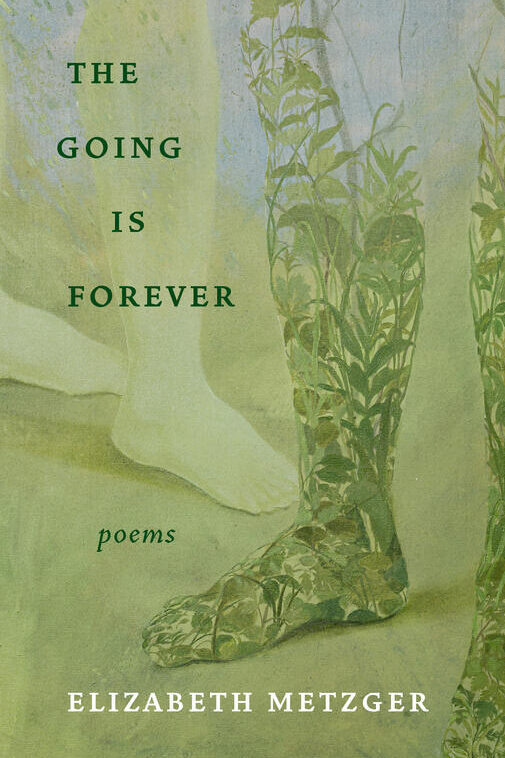
The Going Is Forever
reviewed by Heather Treseler
What are the spiritual stakes of upending your everyday reality in early mid-life? And what kinds of strange intimacies emerge once a married couple has agreed to a separation, or a child suddenly regresses to a pre-verbal state, as if protesting the misprision of language? Elizabeth Metzger’s dazzling new collection of poems, The Going Is Forever, suggests that poetry might be the best means of asking unanswerable questions. In fifty-three poems, many written through extremity, the narrator harkens after the “unflown life [that] comes / flying,” pursuing the airy unknown—at the end of a marriage and after a child’s medical crisis. These poems address the gaping questions left in the wake of such emergencies.
As in Louise Glück’s Meadowlands, in which a contemporary marriage is examined through the eyes of Telemachus, Penelope, Circe, and Odysseus, Metzger incorporates mythology, the fragile landscape of suburban Los Angeles, the New York apartment of her childhood, and references to Ovid, Picasso, Catullus, Susan Sontag, and Etel Adnan, among others, to give familial scenarios ballast and breadth. In the poem, “You and I Are Earth,” a postmodern Eve reminds Adam: “Remember sex was a mistake / made while gardening,” and “No one entered the other forever.” Like one of her mentors, Frank Bidart, Metzger can be both hilarious and devastating. As the couple plots a separated life while sharing a last soapy bath together, they realize that “They are shiny and out of apples and coming / Or were.” Erotic passion has run its course: they must both leave the garden.
While an unmapped future beckons, memory haunts her. In “As We Made Him,” a poem with the chassis of a rondeau, the narrator recounts her son’s fourth birthday during his spell of regression, when he refused speech and became “missing.” The speaker asks, in the final line, “If he were to forget us, would we still be the ones who made him?” The Going Is Forever follows on Metzger’s Spirit Papers (2017), winner of the Juniper Prize for Poetry, and Lying In (2023), a chronicle of two pregnancies requiring bedrest. These new poems—fearless in their truths, precise in their ambiguities, stringent in their self-interrogation—evince the poet entering her full powers, drawing on every resource to make sense of a fraying plot. Here, too, she appears to be an heir of Glück who argued in “Against Sincerity” that the poet-narrator achieves authenticity by turning the paring knife of doubt on herself. Each story must have complication, each lyric its philosophical qualification: otherwise, the poet slips into bland testimonialism, and we hear a deposition, not a poem.
Subtly, Metzger’s collection suggests that the plight of women who wish to be mothers—racing against the reproductive clock to find a partner, trying not to confuse maternal longing with romantic attachment—might be one of the quiet tragedies of modern life. In “Mid-Thirties Square Dance,” the narrator notes that the yearnings for children and for fulfilling erotic love don’t always reliably coincide, or last. Women are often drawn into making hard bargains. “At thirty-four I have ticked every box I set out to,” she notes. “My mistake was thinking I could be loved / in little white squares.”
Such squares, and what doesn’t neatly fit inside them, recur in the images of a front yard, an unshared bed, a window’s frame, a blank ceiling, a restaurant courtyard, a hologram, a sleeper train, and online rental listings. Stasis and rupture flirt on these flat planes as she reckons with what John Berryman termed “the horror of unlove.” Metzger’s narrator finds there is no established recipe for such decision-making. In “Blueprint,” she writes:
Some friends call mine a spiritual problem
and when they do
I become a minister of the real
and go on Zillow
moving my future into various crannies of Los Angeles.
As in Miranda July’s All Fours, marriage, children, love, erotic hunger, and real estate are tied in a Gordian knot, one without a simple solution. Metzger’s poem captures an impulse to turn a “spiritual problem” into furniture, while admitting that it isn’t nearly so easy or clear. In “After Argument,” domestic tension becomes humorously concrete.
For weeks polyester has been filling our yard.
The squirrels eviscerated a pillow from the porch
and now they’re working through a lifetime of material.
Instead of raking it, I wait to see if they’ll return.
The grass might suffer but doesn’t seem to.
Sometimes staying is what seems reckless.
Sometimes I imagine all the pillows we’ve shared
will go to use again, cushioning a hole in nature
we are not responsible for making.
Here, the poet interrogates not just herself, but the seemingly ready-made engine of lyric: the pillow stuffing, the “lifetime of material.” The polyester strewn yard enacts the eviscerated marriage. But in every tale of departure, there is—in the tradition of midrash—a new story taking form, taking flight, “at least as beautiful as any boy / or helicopter” as Adrienne Rich once wrote. We ascend with Metzger’s rendering of the “unflown life [that] comes / flying” to view the wreckage and the horizon in this remarkable, lasting book.
Published on November 10, 2026