
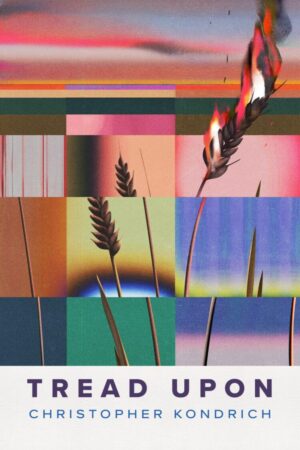
Tread Upon
by Christopher Kondrich
reviewed by Erick Verran
Harvest it as wheat and roll over it with a stone. Treat it with pesticides or leave it to wild, which attracts both pollinating insects and busybodies from one’s local HOA. There’s a lot you can do with grass. Some mow it for a living. Others talk of smoking it. Unkempt hair of the dead. Nature’s funerary sheet. (“I am the grass,” wrote Carl Sandburg. “I cover all.”) Panhandlers and train hoppers manage to thumb airy tunes out of it, “vibrating / the piece of your body pressed there,” in the words of Christopher Kondrich. Thanks to him, the euphemistic idea of a creature that is all back—la bête à deux dos, coined by François Rabelais—now applies to a faceless blade of grass turning like a rudder in the current. Stepped on, grass is at best masochistic. Either it enjoys getting trampled underfoot or doesn’t care, or doesn’t know it doesn’t care.
Tread Upon, Kondrich’s third collection, goes where the angels of our better nature willingly go. Into a searing litany, for instance:
The tenth most common thing is a thoracic cavity
opened with a few cranks of the rib spreader,
after which the esophagus and lungs are fished around
by the hands of the surgeon who begins to massage the heart,
to clamp the aorta, so that more blood is directed into the brain
instead of into the bowels, which have emptied by now,
while what is being filled are the gun racks
of those whose child is not on the table,
is not statuesque in the beauty sense of the word,
but in the way rigor mortis sets in.
Throughout, the human and the vegetal are perpetually mixed, “seen not as they are, but as a metaphor”: the lungs of the world are a rainforest in Brazil and fire is described as “a fist perpetually closing,” a lovely image. Depending on whom you ask, empathy is a futile exercise when it comes to the inner lives of others. What is it like to be a bat, or a concrete patio? What would it mean to acknowledge a sparrow? Meanwhile, the new body, that fleshy “slab / of how long we have,” must contend with heatstroke, drought, and carbon guilt. As Kondrich admits, “Once you start seeing // something as a metaphor you keep seeing it / that way.” True enough, we’re hurting ourselves when we trash an estuary or deregulate methane. But birches are surely opinionless on the topic of some boy’s swinging and lime trees would happily imprison poor old Coleridge. As A. R. Ammons put it in the still unnerving “Gravelly Run,” “Hegel is not the winter / yellow in the pines: the sunlight has never / heard of trees.” How’s that for symbiosis?
Less familiar than the Revolutionary Era slogan “DONT TREAD ON ME,” today commonly seen in the form of a bumper sticker or Facebook profile photo, Kondrich is thinking of Psalm 91:13. There, we learn, “Thou shalt tread upon the lion and adder,” an echo of the promises of Genesis. Just look at the gutting of the country’s federally protected lands under the Trump administration. If, like the gargantuan Pando, a colony of genetically identical quaking aspens that together form the planet’s most massive living organism, even a tree may be next to nothing in itself, you have to admire Tread Upon’s advocacy on behalf of the small. Clusters of words from the proem are reused for the book’s seven headings, like a dandelion strewn on the wind, and this textual horizontality gives Kondrich’s collection an ecosystemic flow. Massed together thusly with no titles in sight, his poems become topological, a sameness like that of landscape.
Not unselfconsciously so, Tread Upon’s politics are decidedly New York Times, with a dash of The Atlantic, its diatribes aimed squarely at Washington lobbyists, gun owners, and the coal industry. Certain declarations land harder than others, whereas an ending like “I stay buckled until the seatbelt sign is turned off” is likely funnier than intended. “I will be human, then,” Kondrich declares. “If no one else will.” He daydreams about chaining himself to a redwood threatened by loggers, in short of being a climate martyr. Perhaps unavoidably, our guide through the exponential hell that is the Anthropocene, “[n]ot as Virgil, not as Beatrice,” comes across greener-than-thou. Tread Upon, Kondrich’s rhetorical turn, captures the ambivalence of middle-class consumerism with weary fury (“you are complicit, / but you cannot do anything about most things”), where seemingly the only choice is a false dichotomy, two evils vying for your conscientious dollar.
meaning I don’t have to feel like I’m sacrificing
anything, the transition is seamless, meaning I barely notice
the difference, meaning not noticing the difference
is the most valuable resource in the mountain.
“This world // is not going anywhere,” Kondrich mockingly assures us. “It just won’t be / the world anymore.” Were nature to take the human race to court, who wouldn’t serve on that jury?
Published on November 17, 2026