
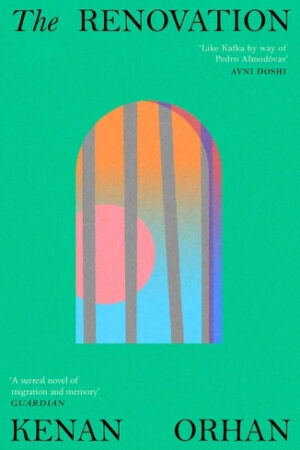
The Renovation
by Kenan Orhan
reviewed by Victoria Zhuang
Kenan Orhan’s debut novel, The Renovation, seems on the face of it to be about a renovation gone wrong. How else can one describe the situation for Dilara, who ordered a new and improved bathroom for her home, but sees that in its place a prison cell has been installed?
“You’ve bungled my renovation!” she tells the contractor over the phone. “I don’t think so,” the contractor replies. He sends her scans of her signature approving all the materials and fixtures used. He hangs up on her further protests. When she enters the mysterious cell, she is transported far away to a well-known prison in Turkey, the homeland she had left behind.
This comically absurd premise has echoes of Gregor Samsa’s disbelief, in Franz Kafka’s The Metamorphosis, at discovering that he has awakened transformed into a repulsive insect. If Gregor’s living nightmare is a literal manifestation of the dehumanization he has succumbed to in a profit-chasing world, Dilara’s tale can be thought of as the palpable version of stumbling upon a former life that was locked away.
The novel shines, like a mosaic lamp illuminated, as it follows Dilara into this bathroom turned jail cell. Slowly, a past she was hiding from comes to light in flashbacks and shimmering sentences. The cell is part of a vast complex within Istanbul’s Silivri Prison, where women of all ages and classes are housed for their alleged conspiracies against an oppressive regime. Dilara had fled Turkey around a decade ago with her husband and mentally declining, dissident father to apparent freedom in the mountains of Italy. But try as she might, she cannot now conjure away the prospect of imprisonment; it has literally followed her.
Dilara’s cell comes to embody many other metaphorical prisons she lives in. Detailing these confinements, Orhan performs an exquisite excavation of a self that was buried: buried by roles played for others, time and senescence, and organized forgetting.
The novel also unearths the quiet tolls, the silent imprisonment, of caring for a loved one with dementia. Dilara’s husband takes the appearance of the cell as a sign the Turkish authorities are on their tail and abandons their home, leaving Dilara to care for her father on her own as he suffers from Alzheimer’s. Her father was once an outspoken professor and novelist; he now slips and falls easily, has lost his sense of humor, cannot recall basic words, and fails to recognize his own daughter. Slowly he becomes entombed in the mental fortress of his illness, and Dilara herself is filled with anguish, anger, and sorrow watching him fade. “How much it hurts to watch someone dissolve beneath their own skin,” Dilara thinks.
Dilara had ordered the renovation of the master bathroom to accommodate her father as he grew more infirm. But as the weeks pass, she becomes drawn to the cell as a refuge. She finds solace even in addressing curt prison guards who pace outside speaking to her in Turkish. She takes in the smells of Turkey, the flavors from her father’s beloved coffee shop and her favorite baker’s marzipan, and the thrill of being among her own buried people as the prisoners converse. She recalls the turbulent years leading up to her departure from Turkey, years full of vitality and family memories, which are interspersed with a calm, inadequate present in Italy that grows more desolate, with only her cell becoming more vibrant.
Exile for many immigrants is its own form of imprisonment, Orhan suggests. Secluded in the mountains outside Salerno, Dilara has become invisible, bereft. Attempting to assimilate once she moved, she rarely spoke her mother tongue but failed anyway to find work in her former occupation as a school psychologist. She resigned herself to becoming a housewife. Her once passionate marriage became stale. “Life becomes a silt around your relationships, and before you know it, you’re half buried and unable to adjust,” she observes.
Orhan’s prose, though, is a continual breaking out of that silt. His words are resonant, limpid, and wistful, like a series of camera flashes with the resultant frames whirring by in a reassuring succession of committed motions. He describes the waters by Istanbul’s shores, in one passage, as if documenting an immense catalog of historic moments:
“Some days the water is thick and dark as velvet; other days, it is flat and bright in the sun, and other days still it is a quicksilver sardine in a shallow inlet, and in the faltering dusk I have seen it burn like copper, and in the misty mornings it vanishes and the city teeters above a void.”
In this moment, Dilara is thinking back in the cell to her days in Istanbul, with its irreplaceable views of the Black Sea. She remembers everything she has lost. There is her mother, her old friends, her father before his illness, and the city itself.
“I remembered it all, but only in the way that in dreams we can speak other languages or have learned the trick of flight—it feels true but there is no root under the soil,” she says. The forgotten memories come rushing in, as a misty coating of salty water from that sea settles upon her skin when she is in the cell. However, “the droplets of memory fell away as soon as I left the room, rivulets running back to the fathomless sea.”
That the author, himself a Turkish émigré, decided both to write this novel in English and to set it in Italy adds another layer of dislocation and distance from home. Italy, known for its buried ruins, is a fitting stage, and the narrative certainly feels as salubrious a read as if one were diving clean into the blue by Orhan’s forsaken shore.
Published on June 23, 2026