
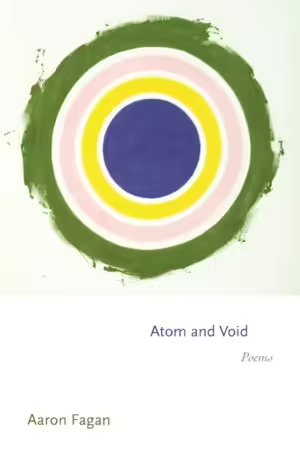
Atom and Void
by Aaron Fagan
reviewed by Carmen Bugan
The title of Aaron Fagan’s fifth collection of poems, Atom and Void, promises a view of existence based on a metaphor derived from the sciences. It alludes to Atom and Void: Essays on Science and Community by Robert Oppenheimer, whose Reith Lectures on the BBC in 1953 were published as “Science and the Common Understanding.” Oppenheimer created the atomic bomb and later dedicated himself to educating the public on the importance of science in society. The atom and void concept has a longer history traceable to the Greek philosopher Democritus, who is thought to have said that the natural world is made of atoms and the void, both of which are indivisible.
However, we now have learned that the particle physics field has discovered lots of subatomic particles that are far more organized than we realized. Knowledge evolves, and with it, our perception of reality and our place in the world. This background informs, at least in part, Fagan’s collection, preparing the readers for shifting perspectives on the nature of the world around us. But the collection delivers something different: the chaos of the poet’s inner world (chaos being a leitmotif in these poems). Beneath the visible structure of the poems, fragmentation and chaos are given free rein. In the title poem, “Atom and Void,” the speaker confesses to suffering from continuous distraction:
I open a book, forgetting how to read
The moment the sun begins to shine.
I open the door to go out for a stroll,
But run off like a rider without a horse
All night, hearing flying insects circle,
Chancing thoughts from I don’t know
Where, as they crowd upon me, dying
Music I have lost a way to understand.
We go from forgetting to read once the sun begins to bring about light to a stroll that turns into a directionless run; it’s suddenly light again; thoughts come and go; the speaker has “lost a way to understand.” Surely there are words, but, if we are to expect coherence, we’ll be disappointed: they lead into a void. The question becomes, is void an inescapable state?
The words in this collection might be atoms in the art of conversation, or in the art of poetry; they invite a look inside themselves, and they can be explosive: “love,” “sun,” “fuck,” “art,” “trials,” “chaos,” and so on. But there is very little meaning-making; the poems are combinations of phrases. Floating in the general soup of language, they are whimsical at best. Decidedly dark and obfuscating, the poems remark on “this worthless amazement of things” and “love” that “resumes an impenetrable hell resembling / A doctrine fading under a foreign ethic of despair” (“Variations of Incomplete Open Cubes”).
We can read this collection with the hope that “genuine poetry can communicate before it is understood,” as T. S. Eliot said of reading Dante: “The experience of a poem is the experience both of a moment and of a lifetime. It is very much like our intenser experiences of other human beings.” Not all experiences can be adequately verbalized. We might think of lines and bits of these poems as fragments of moments, even as fragments of a lifetime, but what is certain is that the poet makes no apology for the lack of meaning in these poems. It is up to the reader to decide whether the poems communicate anything at all. As the “Envoy” proclaims,
One must savor
An inability
To put certain
Appetites into
Words—my
Shadow comes
To look for me
But not for long.
Though it would be tempting to wrap up a discussion of this collection with the thought that the poems resist meaning-making, the reader would miss the grief of isolation expressed. It’s the grief that is part of today’s fragmented language still seeking the old in the new, as in “Maladroit,” where:
…………………..… you
Approach this pond
To swallow whole
A rippled image
Of the moon—
Echo of old desire
In new passion—
Reflecting light
In cupped palms
You dare to call
The eye of heaven.
Here we have the glimpse of a single moment that is also an apprehension of eternity, which would, in Eliot’s vision of poetry, constitute an experience both “of a moment and of a lifetime.” However, for most of the poems in this collection, the reader would have to make do with—as the first line of the poem “An Atlas of Rare and Familiar Color”suggests—“Movements toward the unexceptional.”
Published on May 21, 2026