
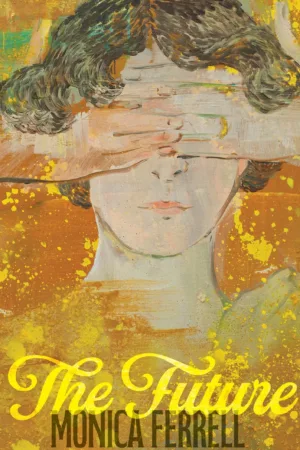
The Future
by Monica Ferrell
reviewed by Rhony Bhopla
Monica Ferrell is an award-winning author of one novel and three books of poetry, including her recent collection The Future. The poems in this collection are a tribute to language, philosophy, and the ecopoetic conceit. Most of all, the collection is an ode to the youngest generation of the Anthropocene. The chronology of the work is a compelling ecopoetic text directed at our insatiable civilization, responsible for the destruction of the ecological environment. This book evokes the poet as an ancestor speaking from afar, echoing poetry into the future.
Ferrell unearths historical moments, such as in this excerpt from “The Fifties:”
They never had to worry about memories
Swelling and following them like algal blooms
Through the internet’s tides of forever—
I don’t even know what starch is
And have never used Brylcreem
Or testified, sweating liberally,
Before the Un-American Committee
I’ll bet back then was crummy too
The “Un-American Committee” is an allusion to Paul Robeson, a member of the Harlem Renaissance and son of a former enslaved African. Robeson built his career as an American artist, becoming an icon and prophet. He spoke more than 20 languages and successfully completed his academic pursuits, but faced adversity throughout his education and career. The poem references his testimony in front of the House Committee on Un-American Activities, which accused him of being a Communist.
Another historical reference in the collection is the poem “Hôtel du Palais,” which is the former imperial residence of Napoleon III in France, now converted into a luxury hotel. As though viewing the world from the cosmos, as the poem states, “Somebody took a wind-up clock / And lobbed it into the Milky Way,” Ferrell delves into the problem of the perplexing antipathy that results from fleeting human perspectives.
While we’re here, though,
The accommodations are very spacious,
I must say, also shining
The view of this excellent canopy cannot be beat
And one feels at home
I’m quite comfortable
In this flesh-toned bodysuit
Would not want to take it off, ever
Would not want to leave
The hotel caters to the idea of insatiability, which is deemed derogatory given the unsustainable future. Similarly, in “Giambattista Vico,” the poet asks, “What is the point?” and then refers to the busyness of “… Saturday, sorry / Chess lessons / Storytime // Playdate / I bring home the bacon / Then make it with pancakes.” The tercets express that in the immediacy of domestic life, planetary concerns have to be sacrificed. The musings of Vico’s rhetoric and philosophy cannot compete with the need to make breakfast; the post-pandemic day-to-day activities fill our imaginations rather than the predictable eco-calamity.
The pivots to motherhood and the domestic are where the collection becomes an ode to humanity. At the end of the long poem “Duino Elegies,” the title of the book transforms into a metaphor for birthing: “I reached between my legs to feel / a soft head. That was you, future, breaking through.” The poem “The Labor Hours” is the most memorable poem of the work, and the pinnacle of the entire collection.
I lung it through hours of rowing, pulling hard
Across a lake of breaths they say will lead to morning,
It’s a heavy lift.
Now would be a good time to cry out,
To shake something until it breaks: these windows
Maybe, night-smeared, plush as wolf-pelts.
Torn only where the sun’s hot bullet drains life
From a hole. Yes, we did it. It’s dawn. We’re finished.
I’ve become a doorway, that threshold step passed
Over when the future clambers out into the open.
In these couplets, the anthimeria “lung it” is rich in brevity and power, combining both parts of speech to illustrate the sustained force of breathing. The poem’s merging of language and body brings forth the indescribable sensations of a woman giving birth. Engaged in the mind of the laboring mother, the reader experiences it as a shattering of boundaries. We are left with the epiphany that there is possibility in a bleak world of greed and plastic.
Monica Ferrell’s The Future is like a visual art collage depicting today’s civilization. This is a discontented civilization portrayed as a binary operating in the human consciousness; on the one hand there is the precedent of unalterable history, and on the other, the bleak future. As a unifying feminist work of art, The Future presents the past as a patchwork of dreams excavated from civil unrest. Ultimately, what is discovered is the ode born of motherly love.
Published on April 22, 2026