
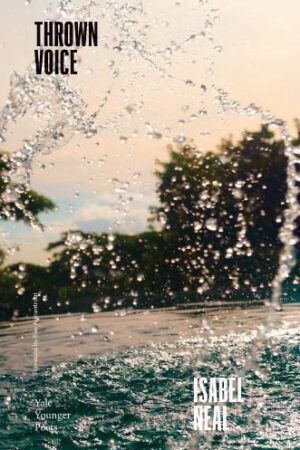
Thrown Voice
by Isabel Neal
reviewed by Rhony Bhopla
Isabel Neal’s debut collection, Thrown Voice, offers us ecopoems that transform the sensory into language. The work reveals the art of human consciousness through the experience of the non-human natural world. In the description of rivers, birds, or rocks, poetry enacts awareness that is enlivened but is also confronted with its limitations. The speaker is a visual artist who depicts what is “crosshatched” or observes “Papier-mâché over rolled and crushed chicken wire.” At times, the poems are the witness. In “Querent” we learn of cattle egrets possibly feasting on insects on a cow in labor:
I kneel to catch a newborn.
I sing to the cow in the field whose side opens:
white birds. Wailing.
Bouquet of dry beans, speckled, fall
like rain off the stalk.
The white birds have to do with the scene rather than the propensity of naming birds. A human being wails in grief, and we are left in sound, image, and motion. The poems contain multiple figures of speech and incorporate various closed forms. Word combinations are surprising and rely on the reader’s familiar experiences through scene and soliloquy. In her introduction, with reference to Neal’s rare use of first person, Rae Armantrout writes: “Although not unimportant when it does appear, it is important only in relation to its surroundings.”
In section one, the first poem describes a crisis where the speaker contemplates a binary as a metaphor:
All winter, I pined.
I coned, caved.
I held my bridle lip,
my bride.
Ending with:
What if, fearing
being led, I lead?
This question, with its allusion to a human tendency to subjugate what it cannot understand, depicts the anthropocene. In “Local Heron,” the type or color of heron is not described but a soliloquy emerges: “Think of an emotion // like a room.” The room, while an actual space, is notional as in ekphrasis. The reader conjures a room.
Much of the collection incorporates lines by other poets. In “Tennessee Letters” the Lower Hatchie River is described as “weak tea” and these lines form a commentary on a past tragedy, perhaps the collapse of the bridge in 1989:
I invited myself here
to haul loose work, lead work
To stop near the flooded road
Look above and below at the bloodwater
with those stones to match
However, what follows are excerpts of letters from the author’s grandfather from 1950 that read like a journal entry but are lineated: “I washed / three pair of socks by hand / I walked several miles…” Combination of time and observation around the river signals continuity between generations. While the emphasis is of ecological concern, Neal’s work also relates the collection to her foundational literary influences. Poems call upon poets such as Gerard Manley Hopkins and Emily Dickinson and in “Lake Costume” Neal borrows the line “I’m knocking on every door” from Eduardo C. Corral’s “Self-Portrait with Tumbling and Lasso.”
There are several prose poems in the collection. In an untitled prose poem, Neal brings a whole experience to the point of sound and visuality. It begins with a metaphor between speech and a teapot placed in a desert:
My stale phrase, my little departure, takes the shape of a teapot.
I place it in the desert…
…I read, I slept, rode a pale blue bicycle.
Steady or drunk, wind or none. Whether or not my palm worked
loose the fine spine of that lobed cactus, I open only briefly
before I shut like a screen door. The other side swings into focus,
crosshatched.
The crosshatch serves as an allusion to the shadow work of a pencil sketch but also of the imagined net door closing. Its swing represents sudden danger. The fine spine of a cactus can be well shorn if it were burned or cut with a blade. This sequence of events highlights the danger of risk by arresting the emotions of fear, failure, and relief all in one set of phrases. In a similar vein, the next poem “Dream” references “a hinged screen” and “A loosening / a room away.” These resonances create lasting effects that are sensorial rather than a mirroring of nature. They showcase the poet’s consciousness as human interiority without intention.
Thrown Voice has powerful reach beyond description and lament on behalf of the environment. The realizations of this text confirm that the non-human natural world exists beyond our benefit.
Published on August 14, 2026